Masters golf odds attract more betting volume than any other tournament on the PGA Tour calendar. This guide breaks down Augusta National’s course profile, every major betting market, historical trends that shape the odds, and how AI agents can systematically trade Masters futures.
Masters Odds by Year
Full historical odds, line movement, and vig analysis for every Masters since 2020:
2025 Masters Odds — McIlroy completes the Grand Slam at +900 | 2024 — Scheffler wins second jacket at +500 | 2023 — Rahm’s Sunday 65 comeback at +900 | 2022 — Scheffler’s breakout at +1400 | 2021 — Matsuyama makes history at +3500 | 2020 — DJ’s record -20 in the November Masters
Tournament Overview
The Masters Tournament is the first of four men’s major golf championships each year. It is held at Augusta National Golf Club in Augusta, Georgia — the only major played at the same venue every year. The tournament is played over four rounds (72 holes) from Thursday through Sunday, typically in the second week of April.
Key tournament facts for bettors:
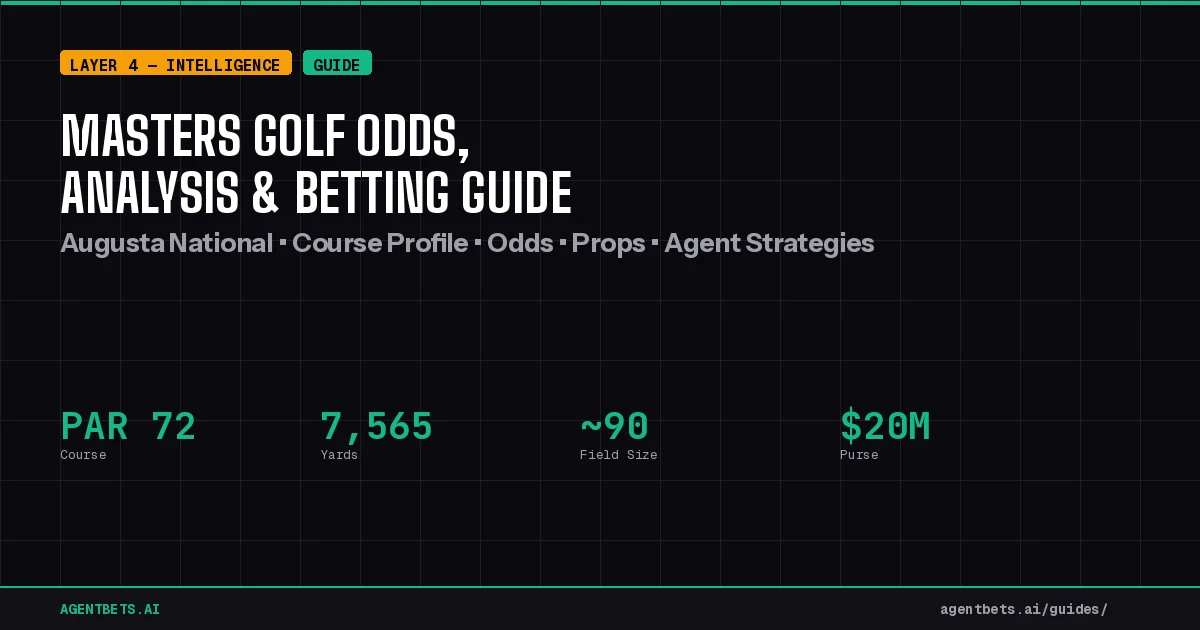
- Course: Augusta National Golf Club — par 72, 7,565 yards (2026 measurement)
- Field size: ~90 players (smallest of any major; invitation-only)
- Cut: Top 50 and ties after 36 holes
- Purse: $20 million (2026)
- FedExCup points: 750
- Defending champion (2025): Rory McIlroy (-11, playoff over Justin Rose)
- 90th edition in 2026 — tournament dates to 1934
The invitation-only field is a critical factor for bettors. A smaller field concentrates talent at the top and reduces the long-tail variance seen in full-field PGA Tour events.
Live tournament scores will appear here during Masters week. Updates 3x daily at 6:00, 14:00, and 22:00 UTC.
Augusta National Course Profile
Augusta National is not a course where generic ball-striking stats translate cleanly to performance. It demands a specific skill set that explains why certain players outperform their world ranking at Augusta while others consistently underperform.
Key Course Characteristics
Length and elevation: At 7,565 yards, Augusta plays longer than its yardage suggests on uphill holes (1, 5, 8, 10, 18) and shorter on downhill holes (2, 3, 9, 10, 16). The net elevation change across 18 holes creates approach shot distances that deviate significantly from flat-course norms.
Greens: Augusta’s bentgrass greens are among the fastest on Tour, typically stimping at 13-14. They feature dramatic contours, multiple tiers, and back-to-front slopes that punish any approach above the hole. Putting accounts for a disproportionate share of scoring variance at Augusta relative to other venues.
Width off the tee: Augusta’s fairways are wider than most Tour courses, but positional accuracy matters enormously. Specific landing zones open up favorable approach angles to tucked pins, particularly on holes 1, 7, 9, 10, 11, 13, and 18.
Amen Corner (holes 11-13): This three-hole stretch is the most consequential scoring zone in major championship golf. Swirling winds off Rae’s Creek make club selection on the par-3 12th (155 yards, Golden Bell) an exercise in risk management. The par-5 13th (Azalea, 545 yards) offers eagle opportunities but with water guarding the green. More tournaments are won and lost at Amen Corner than anywhere else on the course.
Hole-by-Hole Scorecard
| Hole | Name | Yards | Par | Avg Score | Rank |
|---|---|---|---|---|---|
| 1 | Tea Olive | 445 | 4 | 4.24 | 6 |
| 2 | Pink Dogwood | 585 | 5 | 4.82 | 14 |
| 3 | Flowering Peach | 375 | 4 | 4.04 | 12 |
| 4 | Flowering Crab Apple | 265 | 3 | 3.08 | 16 |
| 5 | Magnolia | 495 | 4 | 4.33 | 3 |
| 6 | Juniper | 190 | 3 | 3.08 | 15 |
| 7 | Pampas | 450 | 4 | 4.16 | 9 |
| 8 | Yellow Jasmine | 570 | 5 | 4.85 | 13 |
| 9 | Carolina Cherry | 460 | 4 | 4.13 | 11 |
| 10 | Camellia | 500 | 4 | 4.23 | 7 |
| 11 | White Dogwood | 520 | 4 | 4.34 | 2 |
| 12 | Golden Bell | 155 | 3 | 3.15 | 17 |
| 13 | Azalea | 545 | 5 | 4.77 | 18 |
| 14 | Chinese Fir | 475 | 4 | 4.21 | 8 |
| 15 | Firethorn | 550 | 5 | 4.71 | 10 |
| 16 | Redbud | 170 | 3 | 3.08 | 16 |
| 17 | Nandina | 450 | 4 | 4.16 | 9 |
| 18 | Holly | 465 | 4 | 4.23 | 5 |
The hardest hole historically is No. 11 (White Dogwood), a 520-yard par 4 that plays into the prevailing wind with water guarding the left side of the green. The easiest is No. 13 (Azalea), where eagles are common for players who take on the green in two.
Statistical Profile of a Masters Winner
Based on historical winner profiles, bettors should weight these stats when building models:
- Strokes Gained: Approach — the single strongest predictor of Augusta performance. Winners consistently rank in the top 10% of the field in iron play.
- Strokes Gained: Putting (bentgrass) — Augusta’s greens amplify putting skill more than any other venue. Separate bentgrass putting stats from Bermuda/Poa annua data.
- Driving distance — top-20 in distance is nearly a prerequisite in the modern era. Short hitters have not won since Zach Johnson in 2007 (and he was elite everywhere else).
- Scrambling — Augusta’s miss penalties are severe but recoverable for elite short-game players. Scrambling rate from 20-30 yards is critical.
- Par-5 scoring — Augusta has four par 5s, all reachable in two for long hitters. Birdie-or-better rate on par 5s separates contenders from the field.
- Course history — Augusta shows stronger year-over-year correlation than any other venue. A player’s average finish in their last 3-4 Masters appearances is a high-signal input.
Masters Outright Odds
The headline market. Sportsbooks post outright odds weeks or months before the tournament, and lines move continuously based on form, news, and handle.
Loading live Masters odds...
How to read outright odds: At +500, a $100 bet returns $600 total ($500 profit). The implied probability is 1 / (1 + 5.00) = 16.7%. Compare this to the player’s true win probability from your model. When your estimated probability exceeds the implied probability (after accounting for vig), you have a positive-expected-value bet.
Vig on golf outrights: Golf outright markets carry significantly higher vig than two-way markets. A typical Masters outright book runs 25-40% total overround across the full field. The Vig Index tracks which sportsbooks offer the lowest overround on golf futures. Offshore books typically offer 5-15% less vig than regulated US books on outrights.
Line Movement History
Tracking how odds change over time reveals market sentiment and sharp action. The table below shows how the best available odds for top players have shifted across recent snapshots.
Loading line movement data...
Historical Betting Trends
Historical patterns at the Masters are more reliable than at other majors because the venue never changes. These trends should inform — but not dictate — betting decisions.
Favorite Performance
Since 2005, only two pre-tournament favorites have won the Masters. The favorite finishing outside the top 5 is common. This structural reality means that blindly backing the favorite is a negative-EV strategy over a large sample.
| Year | Favorite | Odds | Finish | Winner | Winner Odds |
|---|---|---|---|---|---|
| 2025 | Scheffler | +450 | 4th | McIlroy | +900 |
| 2024 | Scheffler | +500 | 1st | Scheffler | +500 |
| 2023 | Rahm | +900 | 1st | Rahm | +900 |
| 2022 | Rahm | +900 | 27th | Scheffler | +1400 |
| 2021 | D. Johnson | +750 | T2 | Matsuyama | +3500 |
| 2020 | Rahm | +800 | T7 | D. Johnson | +1200 |
| 2019 | McIlroy | +700 | T21 | Woods | +1400 |
| 2018 | D. Johnson | +750 | T10 | Reed | +2500 |
Winning Odds Range
Most Masters winners since 2010 have come from the +900 to +3500 odds range. This mid-tier of the odds board — players ranked roughly 3rd through 15th in pre-tournament pricing — is the highest-EV hunting ground for outright bets.
Repeat Winners
No player has won back-to-back Masters since Tiger Woods in 2001-2002. Only four players since 2000 have won twice within a three-year span: Woods, Bubba Watson (2012/2014), Phil Mickelson (2004/2006), and Scottie Scheffler (2022/2024). Defending champions historically underperform their pre-tournament odds.
Age and Experience
Every Masters winner since Dustin Johnson’s 2020 victory at age 36 has been under 40. Augusta rewards experience but demands the physical capacity to overpower the course’s par 5s. The sweet spot for Masters winners is 26-35 years old with at least two prior Augusta appearances.
First-Timers
Debutants rarely win. Only three players have won the Masters on their first attempt: Horton Smith (1934), Gene Sarazen (1935), and Fuzzy Zoeller (1979). In the modern era, first-timers who finish top-10 in their debut (like Ludvig Aberg’s runner-up in 2024) typically become long-term contenders at Augusta.
Masters Odds Archive (2020–2025)
Full historical odds snapshots — pre-tournament favorites, closing lines, winner odds, and vig analysis — for every Masters since 2020. Each year page includes detailed odds tables, line movement data, and sportsbook vig comparisons.
| Year | Winner | Score | Opening Odds | Closing Odds | Pre-Tournament Favorite | Purse | |
|---|---|---|---|---|---|---|---|
| April 10–13, 2025 | Rory McIlroy | -11 | +1000 | +725 | Scottie Scheffler (+550) | $20,000,000 | Full Odds → |
| April 11–14, 2024 | Scottie Scheffler | -11 | +900 | +500 | Scottie Scheffler (+500) | $18,000,000 | Full Odds → |
| April 6–9, 2023 | Jon Rahm | -12 | +1100 | +1725 | Scottie Scheffler (+1525) | $18,000,000 | Full Odds → |
| April 7–10, 2022 | Scottie Scheffler | -10 | +4900 | +2000 | Jon Rahm (+1200) | $15,000,000 | Full Odds → |
| April 8–11, 2021 | Hideki Matsuyama | -10 | +5900 | +6400 | Justin Thomas (+1100) | $11,500,000 | Full Odds → |
| November 12–15, 2020 | Dustin Johnson | -20 | +1800 | +850 | Bryson Dechambeau (+800) | $11,500,000 | Full Odds → |
2026 Course Change
Augusta National lengthened the 17th hole (Nandina) for 2026, moving the tee to create a total playing distance of 450 yards. The change is modest — roughly 12 yards — but it turns a comfortable mid-iron approach into a more demanding shot for shorter hitters, particularly when the pin is back-left on the three-tiered green. Bettors should note that Nandina historically plays as the 9th-hardest hole; the added length may push it higher in difficulty rank this year.
Vig Analysis for Golf Outrights
Golf outright markets carry the highest vig of any major sport betting market. Understanding how vig varies across sportsbooks is essential for long-term profitability.
Loading vig analysis...
The Vig Index quantifies total overround (the sportsbook’s margin embedded in the odds) across tracked books. For Masters outrights, vig differences between the best and worst sportsbooks can exceed 15 percentage points — meaning you’re giving up 15 cents on every dollar by betting at the wrong book.
Typical vig ranges for Masters outrights:
- Low-vig books (Pinnacle, offshore sharp books): 20-25% total overround
- Mid-range (BetOnline, Bovada): 25-30%
- High-vig (regulated US sportsbooks like DraftKings, FanDuel): 30-40%
For a bet on a +2000 player, the true probability might be 4.5% at a low-vig book versus 5.5% implied at a high-vig book. Over hundreds of outright bets, that difference compounds massively.
Compare offshore sportsbooks and regulated sportsbooks for the best available lines. For programmatic odds comparison, see the Vig Index methodology.
Agent Strategy for Masters Betting
AI betting agents can exploit structural inefficiencies in Masters markets that manual bettors cannot capture at scale. The Agent Betting Stack provides the architectural framework.
Odds Monitoring and Line Shopping
An agent running on a scheduled loop can poll multiple sportsbooks via The Odds API every 15-60 minutes, detect line movements, and alert on or auto-execute when a player’s odds cross a threshold relative to the agent’s model output.
Agent Loop (Masters Outrights):
1. Fetch odds from N sportsbooks via API
2. Calculate implied probabilities per player per book
3. Compare to model's estimated win probabilities
4. Flag any player where (model_prob - implied_prob) > edge_threshold
5. Rank flagged bets by Kelly fraction
6. Execute or alert
This is a Layer 3 (Trading) workflow. The agent needs a model (Layer 4 — Intelligence) feeding probabilities, a wallet layer for bankroll management, and an identity layer for authentication with each sportsbook API.
In-Tournament Round Matchups
During the tournament, an agent can process live scoring data from the PGA Tour API, update strokes-gained estimates after each hole, and trade round matchups as odds adjust. The speed advantage of automated execution matters most during the Saturday and Sunday rounds when odds move rapidly.
For a deeper look at how agents handle position sizing on high-variance golf outrights, see the Kelly Criterion guide. Golf outrights are a textbook case for fractional Kelly (0.25x-0.5x) due to the extreme variance inherent in a 90-player field.
Prediction Market Angle
Prediction markets like Polymarket have begun listing golf major winner contracts. These markets offer 0% vig (you’re trading against other bettors, not a sportsbook) but have lower liquidity than traditional sportsbooks. An agent can arbitrage between prediction market prices and sportsbook odds when the two diverge, which happens frequently in the 48 hours before the tournament.
For prediction market API integration, see the Polymarket API guide and the broader prediction market API reference.
How to Use This Page
This guide is updated annually before each Masters Tournament. The static content — course analysis, historical trends, and agent strategies — is evergreen. The dynamic odds and vig sections above are populated from live API data during Masters week and the weeks leading up to the tournament, updating 3x daily.
For real-time odds comparison across sportsbooks, visit the Vig Index. For the broader context of how sportsbooks and prediction markets are converging around events like the Masters, see The Convergence of Sportsbooks and Prediction Markets.
Browse AI betting agents in the AgentBets marketplace, or explore the sharp betting section for more quantitative approaches to golf and other sports.