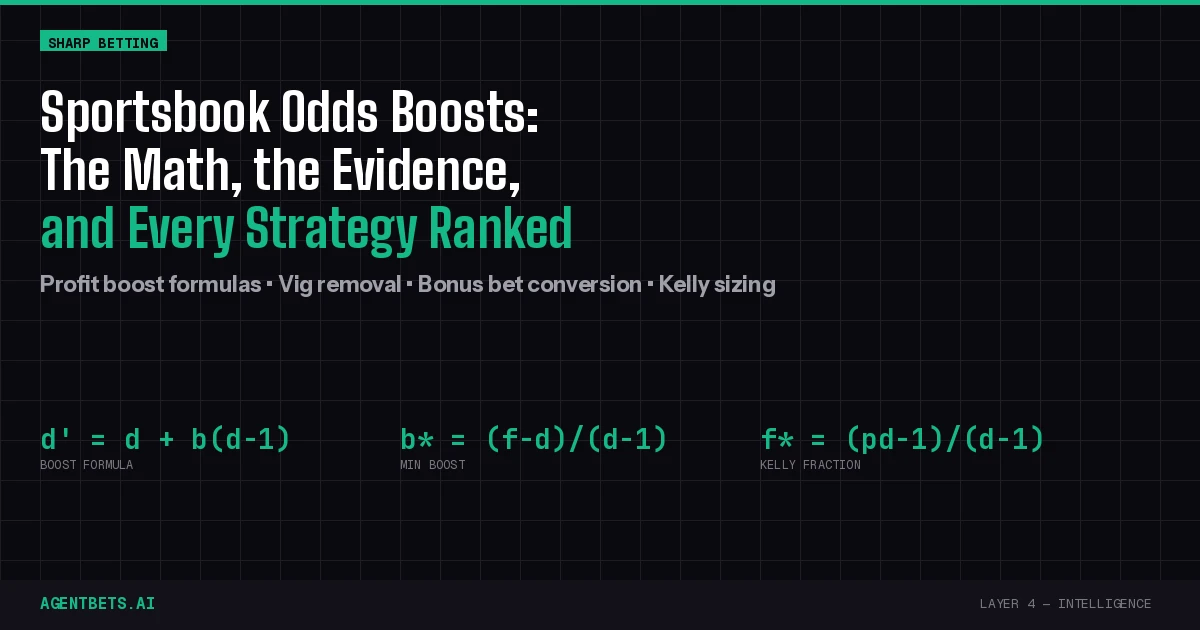
A boost is not free money. It is a coupon on a price. The only serious question is whether the boosted price exceeds fair value. This guide covers the complete math — profit boost formulas, vig removal, bonus bet conversion, parlay analysis, arbitrage mechanics, Kelly sizing — plus what the empirical evidence says about when boosts are actually +EV.
Sportsbook odds boosts are temporary price changes on wagers that are usually already priced with house edge. FanDuel profit boosts cap at $25 stakes with a minimum qualifying price of -200. BetMGM offers 25%, 33%, and 50% boost tokens plus parlay-boost tokens requiring at least four legs and +200 minimum odds. Caesars says cash out may be unavailable on boosted markets, and boosted pricing stops once the max-wager amount is reached. Bonus-bet promos usually do not return stake in winnings.
That leads to the central idea: a boost is good only if the boosted price beats the true price by enough to overcome vig, model error, and practical frictions. A 50% boost on a badly overpriced longshot is still bad. A 10% boost on a near-fair line is excellent.
If you want to compare vig across books before evaluating any boost, the AgentBets Vig Index ranks sportsbooks by efficiency across dozens of sports using live data, updated 3× daily. For a deeper breakdown of vig mechanics, see How to Calculate Vig.
The Core Math
Let decimal odds be d, true win probability be p, and stake be S.
Your expected profit is:
EV = S × (p × d - 1)
Break-even condition:
p × d = 1 → d = 1/p
That is the whole game. If the offered decimal odds exceed 1/p, the bet is +EV.
For American odds conversion:
| American Odds | Decimal Odds | Implied Probability |
|---|---|---|
| +A | 1 + A/100 | 100 / (A + 100) |
| -A | 1 + 100/A | A / (A + 100) |
Profit Boost Formula
Most retail “odds boosts” are profit boosts — they scale the profit portion, not the stake. If original decimal odds are d and the boost fraction is b (25% → b = 0.25), the boosted decimal odds are:
d' = 1 + (1 + b)(d - 1) = d + b(d - 1)
For positive American odds, this is straightforward: +150 with a 50% profit boost becomes +225.
Minimum Boost to Break Even
If your estimate of fair decimal odds is f and the book offers d, you need:
b* = (f - d) / (d - 1)
Example: A book offers +110 (d = 2.10). Your no-vig estimate says fair is +120 (f = 2.20).
b* = (2.20 - 2.10) / 1.10 = 0.0909
A boost above 9.1% makes it +EV. A 20% boost turns +110 into +132, yielding:
EV/$1 = 0.4545 × 2.32 - 1 ≈ 0.0545
That is a 5.45% edge. But if the promo caps at $25, total expected profit is about $1.36. Promo betting is a game of small but real edges.
Removing Vig: Estimating Fair Price
In a market with decimal odds o₁, …, oₖ, the booksum is:
B = Σ (1/oᵢ)
If B > 1, the excess is the overround (vig). The standard no-vig estimate is:
p̂ᵢ = (1/oᵢ) / B
This is the starting point your agent uses in the +EV betting bot framework. A more refined alternative is Shin normalization, which adjusts for favorite-longshot bias rather than mechanically rescaling inverse odds. Research comparing methods shows that simple normalization is standard, but Shin-type adjustments produce less biased estimates when favorite-longshot effects are significant.
The practical implication for boosts: a flashy boost on a longshot is not automatically generous, because the original longshot may already carry a much fatter embedded margin. Check actual vig levels per book per sport on the Vig Index before assuming any boost is good.
What the Empirical Evidence Says
The picture is mixed — which is the correct answer.
In large online European football markets, researchers found weak-form efficiency on average, with detected biases mostly increasing bookmaker profit rather than creating easy bettor profit. In U.S. college basketball and college football moneyline markets, favorite-longshot bias was present — heavy favorites came close to break-even, which is much better than the average retail bettor achieves. In NBA markets, opening lines around player absences showed significant bias, but that bias disappeared by closing time, indicating the close absorbed information the open missed.
The takeaways:
- Openers can be wrong. That is where the closing line value tracker earns its keep.
- Closes are tough. Your agent needs to act before the market corrects, which is why steam move detection matters.
- Structural biases exist — but many are too small, unstable, or crowded to generate consistent profit after vig and limits.
So odds boosts sit on top of markets that are often efficient but not perfectly so.
Strategy A: Line Shopping + Selective Straight-Bet Boosts
This is the cleanest mathematically and the strongest general-purpose approach.
Method:
- Estimate fair odds from a no-vig consensus — ideally from sharper or broader market prices like Pinnacle
- Apply the boost formula
- Bet only if the boosted price beats fair price by enough
Straight bets in two-way liquid markets are easier to price than parlays and less vulnerable to hidden correlation or rule differences. In practice, the best boosts live not in flashy longshot markets but in boring sides or totals that were already near fair.
A key optimization: with promos, absolute EV matters more than percentage edge. A 20% edge on a $10 cap is worth less than a 5% edge on a $200 cap.
Use the vig shopping strategy to identify which books consistently offer near-fair lines, then layer boosts on top. The DraftKings vs FanDuel vs BetMGM odds comparison shows how much pricing varies across the big three regulated books.
Strategy B: Arbitrage and Matched Betting
The strongest math and the messiest execution.
If you take the best available decimal odds dᵢ on each mutually exclusive outcome and:
Σ (1/dᵢ) < 1
then a surebet exists. For total stake T, choose stakes:
sᵢ = T × (1/dᵢ) / Σ(1/dⱼ)
Guaranteed payout on every outcome:
Payout = T / Σ(1/dⱼ)
Guaranteed profit:
T × (1/Σ(1/dⱼ) - 1)
There is empirical support: one study of bookmaker-versus-exchange combinations found guaranteed positive return opportunities in 19.2% of matches in top-five European soccer leagues. But the real-world frictions are enormous — books restrict accounts, promos expire in 24 hours, stake caps are small, and rules differ across books.
For a complete implementation, see the sports betting arbitrage bot guide. The arbitrage math is pristine. The operations are fragile.
Strategy C: Bonus Bet Conversion
Because bonus bets do not return stake, a bonus bet of size S at decimal odds d has expected cash value:
EV_bonus = S × p × (d - 1)
Notice what disappeared: the -S(1-p) loss term. That changes everything.
Under fair odds (d = 1/p), this simplifies to:
EV_bonus = S × (1 - p)
So under fair pricing, longer odds produce higher bonus bet EV:
| Bonus Bet ($50) | Fair Odds | EV |
|---|---|---|
| Even money | +100 | $25.00 |
| Moderate favorite | +200 | $33.33 |
| Longshot | +400 | $40.00 |
The slogan “use bonus bets on longshots” is directionally right in pure EV terms. But maximizing EV is not the same as maximizing utility. Longer odds create much higher variance, and if you convert by hedging at another book, the realized cash conversion depends on frictions, limits, and the hedge price.
Strategy D: Parlay Boost Hunting
The most misunderstood category.
For independent legs with probabilities p₁, …, pₙ and decimal odds d₁, …, dₙ:
p_parlay = Π pᵢ
d_parlay = Π dᵢ
With a profit boost b:
d' = 1 + (1 + b)(d_parlay - 1)
EV = p_parlay × d' - 1
Concrete example: Four independent 50/50 legs each at -110 (decimal 1.9091).
Parlay price:  1.9091⁴ ≈ 13.28
Fair price:    2⁴ = 16.00
Break-even boost: b* = (16.00 - 13.28) / (13.28 - 1) ≈ 22.1%
A 25% profit boost makes this parlay slightly +EV. That surprises people.
But in practice, most parlay boosts require at least four legs and +200 minimum odds, and many attractive markets are same-game parlays where independence is false and hidden margin is harder to detect. That is the fastest way to hallucinate EV — multiplying “independent” probabilities for correlated legs.
The right conclusion is not “never bet boosted parlays.” It is: treat them as pricing problems, not entertainment products.
Strategy E: Favorite Bias Exploitation
This has some empirical support in certain markets but is not universal.
The idea: underdogs and longshots may be overpriced because bettors like lottery-like payoffs. In college basketball and college football moneyline studies, heavy favorites came close to break-even on average — much better than the average retail bettor usually achieves.
Best described as: sometimes a good directional prior, not a universal model, and not a license to blindly lay -400 everywhere. A favorite can be “less bad than the dog” without being good.
Strategy F: Chasing Closing-Line Value
One of the better diagnostics for any betting approach, including boost exploitation.
If you repeatedly take prices that close shorter than what you bet, that is evidence of edge. It is not proof of positive EV, but it is far more informative than a noisy 30-bet ROI. Research on NBA player-absence games found opening lines had systematic errors but the closing line removed them — exactly what you’d expect if the close is a more information-rich price.
“Beat the close” is a sensible scorecard. Build it into your pipeline from day one using the CLV tracking bot.
Strategy G: Kelly Staking and Fractional Kelly
The most elegant bankroll rule.
If your estimated win probability is p̂ and decimal odds are d, the full Kelly fraction is:
f* = (p̂ × d - 1) / (d - 1)
Kelly maximizes long-run logarithmic growth if your probability estimates are correct. That is a big “if.” Research on sports-betting investment strategies argues the main practical problem is precisely the unrealistic assumption that bettors know true probabilities.
That is why half-Kelly or quarter-Kelly are almost always more sensible than full Kelly for sports betting. The error is not in the formula. The error is in the probability estimate.
For a complete implementation, see the Kelly criterion bot.
Strategy H: Flat Betting
Mathematically inferior if your edges differ and you estimate them accurately. But flat betting has one virtue: it is robust to the common problem of overconfidence in estimated edge.
Not optimal. A crude guardrail against bad estimation.
Strategy I: Cash Out, Hedging, and Middling
These get conflated but are different.
Cash out is usually selling your ticket back at a price with extra margin. Sportsbooks may disable cash-out on boosted markets entirely.
Hedging can be rational when another book offers a mispriced offset or when converting a bonus bet.
Middling is positive EV when line movement crosses valuable numbers, but without a distribution model it is easy to overpay vig for a tiny middle window. See the middling bot guide for the detection algorithm.
“Locking profit” is not automatically smart. Sometimes it is just paying another hidden fee.
The Biggest Statistical Traps
The main danger in boost analysis is not algebra. It is bad inference.
Small Samples
At -110, break-even win rate is 110/210 ≈ 52.38%. A strategy that truly wins 54% has only a 1.62 percentage-point edge. You need roughly 3,600 bets to distinguish that from break-even at 95% confidence. Most “systems” based on 100–500 bets are statistically weak.
Multiple Testing
Scan 1,000 angles and a few will look amazing by luck alone. Backtests of boosts, props, and “Tuesday night home dog after two losses” systems are especially vulnerable.
Selection Bias
Books advertise boosts on markets that are fun, viral, and high-handle. That does not prove they are bad, but it should make you suspicious the promotion is doing marketing work first and price-discovery work second.
Correlation Error
People constantly multiply independent probabilities for same-game parlays when the legs are correlated. This is one of the fastest ways to hallucinate EV in parlay boost analysis.
Variance Blindness
Longshot boosts and bonus-bet strategies can have strong EV and miserable short-run experience. For a binary cash bet, variance is:
Var(X) = p(d-1)² + (1-p)(1)² - (pd-1)²
Higher payout multiples usually mean much higher variance. EV-maximizing and bankroll-friendly are not always the same thing.
Mathematical Ranking of All Strategies
Strongest
- Selective line shopping + no-vig fair pricing on straight bets. The vig shopping strategy and juice comparison across books cover this in depth.
- True arbitrage / matched betting / bonus conversion when mechanics are favorable. See the arbitrage bot guide.
- Fractional Kelly or conservative sizing once edge is established. The Kelly criterion bot implements this.
Conditional
- Parlay boosts on carefully chosen, near-fair independent legs.
- Early betting when you genuinely beat the close. Tracked via the CLV API.
- Favorite-biased strategies in markets where the bias is documented.
Weakest
- Adding legs just to “use the boost.”
- Blind longshot boosting because the percentage looks big.
- Cashing out for comfort.
- Tiny-sample trend systems and social-media tipster records.
How This Fits the Agent Betting Stack
Everything in this guide maps to Layer 4 — Intelligence in the agent betting stack. The boost evaluation pipeline looks like this:
Odds Ingestion (The Odds API / OpticOdds)
    → Vig Removal (no-vig fair price estimation)
    → Boost Application (profit boost formula)
    → EV Calculation (boosted odds vs fair odds)
    → Position Sizing (fractional Kelly)
    → Execution (lowest-vig book selection)
    → CLV Logging (close capture for feedback)
This pipeline is the same architecture described in the sharp betting hub — boost evaluation is just another signal your agent processes. Wire it into the sharp signal aggregator alongside steam moves, CLV projections, and reverse line movement.
For the data layer, the AgentBets Vig Index and odds comparison pages give you the pricing landscape. The offshore sportsbook API guides cover how to access odds programmatically from books that offer the softest lines. For a bankroll-level comparison of prediction markets versus sportsbooks, see Prediction Markets vs Sports Betting.
Bottom Line
The clean workflow:
- Estimate fair price — strip vig using multi-book consensus or Pinnacle benchmark
- Apply the boost formula — d’ = 1 + (1 + b)(d - 1)
- Compare boosted odds to fair odds — if d’ > f, the boost is +EV
- Size conservatively — fractional Kelly because your probability estimate is noisy
- Judge process over outcomes — CLV and price quality matter more than 30-bet ROI
Odds boosts can absolutely be +EV. The best ones are often smaller and duller than bettors expect. Parlay boosts are sometimes good but far less often than casual bettors think. Bonus bets behave differently from cash and deserve separate analysis. And bankroll management matters at least as much as picking winners.
The sharpest retail style is selective, price-driven, capped, and a little boring — which is exactly what good gambling math tends to look like.
What’s Next
- Sharp Betting Hub — The parent section covering all seven sharp concepts with Python implementations
- +EV Betting Bot — Automate the +EV detection workflow described above
- Kelly Criterion Bot — Implement the position sizing formulas in production
- Sports Betting Arbitrage Bot — Full arb bot architecture including bonus bet conversion
- AgentBets Vig Index — Live sportsbook efficiency rankings to identify which books offer near-fair lines
- How to Calculate Vig — The foundational vig formula this guide builds on
- Juice Comparison Across Books — Per-sport vig analysis across offshore and regulated books
- Odds & Sportsbook Comparisons — 750+ dynamically updated odds and comparison pages