Polymarket is the world’s largest prediction market by trading volume, processing over $8 billion monthly as of March 2026. Built on the Polygon blockchain with USDC settlement, it provides a three-component API stack — Gamma, CLOB, and Data — that makes it the primary venue for automated prediction market agents. This review covers markets, fees, API architecture, the US relaunch via QCEX, and what builders need to know.
What Polymarket Is
Polymarket is a blockchain-based prediction market where users trade binary outcome contracts denominated in USDC on the Polygon network. Shayne Coplan founded the company in 2020 in New York. Contracts are priced between $0.01 and $0.99, representing implied probability, and settle at $1.00 (yes) or $0.00 (no) via UMA’s Optimistic Oracle — a decentralized resolution mechanism where asserters post bonds and outcomes can be disputed on-chain.
The hybrid-decentralized architecture is what separates Polymarket from Kalshi. Order matching happens off-chain through a Central Limit Order Book (CLOB) operator for speed, while settlement executes on-chain through smart contracts for transparency and non-custodial guarantees. Users never deposit funds into a Polymarket-controlled account — assets remain in their Polygon wallet, and the Exchange contract facilitates atomic swaps between outcome tokens and USDC.
As of March 27, 2026, Intercontinental Exchange — the parent company of the New York Stock Exchange — announced an additional $600 million investment in Polymarket, bringing ICE’s total commitment close to $2 billion. The October 2025 round valued Polymarket at $9 billion post-money. Reports from The Wall Street Journal and Fortune indicate the company is in early discussions for a new round targeting a $20 billion valuation. Total funding exceeds $2.3 billion across all rounds, with investors including Founders Fund, Vitalik Buterin, and 1789 Capital. The company has approximately 40 employees.
The platform’s trajectory accelerated through the 2024 US presidential election, where over $3.3 billion was wagered on the Trump vs. Harris race. Monthly volume hit $3 billion by October 2025, and by March 2026, monthly volume exceeded $8 billion according to on-chain data. A single-day volume record of $425 million was set on February 28, 2026, driven by Iran-related market resolutions.
Recent acquisitions signal aggressive expansion. Polymarket acquired Brahma (DeFi infrastructure, $1B+ in processed volume) on March 18, 2026 to streamline wallet creation and token redemption. Earlier in February 2026, it acquired Dome (YC-backed developer tools) and Lunch (boutique executive search). On March 10, 2026, Polymarket announced a partnership with Palantir Technologies and TWG AI to deploy the Vergence AI engine for sports integrity monitoring — screening for suspicious trading activity, insider trading patterns, and prohibited participants.
Markets and Categories
Polymarket hosts thousands of active markets across multiple categories. Sports is the fastest-growing segment, with over 3,200 active sports markets as of March 2026 and approximately $800 million in cumulative sports trading volume.
Sports cover NFL, NBA, MLB, NHL, college basketball (NCAAB), college football, soccer, golf, tennis, and esports. Contract types include moneylines, spreads, totals, and player props. The 2026 FIFA World Cup winner market is already the most-traded sports market on the platform, with Spain currently favored at 16% implied probability. The Vig Index tracks pricing efficiency across Polymarket’s sports markets relative to traditional sportsbooks.
Politics is where Polymarket built its reputation. Election outcomes, policy decisions, approval ratings, and congressional actions draw deep liquidity. The 2024 presidential election market alone generated over $3.3 billion in volume. Political markets are being brought under the new fee structure on March 30, 2026.
Crypto markets are the highest-velocity category. 15-minute price prediction contracts on Bitcoin, Ethereum, and Solana generate continuous trading activity and were the first category to receive taker fees in January 2026. One Bitcoin price market surpassed $4 billion in cumulative volume.
Geopolitics covers conflicts, international relations, regime change, and military operations. These markets will remain permanently fee-free — an explicit strategic carve-out to encourage information aggregation on high-stakes global events. This category has also generated the most controversy, including the Iran war betting controversy in March 2026 and allegations of journalist harassment tied to market outcomes.
Economics includes Fed rate decisions, CPI prints, and nonfarm payroll data. Weather markets cover temperature thresholds, rainfall, and snowfall. Entertainment spans Oscars, Grammys, and cultural events. Mentions markets (will a specific word appear in a speech or post) exist but face thin liquidity and insider trading concerns.
Fee Structure
Polymarket operated with zero trading fees from launch through the end of 2025, subsidizing growth with venture capital. The transition to a revenue-generating model began in January 2026 and accelerates significantly on March 30, 2026.
Fees are dynamic and probability-based. The effective fee peaks when a contract trades near 50¢ (maximum uncertainty) and decreases toward the extremes. Only takers pay fees — makers trade fee-free and receive rebates funded by taker fees.
Previous fee parameters (through March 29, 2026):
| Category | Peak Effective Rate | Maker Rebate |
|---|---|---|
| Crypto (15-min) | ~1.56% | 20% |
| Sports (NCAAB, Serie A) | ~0.44% | 25% |
| All other categories | 0% | N/A |
Current fee parameters (effective March 30, 2026):
| Category | Peak Effective Rate | Maker Rebate |
|---|---|---|
| Crypto | 1.80% | 20% |
| Sports | 0.75% | 25% |
| Finance | 1.00% | 50% |
| Politics | 1.00% | 25% |
| Tech | 1.00% | 25% |
| Economics | 1.50% | 25% |
| Mentions | 1.56% | 25% |
| Culture | 1.25% | 25% |
| Weather | 1.25% | 25% |
| Other / General | 1.25% | 25% |
| Geopolitics | 0% (permanently) | N/A |
Deposit and withdrawal costs:
| Method | Deposit | Withdrawal |
|---|---|---|
| Crypto transfer (USDC on Polygon) | Free | Free (gas only) |
| Coinbase on-ramp | Free | Free |
| MoonPay / card | 1–4.5% (third-party fee) | N/A |
| Polymarket US (QCEX) | Varies by method | Varies by method |
For agent strategies, the new fee structure creates meaningful differences across categories. A bot trading 50¢ sports contracts at the peak 0.75% effective rate pays approximately $0.38 per $50 trade — substantially lower than Kalshi’s $0.02-per-contract cap. Maker strategies eliminate fees entirely and earn rebates, making Polymarket structurally cheaper for liquidity-providing agents. Based on current volume, Polymarket projects approximately $800,000–$1 million in daily fee revenue after the March 30 expansion, annualizing to roughly $300 million.
API and Developer Experience
Polymarket’s developer stack splits across three distinct APIs, plus WebSocket feeds. This is architecturally more complex than Kalshi’s single REST v2 endpoint but offers finer-grained control.
Gamma API (gamma-api.polymarket.com) is the read-only market discovery layer. No authentication required. Query active markets, events, price history, volume, and market metadata. This is where you browse the catalog.
import requests

# No auth needed — query active sports markets
response = requests.get(
    "https://gamma-api.polymarket.com/markets",
    params={"tag": "sports", "active": "true", "limit": 5}
)
for market in response.json():
    print(f"{market['question']} — Volume: ${market.get('volume', 0):,.0f}")
CLOB API (clob.polymarket.com) handles all trading operations: order placement, cancellation, position queries, orderbook depth, midpoints, and spreads. Requires authenticated API credentials derived from your Ethereum wallet.
from py_clob_client.client import ClobClient
from py_clob_client.clob_types import OrderArgs, OrderType
from py_clob_client.order_builder.constants import BUY

client = ClobClient(
    "https://clob.polymarket.com",
    key="<your-private-key>",
    chain_id=137,  # Polygon mainnet
    signature_type=1,
    funder="<your-proxy-wallet-address>"
)
client.set_api_creds(client.create_or_derive_api_creds())

# Place a limit order
order = OrderArgs(
    token_id="<token-id>",
    price=0.55,
    size=10.0,
    side=BUY
)
signed = client.create_order(order)
resp = client.post_order(signed, OrderType.GTC)
Data API provides user-specific information: positions, trade history, PnL, and portfolio data. Requires authentication.
WebSocket feeds deliver real-time orderbook updates, trade streams, and price changes. Connect to wss://ws-subscriptions-clob.polymarket.com/ws/market for live data.
Authentication uses EIP-712 signed messages — you sign structured data with your Ethereum private key to derive API credentials (key, secret, passphrase). The py-clob-client SDK handles this automatically. Official SDKs exist in Python, TypeScript (@polymarket/clob-client), and Rust. The Polymarket API guide covers complete setup including wallet configuration, authentication flows, and the auth troubleshooting guide addresses common errors. For the most frequent integration pitfalls — L1/L2 auth confusion, identifier mismatches, heartbeat timeouts, and US NO-side pricing — see the top 10 Polymarket API problems guide.
No demo sandbox exists. Unlike Kalshi, which provides a full demo environment at demo-api.kalshi.co, Polymarket has no testnet for order logic testing. All bot development happens on mainnet with real USDC. This is the single largest friction point for agent builders — your first order is a real order. Start with tiny position sizes.
For a comparison of API patterns across platforms, see the prediction market API reference. The Polymarket Gamma API guide covers the market data layer in depth, and the Polymarket rate limits guide documents per-endpoint throttling across all three APIs. Additional SDK references are available for TypeScript and Rust.
US Relaunch via QCEX
Polymarket’s original US operations ended in January 2022 after a CFTC enforcement action resulted in a $1.4 million fine for operating as an unregistered derivatives exchange. For three years, the platform operated outside the US, geo-blocking American users.
The path back began in July 2025 when Polymarket acquired QCEX — a CFTC-licensed Designated Contract Market (DCM) and Derivatives Clearing Organization (DCO) — for $112 million from Quadcode Group. The consideration included cash and Polymarket equity. On November 25, 2025, the CFTC granted Polymarket an Amended Order of Designation enabling it to operate an intermediated trading platform through registered brokerages and futures commission merchants.
Polymarket US launched in January 2026 with sports markets only. Access is via a waitlist-based rollout — not all US users can trade yet. The US version operates under QCEX’s CFTC licenses, uses a flat 0.01% taker-only fee on contract premiums (separate from the global fee structure), and requires KYC verification. US users interact through the Polymarket app but trade on regulated QCEX infrastructure.
The Polymarket US API uses Ed25519 authentication (different from the global CLOB’s EIP-712 signatures), offers 23 REST endpoints and 2 WebSocket channels, and enforces 60 requests/minute rate limits. For agent builders targeting US users specifically, this is a separate integration from the global platform.
The broader implication is that Polymarket now operates two parallel systems: the global, blockchain-native platform with deep liquidity across all categories, and the US-regulated QCEX platform with sports-only access and different authentication. Your agent architecture needs to account for which system you’re targeting.
Legal Status as of March 2026
Polymarket’s legal position is bifurcated: the global platform operates in a crypto-regulatory gray area, while the US platform operates under explicit CFTC authorization.
US federal position: The DOJ and CFTC formally ended their investigations into Polymarket in July 2025 without bringing new charges, resolving the regulatory overhang from the 2022 enforcement action. The QCEX acquisition provides DCM and DCO licenses. However, Polymarket faces the same state-level litigation that affects Kalshi — states arguing that event contracts constitute gambling under state law regardless of federal CFTC oversight.
Nevada: The Nevada Gaming Control Board filed a civil complaint against Polymarket seeking to prevent the platform from offering event contracts to Nevada residents without a state gaming license. The restriction mirrors the approach taken against Kalshi.
Massachusetts: The preliminary injunction issued against Kalshi in January 2026 — which found that prediction market contracts function as illegal sports wagering under state law — has been cited by Nevada regulators as supplemental authority. The ruling’s reasoning applies equally to Polymarket’s US operations.
International bans: Polymarket has been blocked or banned in France, Singapore, Belgium, Poland, Romania, and Portugal (most recently on March 17, 2026, when Portugal’s SRIJ ordered ISPs to block the platform). Each ban cites lack of proper gambling or gaming licenses.
FBI investigation: In November 2024, the FBI raided founder Shayne Coplan’s home and seized his phone. Bloomberg reported the DOJ was investigating Polymarket for allegedly allowing US-based users to make bets while US access was blocked. This investigation was resolved with the broader DOJ/CFTC closure in July 2025.
Advisory role: Donald Trump Jr. has taken on an advisory role at Polymarket, a political connection that provides some regulatory insulation in the current administration but creates reputational complexity.
Insider trading and market integrity: Multiple incidents have drawn scrutiny. In January 2026, a newly created account netted over $400,000 from positions on the Venezuela intervention before it was publicly announced. In March 2026, users betting on an Iranian missile strike allegedly harassed Israeli journalist Emanuel Fabian of The Times of Israel to pressure reporting outcomes. Polymarket condemned the behavior, banned the users, and the Palantir/TWG AI partnership was announced partly in response to these integrity concerns.
For agents, the key risk factors mirror Kalshi’s: state-by-state availability requires geographic checks, and the regulatory landscape can shift quickly. The additional layer for Polymarket is international jurisdiction — your agent needs to handle geo-restrictions across both US states and foreign countries. KYC and geofencing requirements apply to the US platform; the global platform currently relies on self-attestation and IP-based blocking.
Agent Compatibility Verdict
Polymarket is the highest-volume prediction market for automated trading agents globally, with a developer ecosystem that has matured significantly through 2025–2026. The tradeoffs are different from Kalshi, and the right choice depends on your agent’s architecture.
Strengths:
The three-API architecture provides granular control. The Gamma API gives you unauthenticated market discovery — you can scan thousands of markets without credentials, which is ideal for signal-generation agents that monitor across the full event universe before committing capital. The CLOB API’s EIP-712 authentication is standard Ethereum infrastructure, familiar to any developer who has worked with DeFi protocols. On-chain settlement means your positions are verifiable and your funds are non-custodial.
Volume depth is Polymarket’s clearest advantage. With $8 billion+ monthly volume and $445 million in total value locked, liquidity is deep enough for institutional-sized positions in major markets. The volume-to-open-interest ratio of approximately 0.71 indicates active capital rotation rather than static betting — this means your agent will find counterparties consistently.
Fee structure favors makers. If your agent provides liquidity rather than consuming it, you pay zero fees and earn rebates — 20–50% of taker fees depending on the category. This makes Polymarket structurally the cheapest venue for market-making agents. Even as a taker, the peak 0.75% sports fee is lower than Kalshi’s formula-based fees at the 50¢ price point.
If you are building a Polymarket trading bot, the best Polymarket bots guide covers specific implementations. The Polymarket bot marketplace catalogs the full ecosystem of SDKs, agents, and automation tools.
Weaknesses:
No demo sandbox is the most significant friction point. Every order during development is a real order with real USDC on Polygon mainnet. This means your bot’s first bug costs real money. Kalshi’s demo environment at demo-api.kalshi.co eliminates this risk entirely. For production agents, the workaround is to start with penny-sized positions, but you cannot test settlement handling or edge cases without actual market resolution.
The three-API architecture adds integration complexity. Where Kalshi gives you a single REST endpoint for everything, Polymarket requires coordinating across the Gamma API (for market discovery), CLOB API (for trading), and Data API (for positions). Token IDs must be fetched from Gamma and passed to CLOB. Authentication patterns differ between global (EIP-712) and US (Ed25519). The Polymarket vs Kalshi for bot trading guide breaks down these differences in detail.
Crypto custody is required. Your agent needs an Ethereum wallet on Polygon, USDC funding, and the ability to sign EIP-712 messages. This is trivial for crypto-native developers but represents a barrier for teams coming from traditional finance. The wallet comparison guide covers custody options including Coinbase Agentic Wallets, and the Polymarket + Coinbase quickstart walks through the integration.
Oracle risk exists. UMA’s Optimistic Oracle handles settlement, and while disputes are rare, they introduce timing uncertainty. A disputed resolution can delay settlement and lock your capital. This is a qualitatively different risk profile from Kalshi’s centralized settlement, which is deterministic and fast.
The global/US platform split creates two integration targets. If your agent needs to serve both US and international users, you are maintaining two authentication systems, two fee structures, and two regulatory compliance layers. Most agent builders should pick one and focus.
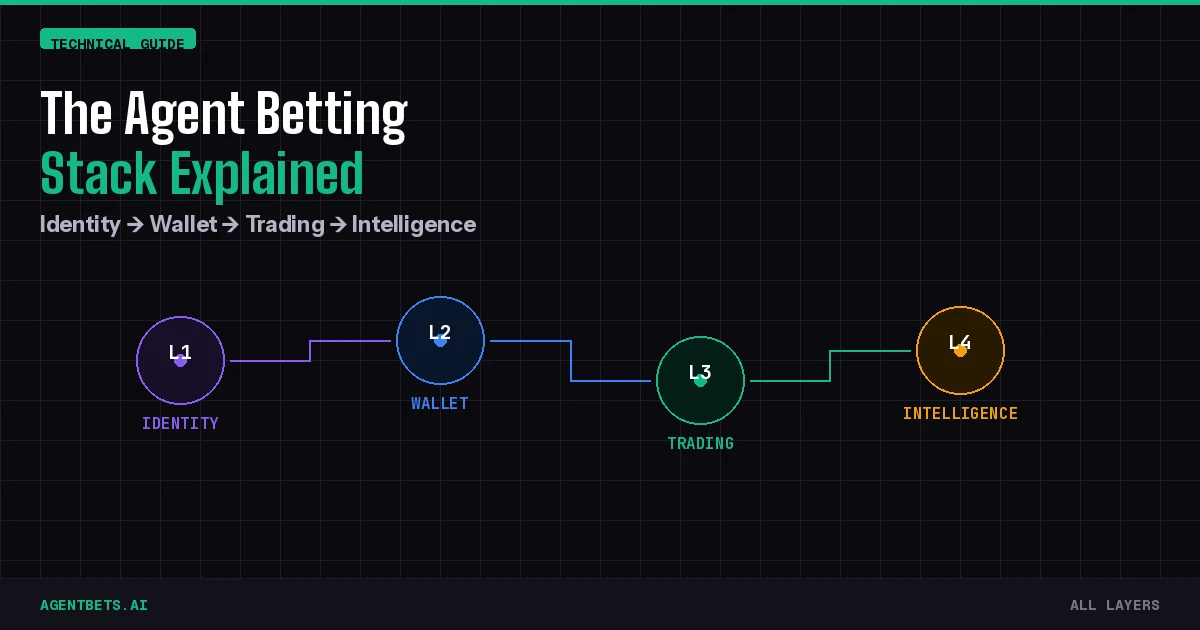
Where Polymarket fits in the stack: Layer 3 (Trading) of the agent betting stack. It handles order execution, position management, and settlement. Layer 4 (Intelligence) components — signal generation, model inference, edge estimation — sit above it. The Polymarket bot marketplace lists production agents already integrated with the platform.
For a head-to-head breakdown against the primary regulated alternative, see the three-way comparison. For comparison focused on developer experience, see Polymarket vs Kalshi for bot trading. For the sportsbook angle, see DraftKings vs Polymarket.