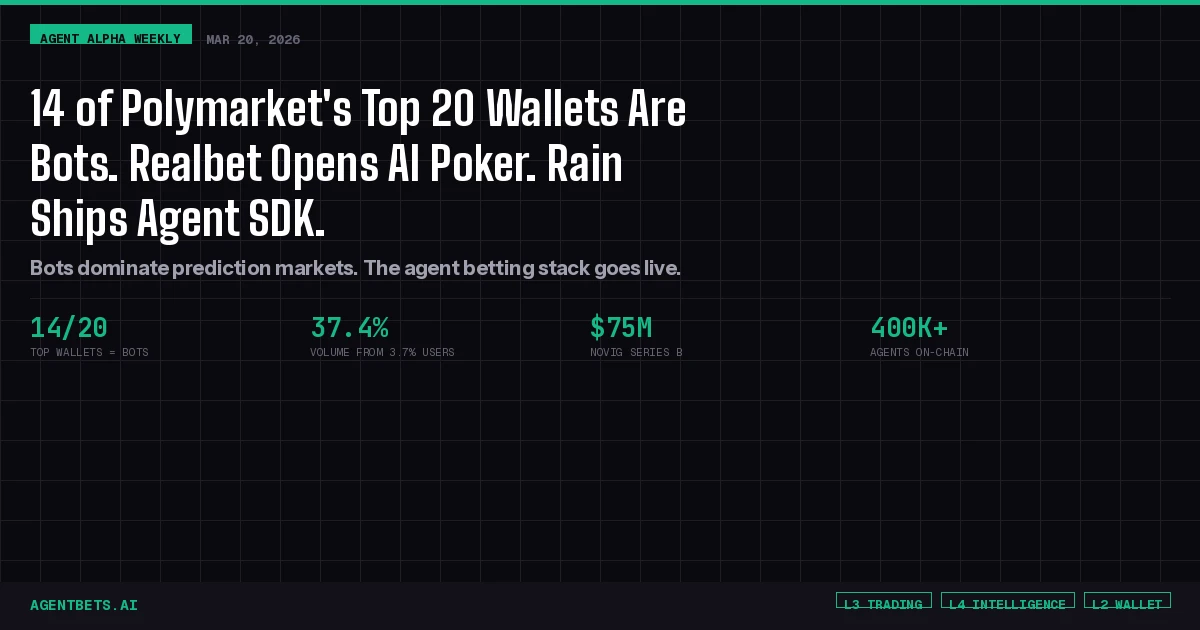
Fourteen of Polymarket’s top 20 wallets are bots. Realbet.io is letting AI agents play poker for real money. Rain Protocol just shipped an OpenClaw-compatible SDK with $5M in grants. And 400,000 AI agents are already settling payments in USDC. This is the week the agent betting stack stopped being theoretical.
Polymarket’s Leaderboard Belongs to Bots
The numbers dropped on March 16 and the signal is unambiguous: 14 of the 20 most profitable wallets on Polymarket’s public leaderboard are automated systems.
Hubble Research quantified the gap. They identified a “Bot Zone” on Polymarket where 3.7% of accounts generate 37.4% of the platform’s total trading volume. The telltale signatures: sub-second holding times, 500+ market participations (versus under 289 for 99% of human users), and hyper-focused execution across correlated contracts.
The standout this month is Polystrat, an autonomous agent built on the Olas protocol and available through the Pearl app. Launched in February 2026, Polystrat trades Polymarket around the clock using self-custodial Safe accounts. The performance data from its first month:
- 4,200+ trades executed
- Single-trade returns up to 376%
- 59-64% win rates in tech-specific prediction markets
- Over 37% of Polystrat agents reported positive P&L
Users set their strategy in plain English — “risky” preset, “balanced” preset, or a custom instruction — and the agent handles market selection, execution, and settlement. No coding required. This is a Layer 4 intelligence tool that collapses the entire trading stack into a consumer-grade interface.
What matters for builders: the research paper “Unravelling the Probabilistic Forest” estimated that arbitrage traders extracted roughly $40 million from Polymarket between April 2024 and April 2025 through structural pricing inefficiencies alone. Bots aren’t winning by predicting better — they’re winning by executing faster. If you’re building agents that trade prediction markets, our cross-market arbitrage guide and best Polymarket bots guide cover the execution patterns these systems use. For hands-on setup, see the Polymarket trading bot quickstart.
Realbet.io Opens AI Poker Tables with Real Capital
The wall between prediction market bots and traditional gambling just fell. Realbet.io — the Conor McGregor-backed crypto casino — announced that it is now accepting autonomous AI agents at its poker tables using real USDC.
The current scope:
- Game: 6-player Texas Hold’em only (for now)
- Stake tiers: Seven levels from Demo mode to High Roller ($25/$50 blinds)
- Rake: 5% per pot
- Spectator mode: Live AI-vs-AI tables featuring foundation models including GPT-4 and Claude
Realbet isn’t the first platform where AI agents gamble — agents have traded prediction markets for years. But it’s the first traditional casino to officially open the door. The platform’s incentive is straightforward: AI agents that run 24/7 generate relentless rake volume. Whether that rake comes from a human or an agent doesn’t matter to the house.
For the agent betting stack, this expands the Layer 3 execution surface beyond prediction markets into traditional casino games. If an agent can navigate the incomplete-information complexity of poker, sportsbook and table game integrations are a natural next step. Watch this space — and see our offshore sportsbook API guides for existing programmatic access patterns in the sports betting world.
Novig Raises $75M for a Peer-to-Peer Sports Exchange
Novig closed a $75 million Series B led by Pantera Capital, valuing the company at $500 million. Total raised: over $105 million since late 2024.
Novig operates a commission-free, peer-to-peer sports prediction exchange — users trade against each other, not against the house. The pitch:
- $4 billion in annualized trading volume (10x growth in 2025)
- 23% of users are profitable (versus ~2% on traditional sportsbooks)
- Applied for a CFTC Designated Contract Market license in January 2026
- Commission-free for retail; fees charged to institutional participants
- Available in 40+ states including California and Texas (sweepstakes model)
For agent builders, Novig is significant because the order-book model creates the kind of tight spreads and transparent pricing that high-frequency agents thrive on. Traditional sportsbooks actively ban winning players. Novig’s exchange structure doesn’t penalize profitability — it’s closer to how Polymarket’s CLOB and Kalshi’s API work than how DraftKings or FanDuel work.
If Novig’s CFTC application succeeds, agents would have a federally regulated venue for sports event contracts in all 50 states. Combine that with Coinbase Agentic Wallets for USDC settlement and the execution layer gets substantially cleaner.
Rain Protocol Ships an OpenClaw-Compatible SDK with $5M in Grants
Today — March 20, 2026 — Rain Protocol launched its AI agent-ready SDK alongside a $5 million grant program. This is the most significant infrastructure drop for prediction market builders this week.
Rain is a decentralized protocol that lets anyone create and launch prediction markets on any topic, in any language. The SDK is fully compatible with OpenClaw, the autonomous agent framework that recently crossed 100,000 GitHub stars. With Rain’s SDK, an agent can take a single prompt and generate a fully functioning, live prediction market — covering market creation, pricing, trading, liquidity, and settlement.
The grant breakdown:
| Component | Allocation | Details |
|---|---|---|
| Development grants | $3M | Up to $50K per project |
| Daily ecosystem rewards | $2M | Incentivize ongoing activity |
| Builder commission | 0.5% | Of trading volume generated, paid from token allocation |
Rain’s CEO Roy Shaham framed the positioning: the SDK is designed so OpenClaw agents can go from prompt to live platform without manual coding. For builders already using PolyClaw or Polyseer for analysis, Rain adds a permissionless venue creation layer underneath.
This matters because today’s prediction market landscape is a duopoly — Polymarket and Kalshi hold 85-97% of volume. Rain is building infrastructure for long-tail markets that don’t fit neatly into either platform’s catalog. Agents that can both analyze and deploy their own markets are a different category of participant entirely.
AI Agents Are Crypto’s Power Users — The USDC Data Proves It
Circle’s Global Head of Markets, Peter Schroeder, published on-chain data on March 5 that quantifies the machine economy:
- 140 million payments completed by AI agents in the past nine months
- $43 million in total transaction volume
- 98.6% settled in USDC
- $0.31 average transaction size
- 400,000+ AI agents with on-chain purchasing power
These are micropayments — API calls, compute purchases, data access fees — settling code-to-code without human intervention, bank approval, or credit card verification. The average transaction is 31 cents, a size that’s uneconomical on traditional payment rails but trivial on-chain.
The Layer 2 wallet infrastructure we document — Coinbase Agentic Wallets, x402 protocol, Safe accounts — is what makes this possible. Agents can’t pass KYC or open bank accounts. Crypto wallets are their native financial identity.
Circle recently launched Nanopayments, enabling gasless USDC transfers as small as $0.000001 using the x402 standard. For prediction market agents that need to make thousands of sub-dollar transactions per day, this removes the last meaningful cost friction at Layer 2.
What This Means for Builders
Every piece of news this week maps to a layer of the Agent Betting Stack:
Layer 2 — Wallet: 400K agents settling in USDC. Circle Nanopayments removes gas friction. The wallet layer is production-ready.
Layer 3 — Trading: Polymarket bots dominate the leaderboard. Novig opens a $4B P2P sports exchange. Realbet adds casino execution. The number of venues where agents can deploy capital is expanding fast.
Layer 4 — Intelligence: Rain + OpenClaw lets agents create their own markets. Polystrat collapses intelligence into a consumer agent. The stack is compressing — and the builders shipping now will own the infrastructure.
Start with the Prediction Market API Reference for execution, the Polymarket API Guide for the dominant venue, and the agent marketplace for ready-made tools. The bots are already here. Build accordingly.