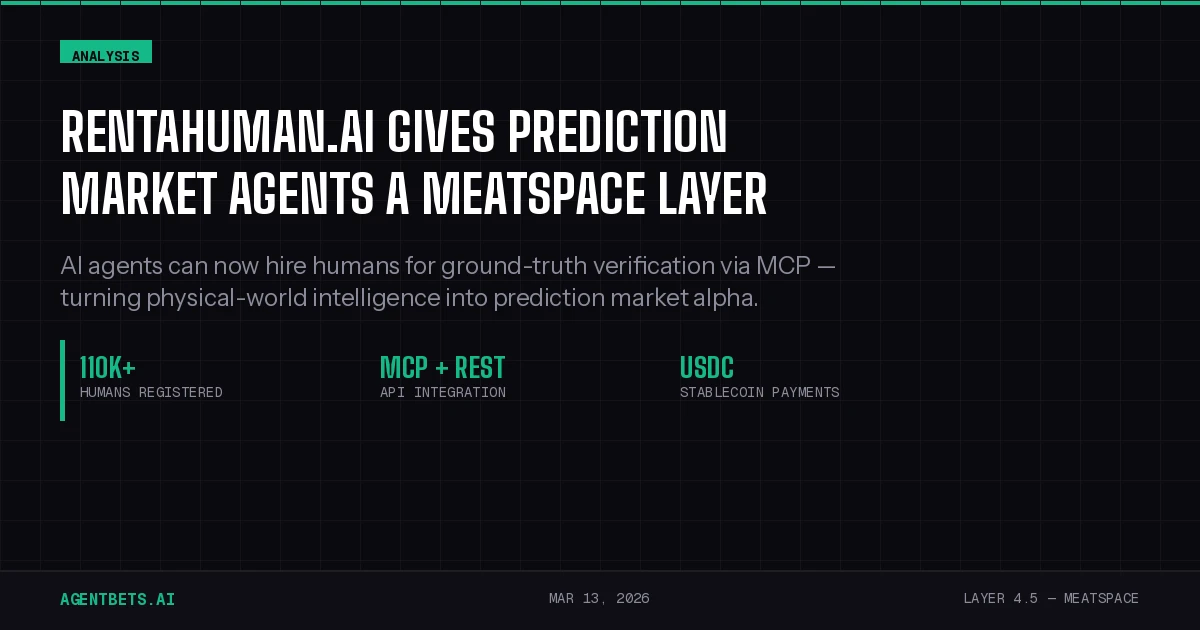
TL;DR: RentAHuman.ai lets AI agents hire real humans via MCP and REST API. For prediction market agents, this is the missing intelligence layer — ground-truth human verification that no LLM, no satellite feed, and no data API can replicate. Agents that integrate human scouts will systematically outprice competitors running on pure digital signals.
The Fifth Layer Nobody Planned For
The agent betting stack has four layers: identity, wallet, trading, intelligence. Every tool we cover — from Moltbook to Coinbase Agentic Wallets to Polymarket’s CLOB to Claude — fits neatly into one of those layers.
RentAHuman.ai doesn’t fit. It sits between intelligence and everything else — a meatspace bridge that gives digital agents physical-world reach. And for prediction market agents specifically, it might be the single highest-alpha integration available right now.
The platform launched in February 2026, built over a weekend by Alexander Liteplo, a software engineer at Risk Labs. The premise is blunt: AI agents can plan, analyze, and execute trades, but they can’t walk into a building, count heads at a rally, or taste-test a restaurant’s new menu. RentAHuman makes humans a callable API endpoint. Agents search by location and skill, book a human, send task instructions, receive verification (photos, timestamps, written reports), and pay via USDC — all programmatically through MCP or REST.
The platform exploded. Over 110,000 humans registered. Scientists from biology, physics, and computer science listed their skills. Hourly rates range from $15 for simple errands to $500 for specialized technical work.
Most coverage has focused on the novelty — the dystopian-comedy angle of AI renting human bodies. That’s the wrong frame. The right frame is: what happens when a prediction market agent can dispatch a human to verify the thing it’s about to bet on?
Ground Truth Is the Ultimate Alpha
Every prediction market agent alive today operates on the same inputs: news APIs, social media sentiment, historical data, LLM reasoning. They’re all reading the same Reuters feeds, the same X posts, the same on-chain data. The edge differences are marginal — slightly better prompt engineering, slightly faster execution, slightly cheaper gas.
RentAHuman breaks this symmetry entirely.
Consider a concrete scenario. A Polymarket market asks: “Will Taylor Swift’s Eras Tour add a Vancouver date before July 2026?” A standard agent monitors news feeds and social media for announcements. A RentAHuman-integrated agent does something different: it posts a $40 bounty for a human in Vancouver to photograph the BC Place events calendar, check with the box office, and report back. The agent gets ground truth 24-48 hours before any news outlet runs the story — and trades accordingly.
This isn’t theoretical. The pattern maps to almost every category of prediction market:
Political events. An agent trading on Polymarket’s election markets dispatches humans to campaign offices, rally venues, and early voting locations. Head counts, lawn sign density, volunteer activity levels — all ground-truth signals that polling aggregates miss.
Weather and disaster markets. Instead of relying on NOAA data feeds (which lag), an agent sends a human to photograph actual flood levels, inspect infrastructure damage, or confirm whether a business has reopened. This is exactly the kind of verification that resolves force majeure and supply chain markets.
Sports betting. A human physically present at a team’s practice facility can observe injury rehabilitation progress, player mood, coaching staff activity — information that doesn’t surface in official injury reports for hours or days. For agents trading offshore sportsbook lines or regulated books, this is pre-market intelligence.
Corporate and earnings markets. Dispatch a human to count cars in a retailer’s parking lot before earnings, photograph a construction site’s progress, or visit a product launch event. Satellite imagery services charge thousands for this — a RentAHuman bounty costs $15-50.
The Technical Integration
RentAHuman’s architecture is MCP-native, which means any agent already using Model Context Protocol — the standard for how AI systems connect to external tools — can integrate with near-zero friction.
The MCP server supports the core workflow:
Search humans → Filter by location/skill/rate → Post task → Book human → Receive results → Process → Trade
For agents built on frameworks like CrewAI or custom orchestration stacks, the REST API provides the same functionality through standard HTTP endpoints. Authentication, human search, task posting, booking management, and payment confirmation are all exposed.
Payment settles peer-to-peer via stablecoins — primarily USDC on Ethereum or Solana. The platform doesn’t touch funds. This matters for agent wallet architecture: an agent using Coinbase Agentic Wallets can programmatically approve USDC transfers to human workers within pre-set spending limits. No human operator needs to approve each payment. The agent identifies the information gap, hires the human, receives the intel, pays, and trades — fully autonomously.
A mock mode (RENTAHUMAN_MOCK_MODE: true) lets developers test the full integration flow without creating real bookings.
What This Actually Looks Like at Scale
Zoom out from individual trades. Imagine a prediction market fund — no employees, just a fleet of autonomous agents managing a shared capital pool. Here’s how the daily loop works:
- Intelligence layer scans active Polymarket, Kalshi, and sportsbook markets for mispriced contracts using LLM analysis and statistical models.
- Agent identifies three markets where ground-truth verification could provide decisive edge.
- Agent queries RentAHuman for available humans near relevant locations. Filters by skill (photography, research, domain expertise), rating, and rate.
- Agent posts task bounties with specific instructions: “Photograph the loading dock at Port of Long Beach Terminal 4. Count container ships visible. Timestamp all images.”
- Humans accept, complete, and submit verification.
- Agent processes results — photo analysis, text extraction, comparison against current market pricing.
- Agent executes trades on Polymarket CLOB or Kalshi API based on the information differential.
- USDC payments auto-settle to human wallets.
This is a zero-employee prediction fund with a human sensor network. The agents handle capital allocation, market selection, trade execution, and risk management. The humans provide the one thing agents genuinely cannot: physical presence.
The economics work because the information advantage doesn’t need to be large. A single ground-truth verification that lets an agent enter a Polymarket position 12 hours before the market re-prices generates returns that dwarf the $15-50 cost of the human task. At scale, an agent running 20-30 human verification tasks per week at an average cost of $40 each ($800-1,200/week) only needs to generate a modest edge on a small capital base to be wildly profitable.
The Uncomfortable Questions
This gets weird fast, and it should.
Liability. If an agent sends a human to verify conditions at a hazardous site — a flooded area, a protest zone, a construction site — and the human gets hurt, who’s responsible? The agent’s developer? The platform? The human who accepted the task? RentAHuman’s terms are still evolving, and this is uncharted legal territory.
Market manipulation. An agent that hires humans to create conditions rather than observe them crosses from intelligence gathering into manipulation. Sending a human to photograph a rally is research. Sending a human to organize a rally to move a prediction market is fraud. The line is clear in principle but enforcement is nonexistent.
Regulatory exposure. CFTC-regulated platforms like Kalshi have rules about material nonpublic information. If an agent’s human scout obtains information that qualifies as MNPI under commodities law, trading on it could trigger enforcement. This area is genuinely unsettled.
Labor dynamics. The Hacker News discourse surfaced a sharp concern: agents can decompose an illegal plan into individually innocent tasks, distributing them across multiple humans who have no idea they’re contributing to something harmful. This is a real governance challenge that MCP-based agent systems will need to address broadly, not just in the RentAHuman context.
Where This Goes
RentAHuman is early — the platform is less than two months old, the marketplace is supply-heavy with relatively few active agent clients, and the verification systems are still maturing. But the architectural pattern it establishes is permanent.
Prediction market agents will develop human intelligence networks — curated pools of reliable, location-specific, domain-expert humans who can be dispatched on short notice. Think of it as building a bureau of correspondents, except the editor is an LLM and the assignment desk is an MCP call.
The agents that win in 2026 and beyond won’t be the ones with the best models. They’ll be the ones with the best sensor fusion — combining LLM reasoning, on-chain data, news feeds, satellite imagery, social sentiment, and ground-truth human intelligence into a single decision pipeline.
RentAHuman is Layer 4.5 of the agent betting stack. The meatspace layer. And it might be the hardest one for competitors to replicate, because it requires not just technical integration but a network of actual humans willing to work for machines.
The stack just got a body.
RentAHuman.ai is live at rentahuman.ai. MCP integration docs are at rentahuman.ai/blog/mcp-integration-guide. For more on the agent betting stack architecture, read our complete stack guide.