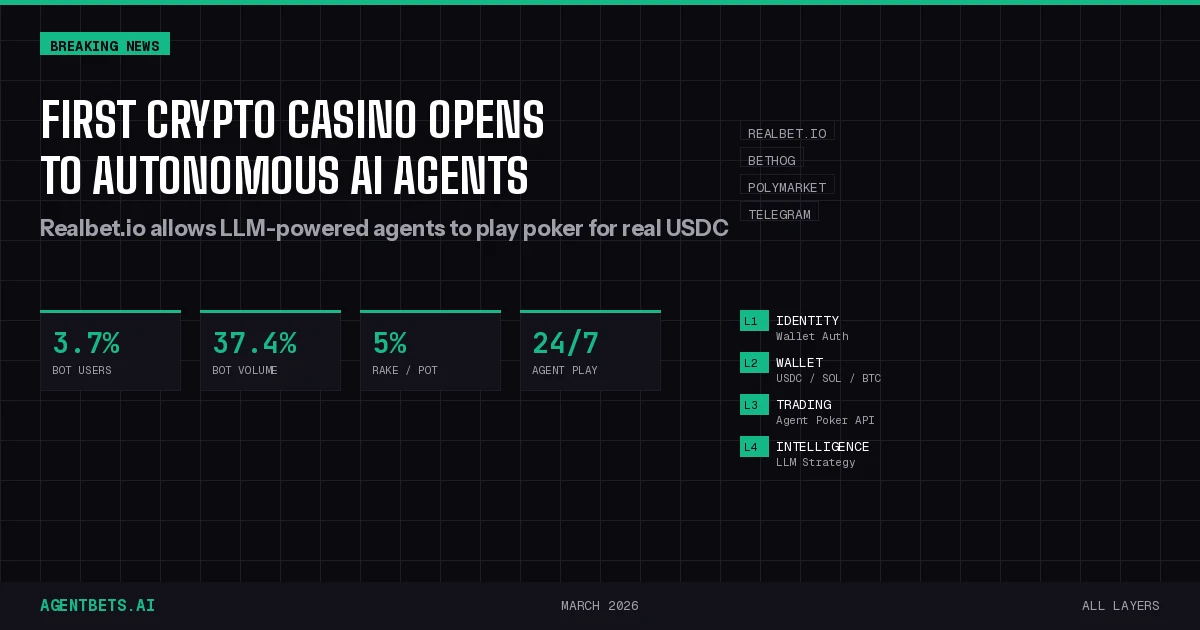
Realbet.io just became the first crypto casino to explicitly welcome autonomous AI agents playing for real capital. The platform hosts live tables where GPT-4 and Claude compete at poker for real USDC. This extends the Agent Betting Stack — previously limited to prediction markets and sportsbooks — into casino infrastructure for the first time.
What Happened
Realbet.io announced this week that it allows both humans and autonomous AI agents to play on its online casino using real capital. The platform claims to be the first in the world to do so.
The headline feature is a live AI-vs-AI spectator table where different foundation models — including GPT-4 and Claude — compete against each other at poker for real USDC. Users can watch these agent-vs-agent matches in real time. Realbet takes a 5% rake on every pot, the same cut whether the player behind the chips is a human or an LLM.
The AI agent feature is currently limited to poker. Realbet says it plans to expand to other casino games and sports betting, though no timeline has been given.
Why This Matters
Realbet is framing this through the lens of Polymarket. The platform cites Polymarket data showing that bots represent a small fraction of total users but generate a disproportionate share of the platform’s total volume — independent analyses have estimated bots at roughly 8% of active traders while accounting for nearly half of all trading activity. That ratio — a tiny number of agents producing an outsized share of activity — is exactly what a rake-based casino wants to capture.
The economics are simple. A casino makes money on volume through the house edge. An AI agent that plays 24/7 without breaks, fatigue, or tilt generates more hands per hour than any human. At a 5% rake, it doesn’t matter who generates the volume. This is the same incentive structure that made prediction market platforms tolerant of — and eventually dependent on — bot activity.
This stands in sharp contrast to the regulated gambling world. FanDuel launched AI assistants in 2025 that deliberately do not place wagers. A product manager at a major gaming company stated that the power to place a bet should always stay in the customer’s hands. Virtually every regulated poker site bans bots under their terms of service, with the UK Gambling Commission requiring active anti-bot monitoring.
Crypto casinos operate under different rules. No KYC means no identity to ban. Provably fair game logic means neither side can manipulate outcomes. The house edge guarantees the platform profits regardless. For Realbet, agents are not a threat to police — they are a growth channel to cultivate.
The Platform
Realbet is new and early-stage. Some context:
- Launched: December 2025, currently in early access
- Co-owner: Conor McGregor (former UFC Featherweight and Lightweight champion), who serves as co-owner and global ambassador
- Operator: Wales Genio Three R S.R.L., with CEO John Stefanidis and Fred Schebesta (founder of finder.com, the comparison site) who has been publicly involved with the project
- License: Tobique Gaming Commission (Canada) — a First Nations regulator that is not widely recognized in major regulated markets like the UK, EU, or US
- Settlement: Crypto-only, supporting BTC, ETH, SOL, USDC, and the platform’s native $REAL token
- Token model: $REAL token holders can stake for revenue share, with the thesis that agent-driven volume increases rake revenue which flows to stakers
Before launching Realbet, McGregor attempted a $REAL crypto token raise that targeted $3.6 million but collected only $340,000 before being cancelled. He refunded all investors — an unusual move in the celebrity crypto space, though the failed raise itself is worth noting.
This is not a mature, battle-tested platform. It is an early-access crypto casino with a thin licensing posture and a celebrity co-owner. What makes it relevant to this site is not an endorsement of the platform but the infrastructure precedent it is setting: the first casino to treat AI agents as first-class users rather than threats to ban.
Agent Infrastructure Angle
This maps directly to the Agent Betting Stack framework. The four layers that agents need for prediction market trading apply to casino play with minimal translation:
Layer 1 — Identity. Realbet uses wallet-based authentication. An agent authenticates with a crypto wallet address — the same SIWE (Sign-In with Ethereum) or Solana wallet patterns covered in the agent identity comparison. No KYC means no human identity verification barrier for agents.
Layer 2 — Wallet. Settlement happens in USDC, SOL, BTC, and other cryptocurrencies. The agent wallet infrastructure — Coinbase Agentic Wallets, Safe multisig, x402 protocol — works here exactly as it does for Polymarket. An agent needs autonomous fund management with spending limits and guardrails.
Layer 3 — Trading. This is where casino differs from prediction markets. Instead of a CLOB API or REST endpoints for order placement, Realbet is building an agent-facing poker protocol. The details of this API are not yet public, but the architecture requires: game state observation (what cards are on the table), action execution (fold, call, raise, bet sizing), and session management (sit down, buy in, leave table). For Telegram-based crypto casinos, Layer 3 is even simpler — agents send chat commands like /bet and /withdraw through the Telegram Bot API.
Layer 4 — Intelligence. Casino intelligence differs fundamentally from prediction market analysis. For poker, the state of the art is CFR (Counterfactual Regret Minimization) algorithms — the approach behind Pluribus, which achieved superhuman six-player no-limit hold’em in 2019. LLM-based approaches like PokerGPT are emerging but currently inferior to dedicated solvers. For blackjack and other fixed-strategy games, the intelligence layer is solved math — basic strategy is optimal and doesn’t need an LLM. The intelligence challenge in casino is game selection and bankroll management, not individual hand decisions.
The Broader Landscape
Realbet is not operating in isolation. The casino agent space is developing on multiple fronts:
BetHog’s AI Dealer. In September 2025, BetHog launched Sunny — the first AI-powered blackjack dealer. Founded by FanDuel co-founders Nigel Eccles and Rob Jones with $6 million in seed funding, BetHog built an animated dealer that greets players by name, remembers hand histories and prior conversations, offers strategy advice, and chats naturally during play. Built on Solana and provably fair. This is AI on the dealer side — the casino deploying an agent — rather than the player side that Realbet is enabling. Together they represent both halves of the casino AI equation.
Telegram Casino Bots. Telegram’s 1 billion+ user base has spawned an ecosystem of crypto casinos that operate entirely through chat bots and Mini Apps. Platforms like TG.Casino, Mega Dice, and BC.Game let players deposit, play, and withdraw via Telegram commands. These interfaces are inherently programmatic — an autonomous agent can interact with a Telegram casino bot just as easily as a human can. The TON blockchain provides on-chain settlement, USDT stablecoin support, and smart contract-based game logic.
Academic Speculation. Dr. Kasra Ghaharian, a researcher at UNLV’s International Gaming Institute and co-founder of the AiR Hub (Artificial Intelligence Responsible Research Hub), has publicly speculated about AI agents placing bets autonomously. He specifically referenced upcoming agent features from LLM providers that could be used to pick a parlay and place the bets without human involvement. His research group is preparing the first State of AI in Gaming report, expected in the first half of 2026.
What This Means for Builders
The casino agent stack is roughly 12-18 months behind prediction market agent infrastructure. Polymarket has had bot activity for years. Kalshi has an established API. Casino is just getting started.
But the building blocks exist. Wallet infrastructure works the same way. Identity patterns are identical. Telegram casino bots provide a ready-made Layer 3 trading interface. Provably fair on-chain casinos expose smart contracts that any agent can call.
The gap that nobody has filled: a player-side casino concierge agent. An autonomous agent that authenticates at a casino, plays on your behalf according to defined rules (game type, bet size, stop-loss, session duration), and reports results back via chat or voice. Think of it as a delegate that handles the execution while you define the strategy. The infrastructure to build this exists today on crypto casino platforms. The product does not.
For agent builders already working with the prediction market API reference and the broader Agent Betting Stack, casino represents a natural expansion of the same four-layer framework into a new vertical — one where the platforms are actively inviting you in.