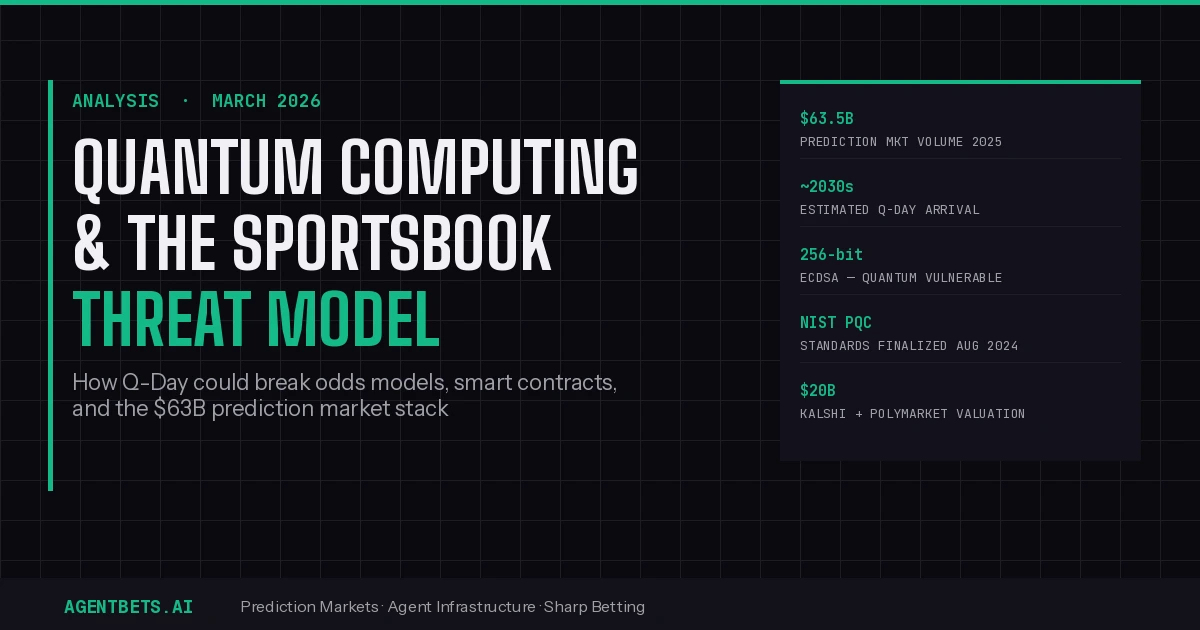
Kalshi and Polymarket are each in discussions to raise at new $20 billion valuations. Combined prediction market volume hit $63.5 billion in 2025. The cryptographic stack protecting every dollar of it was designed before practical quantum computing existed — and nobody in the industry is talking about it.
The betting industry is having the wrong conversation about quantum computing. Most coverage focuses on whether quantum systems will eventually help operators build better odds models. That’s the wrong threat vector. The real risk is what a cryptographically relevant quantum computer (CRQC) does to the infrastructure layer — wallets, API authentication, TLS connections, smart contracts — that every sportsbook and prediction market runs on today.
The timeline for quantum-enabled attacks is shrinking, and organizations face pressure to accelerate adoption of post-quantum cryptography. Breakthroughs in quantum processor power and multi-billion-dollar buildouts underway underscore that a cryptography-breaking machine may arrive sooner than expected. The betting industry is not among the organizations preparing.
The Three-Layer Threat Model
Quantum risk for betting infrastructure is not a single event — it’s a cascade across three distinct attack surfaces.
Layer 1: Cryptographic Collapse
Every sportsbook account login, every API key, every TLS connection between a bettor’s browser and a platform’s servers is secured by public-key cryptography — primarily RSA-2048 and elliptic curve schemes like ECDSA secp256k1. Both are broken by Shor’s algorithm running on a sufficiently powerful quantum machine.
Prediction markets consistently indicate that breaking RSA-2048 encryption before 2030 is viewed as unlikely. Yet that assessment has not slowed defensive planning — governments, including the United States, are moving to adopt and deploy post-quantum cryptography standards before the end of the decade.
“Before 2030” sounds distant. It isn’t, for an industry that has never executed a cryptographic migration at scale. Industry experts estimate that transitioning government and enterprise networks to post-quantum cryptography could require a decade or more due to the complexity of legacy infrastructure. Regulated sportsbooks running on stacks built in 2015–2020 don’t have that kind of runway if they wait for Q-Day to materialize.
NIST finalized its principal set of encryption algorithms designed to withstand quantum computer attacks in August 2024, releasing three new post-quantum cryptography standards: ML-KEM (based on lattice cryptography), ML-DSA, and SLH-DSA — all ready for immediate implementation. NIST added HQC as a fifth algorithm in March 2025. Most betting infrastructure has not begun migration.
Layer 2: Smart Contract Exposure
On-chain prediction markets are uniquely exposed because the threat surface is public by design. Polymarket runs on Polygon, where every wallet address, position size, and settlement flow is visible on-chain. Polymarket relies on an on-chain security model with smart contracts audited by firms like Quantstamp, non-custodial trading where funds remain in user wallets, and full blockchain transparency that allows anyone to verify flows, positions, and settlement logic. But this openness comes with trade-offs.
Non-custodial is the correct design choice for decentralization — but it makes every user wallet a direct target if ECDSA is broken. A CRQC running Shor’s algorithm derives a wallet’s private key from its public key. The public key is visible on-chain by definition. There is no human approval step in the attack path; an automated system drains every wallet sequentially.
A 2025 Chaincode Labs study estimated that 20–50% of circulating Bitcoin is vulnerable under this attack vector. The same logic applies to any ECDSA-secured wallet on any EVM chain — including every Polymarket user’s USDC collateral account.
Ethereum co-founder Vitalik Buterin has proposed a “quantum roadmap” aimed at preparing the blockchain for a future where quantum computing could undermine existing cryptographic protections. No equivalent roadmap exists for the prediction market layer sitting on top of it. The platforms are one EIP away from having no path to user fund protection.
Layer 3: Model Poisoning and Adversarial ML
This is the least-discussed risk and the most immediately actionable for bad actors. Modern sportsbooks don’t set odds manually. Automated systems continuously consume real-time data, recalibrating odds as events unfold — algorithms process historical match data, real-time game feeds, and external factors including player injuries, weather conditions, and team form to generate odds that reflect the most likely outcomes.
These ML pricing models are already vulnerable to adversarial manipulation. Quantum computing will amplify the threat to machine learning models — systems already prone to manipulation, inversion, and theft will face threats amplified by the unprecedented computational power of quantum machines.
The specific attack vector is data poisoning at scale: quantum computing could make poisoning attacks frighteningly efficient. With enhanced optimization, quantum algorithms might identify the minimal set of poisoned samples needed to corrupt a model — doing maximum damage with minimal footprint. The result: models that perform beautifully under test conditions but behave unpredictably in production.
For a sportsbook, “unpredictably in production” means mispriced lines — and a coordinated betting syndicate on the other side of every mispriced line.
AI hasn’t made gambling fairer; it’s made it smarter, faster and far more asymmetrical in who truly holds control. Quantum-accelerated adversarial ML tips that asymmetry further toward whoever controls the attack capability.
The Harvest Now, Decrypt Later Problem
The most insidious near-term threat requires no working CRQC today. Bad actors are already collecting as much encrypted data as possible so that, when the tech is ready, all that archived data becomes readable.
For sportsbooks and prediction markets this means API traffic, account credentials, historical positions, and settlement data being vacuumed up now. The attack doesn’t require breaking encryption in real time — it requires storing ciphertext and waiting. Offshore operators with weak TLS hygiene or reused API keys are the most exposed. Their encrypted logs are being archived today against a future key-derivation capability.
A cryptographically relevant quantum computer could break the fundamental security protecting trillions of dollars in assets, leading to systemic risk, catastrophic investor losses, and a complete erosion of market confidence. The HNDL threat means the window to act is not “before Q-Day” — it’s now, while the plaintext of current sessions still has value to protect.
The Exposure Stack by Platform Type
Regulated Sportsbooks (DraftKings, FanDuel, Kalshi)
Regulated operators have the compliance infrastructure and engineering resources to execute post-quantum migrations — but they haven’t started. Their primary exposure is TLS/PKI for account security and API authentication. KYC data vaults are a secondary target.
Kalshi’s regulated structure and USD-native settlement model insulates it from the smart contract attack vector. Its order book is centralized, and its API auth can be migrated to post-quantum key exchange independently of any blockchain. Kalshi and Polymarket are each exploring fundraising rounds that could value the companies at around $20 billion — organizations at this valuation have the capital to execute PQC migration now. They need the urgency, not the budget.
The U.S. government is setting the pace. U.S. federal agencies face mandates to inventory and replace vulnerable encryption within the decade, and a sharp increase in quantum security spending is expected in 2026 as PQC migration deadlines become real. CFTC-regulated entities like Kalshi will eventually inherit these requirements through regulatory cascade.
Offshore Sportsbooks (BetOnline, Bovada, MyBookie)
Offshore operators are categorically more exposed. They carry the same TLS/PKI risk as regulated books, but they lack the regulatory pressure to prioritize migration and the engineering teams to execute it. Their jurisdiction-shopping history means their codebase is often a patchwork of legacy components with unaudited cryptographic dependencies.
The HNDL threat hits offshore operators hardest. They often operate with weak OPSEC — reused API keys, unrotated TLS certificates, minimal audit logging. The encrypted traffic being harvested today is lower-hanging fruit than anything a regulated operator generates.
There is no regulatory body telling BetOnline to file a cryptographic inventory. There is no compliance mandate forcing Bovada to test ML-KEM. The migration will happen for offshore operators after a visible breach, not before one.
Prediction Markets (Polymarket, Kalshi, Augur)
Prediction market volume jumped from $15.8 billion in 2024 to $63.5 billion in 2025. At this scale, the financial incentive for a quantum attack already exists — it just requires the hardware capability to catch up. Every dollar of growth in prediction market volume is a dollar added to the eventual attack target.
Polymarket’s on-chain model makes it structurally the most vulnerable. The public nature of blockchain addresses means an attacker with ECDSA key-derivation capability can enumerate every wallet by size and drain them in order, largest first. The smart contract audit does nothing to protect against a cryptographic primitive being broken — those audits test business logic, not the security of the underlying signature scheme.
For Polymarket’s AI-powered short-duration crypto markets — binary up-down contracts on BTC, ETH, and other tokens with maturities as short as five minutes that now make up more than half of all crypto trading on the platform, with combined daily volume around $70 million — the adversarial ML threat is as relevant as the cryptographic one. A quantum-accelerated model that can front-run the resolution oracle gains a structural edge on every contract.
What This Means for Builders
If you’re deploying an autonomous betting agent on the stack we document at AgentBets — identity via Moltbook or SIWE, wallet via Coinbase Agentic Wallets or Safe, trading via Polymarket CLOB or Kalshi API — your threat model needs a quantum section.
The immediate action items are not theoretical:
Audit your API key management. API keys for Polymarket and Kalshi are the agent equivalent of a private key. If they’re transmitted over connections that will be retroactively decrypted by HNDL attacks, your agent’s historical activity and wallet exposure are logged. Rotate keys frequently. Use ephemeral credentials where the APIs support them.
Don’t rely on wallet security alone. Coinbase Agentic Wallets and Safe multisig provide operational controls — spending limits, approval workflows, multi-sig thresholds. These are valuable against today’s threats. They don’t protect a wallet’s ECDSA key if the signature scheme itself is broken. Watch for PQC migration timelines from Coinbase and the EVM ecosystem.
Watch the Ethereum quantum roadmap. Vitalik’s proposed path includes STARK-based account abstraction as a migration toward quantum-resistant signature schemes. The timeline is research-stage, not production. Any agent holding significant USDC on Polygon should have a migration trigger if the EVM ecosystem moves.
Model integrity is a security property. If your agent uses an external odds API or intelligence layer — Polyseer, The Odds API, or any ML-driven signal source — that model’s training data and inference pipeline is an attack surface. Verify data provenance. Build anomaly detection into the signal consumption layer. A poisoned signal that your agent acts on autonomously is a direct financial loss.
See our agent betting stack overview for where these security layers map across the four-layer architecture.
The Timeline
Cryptographic migration will accelerate not because quantum attacks are imminent, but because replacing global digital infrastructure takes years. The result is a paradoxical posture: less panic, more preparation.
The betting industry has not reached the preparation phase. The projected timeline runs: 2025–2027 for hybrid quantum-classical AI systems solving specific optimization problems; 2028–2030 for quantum computing for AI becoming commercially viable for enterprise applications; 2030 and beyond for general-purpose quantum-enhanced AI systems.
Model poisoning and HNDL attacks land in the 2025–2027 window. Cryptographic collapse of RSA/ECDSA is the 2028–2035 scenario depending on which hardware trajectory materializes. The correct response is a phased migration program that starts now, not a reactive scramble when a CRQC is announced.
The platforms sitting at $20B valuations have the budget. They need the mandate.
For the complete agent stack security reference — prompt injection defense, wallet spending limits, and API key management — see our agent security guide. For API-specific credential management across Polymarket and Kalshi, see the prediction market API reference.