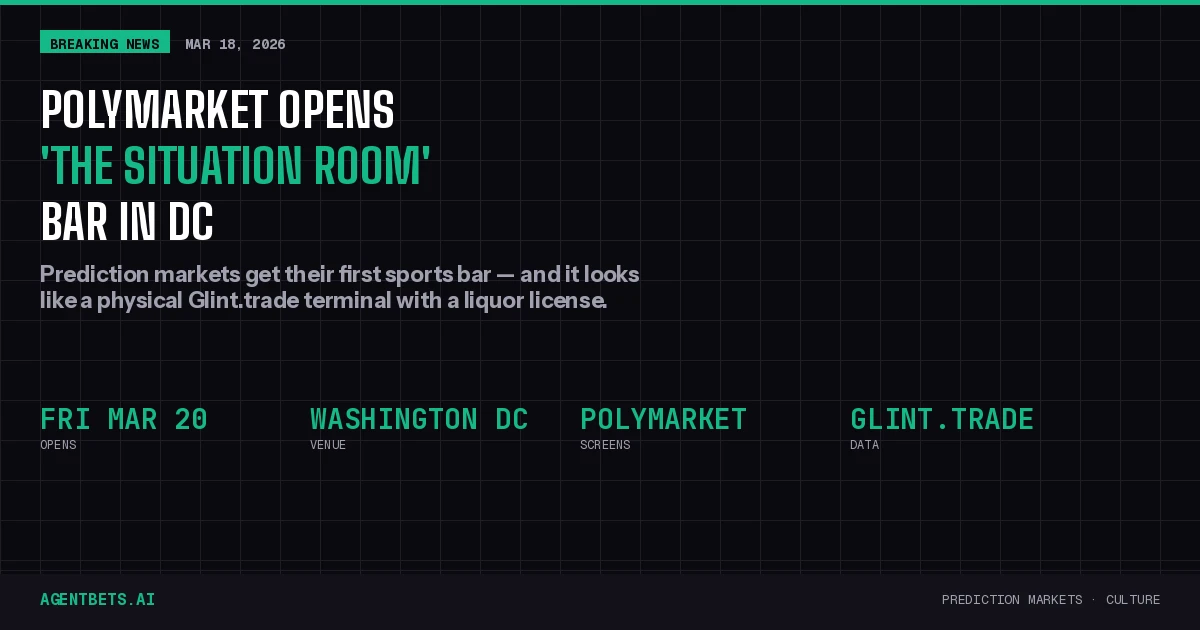
Polymarket is opening a bar in Washington, D.C. called The Situation Room — walls of prediction market screens, Bloomberg terminals, flight radar, and live X feeds. It’s what happens when you take Glint.trade’s real-time intelligence terminal and pour it into a physical space with a liquor license. Grand opening is Friday.
What Happened
Polymarket announced on X on March 18, 2026 that “The Situation Room” is coming to Washington, D.C. The pitch: a sports bar, but instead of ESPN on every screen, patrons watch live prediction market odds, X/Twitter feeds, flight radar, and Bloomberg terminal data.
The grand opening is scheduled for Friday, March 20. Polymarket hasn’t disclosed the exact address — a move that generated immediate speculation. D.C. locals noted it could be a temporary takeover of an existing venue, similar to Polymarket’s February 2026 pop-up “free grocery store” in New York, which drew thousands of visitors and included a $1 million donation to Food Bank For NYC.
The concept image shows a dark, multi-screen environment with a central digital globe — a visual that will look immediately familiar to anyone who has used Glint’s Vision Terminal.
This Is a Physical Glint Terminal
If you’ve used Glint.trade, you’ve already seen The Situation Room in digital form.
Glint is the Polymarket-backed real-time intelligence platform that aggregates signals from X, Telegram, news wires, OSINT sources, and military flight tracking data, then uses AI to classify each signal by impact level (Critical, High, Medium, Low) and automatically match it to relevant Polymarket contracts. Its Vision Terminal renders all of this on a 3D globe with whale trade positions overlaid.
The Situation Room bar is that experience made physical. Replace your laptop screen with a wall of monitors. Replace Glint’s feed filters with a bartender. The core loop is identical: signal appears → AI classifies impact → market reprices → you trade (or in this case, argue with the person next to you about whether the market is mispriced).
The naming is deliberate. The White House Situation Room is where the president monitors crises with classified intelligence feeds. Polymarket’s version positions prediction market participants as doing the same thing — aggregating open-source intelligence to price real-world outcomes — but with drinks and skin in the game.
The Agent Infrastructure Angle
Sports bars exist because sports betting became mainstream. ESPN, DraftKings, and FanDuel built the culture layer that made it normal to have odds on-screen in a public venue. The Situation Room signals that prediction markets are building the same culture layer — and the infrastructure is already there.
Consider what’s running behind the screens at The Situation Room. The data pipeline feeding those monitors is functionally the same stack that autonomous trading agents use:
- Signal ingestion: The same X feeds, news wires, and OSINT sources that agents parse through tools like Polyseer’s multi-agent architecture
- Market data: Live Polymarket odds pulled from the same CLOB API that bots use to place orders via
py-clob-client - Flight tracking: The same ADSB data that geopolitical agents use to detect military mobilizations before markets reprice
- Impact classification: AI-driven signal scoring — Glint’s pipeline classifies signals into 12 categories with relevance scores, exactly the kind of preprocessing an intelligence-layer agent performs before sizing a position
The bar is a spectator view of what agents do programmatically. Patrons watch the same signal-to-market flow that a well-architected Polymarket trading bot executes autonomously — except the bot doesn’t need to wait for a bartender.
This also matters for the wallet layer. Polymarket already supports trading via embedded wallets through Privy (which Glint uses for inline trading). A patron at The Situation Room watching a market move could theoretically open Glint on their phone, see the matched signal, and execute a trade through their embedded wallet before the screen behind the bar even updates. Coinbase Agentic Wallets take this further — an agent running on the bar’s own infrastructure could autonomously trade based on the same feeds displayed on the walls.
What This Means for Builders
The Situation Room isn’t just a marketing stunt (though it’s that too). It represents a meaningful shift in how prediction markets enter public consciousness:
Prediction market bars > sports bars for information traders. Sports bars work because the outcome is binary (your team wins or loses) and the timeline is fixed (the game ends at 10 PM). Prediction markets have the same properties but for everything — geopolitics, economics, tech, weather. The Situation Room tests whether that’s enough to build a social venue around.
The Glint pipeline becomes a venue format. If this works, expect Glint-powered installations in co-working spaces, trading floors, and other bars. The AI signal classification → market matching → trade execution pipeline isn’t just a web app — it’s a spatial experience. Builders working with the Polymarket API ecosystem should pay attention to how physical displays consume the same data their bots do.
Community surfaces accelerate the ecosystem. The prediction market agent ecosystem is still small. Physical gathering points — even temporary ones — create the kind of in-person network effects that Discord and Telegram can’t replicate. If you’re building tools in the agent betting stack, the people watching those screens in D.C. on Friday are your early adopters.
The timing is also notable: this drops during March Madness, when every traditional sports bar in America is packed with NCAA basketball. Polymarket is making a deliberate counter-programming statement — you can watch the games, or you can monitor the situation.