TL;DR — PBot1 is a live automated trader on Polymarket operating from wallet
0x88f46b9e5d86b4fb85be55ab0ec4004264b9d4db. The naming convention (“PBot” + number) strongly suggests a programmatic bot instance, likely one of several. We break down the probable strategy, architecture, and how you’d build a replica using the agent betting stack.
Who Is PBot1?
PBot1 is a Polymarket account that does not hide what it is. The username follows the classic bot-naming pattern: platform prefix + “Bot” + instance number. This isn’t a human trader who picked a quirky handle — it’s an operator who registered a bot and didn’t bother disguising it.
The wallet address 0x88f46b9e5d86b4fb85be55ab0ec4004264b9d4db is a Polymarket proxy wallet on Polygon, meaning PBot1 created its account through Polymarket’s standard onboarding flow. The “1” suffix implies there are (or were) additional instances — PBot2, PBot3, etc. — likely running variations of the same strategy or splitting capital across multiple wallets to manage risk and avoid detection thresholds.
This pattern is common among serious Polymarket bot operators. Running multiple wallets lets you distribute capital, test strategy variants simultaneously, and avoid having a single wallet that draws attention on the leaderboard.
What Markets Does PBot1 Likely Trade?
Without rendering the full JavaScript-dependent Polymarket profile (the positions and activity data require client-side execution), we can infer the likely market focus from what dominates bot activity on Polymarket in 2026.
The overwhelming majority of bot volume concentrates in 15-minute crypto Up/Down markets — specifically BTC, ETH, and SOL binary contracts. These markets resolve every 15 minutes based on whether the asset’s price moved up or down from the window’s opening price. They’re ideal for bots because:
- High frequency: 96 markets per day per asset = thousands of trading opportunities
- Binary outcomes: Simple YES/NO resolution eliminates complex multi-outcome modeling
- Deterministic resolution: The outcome is determined by on-chain price feeds (Chainlink/UMA), not subjective judgment
- Thin liquidity windows: Brief mispricings appear constantly as human traders react slowly to spot price movements
The second-most-likely category is event-driven markets (politics, sports, news), where bots with information advantages — faster news ingestion, sentiment analysis, or direct data feeds — can front-run probability shifts before the broader market reprices.
Given the “PBot1” naming convention (minimal effort, functional), this looks like a crypto market bot rather than a sophisticated event-driven system. Event-driven bots tend to have more opinionated names or no username at all.
Probable Strategy: What PBot1 Is Doing
Based on the dominant profitable bot strategies documented on Polymarket through early 2026, PBot1 is most likely running one of four approaches — or a combination.
Strategy 1: Temporal Arbitrage (Most Likely)
This is the dominant winning strategy for Polymarket crypto bots. The approach exploits the latency gap between confirmed spot prices on exchanges like Binance and Coinbase and Polymarket’s contract prices.
Here’s how it works:
1. BTC moves +0.3% on Binance in the first 8 minutes of a 15-min window
2. Polymarket's UP contract is still priced at $0.55 (lagging the confirmed move)
3. Bot buys UP at $0.55, knowing the true probability is already ~85%+
4. Window resolves UP → bot collects $1.00 per share, nets $0.45 minus fees
The edge is pure speed. The bot monitors exchange WebSocket feeds in parallel with Polymarket’s orderbook and enters positions the moment spot movement confirms a direction but before Polymarket reprices. One documented bot using this strategy turned $313 into $414,000 in a single month with a 98% win rate.
The risk: BTC can reverse in the final minutes, and entry at $0.55 means a loss of $0.55 per share on a reversal. The math only works with extremely high accuracy on directional calls.
Strategy 2: Complete-Set Arbitrage
This is the mathematically simplest and lowest-risk approach. The bot monitors both YES and NO prices on a given market. When the combined cost drops below $1.00 (say, YES at $0.48 + NO at $0.49 = $0.97), the bot buys both sides.
One side will pay $1.00 at resolution. Cost was $0.97. Guaranteed $0.03 profit per share regardless of outcome.
The catches:
- These opportunities are rare and fleeting (average duration under 3 seconds in 2026)
- Profits per trade are tiny ($0.01–$0.03 per share)
- You need sub-100ms execution to capture them before other bots
- You need to fill both legs — partial fills create directional exposure
This strategy produces the signature “linear PnL curve” that many top Polymarket bots exhibit. If PBot1’s positions show thousands of small, consistently profitable trades with near-zero variance, this is the strategy.
Strategy 3: Market Making
Market making bots provide liquidity on both sides of a market and earn the bid-ask spread. On Polymarket, this also qualifies for liquidity rewards, creating a dual income stream.
Bot posts: BUY YES at $0.48, SELL YES at $0.52
Spread = $0.04 per round trip (8.3% gross margin)
+ Polymarket liquidity rewards
Market making requires continuous order management, dynamic spread adjustment based on volatility, and careful inventory management to avoid accumulating a large directional position. It’s capital-intensive (you need $10K+ deployed to generate meaningful returns) but produces the steadiest returns when done correctly.
The open-source poly-maker bot provides a reference implementation, though its author notes it’s no longer profitable without significant customization given increased competition.
Strategy 4: Late-Window Momentum Snipe
This strategy enters positions in the final 1–2 minutes of a 15-minute window when the direction is statistically locked. If BTC has moved +0.4% with 90 seconds remaining, the probability of reversal is extremely low.
The problem: by this point, the market has already repriced. UP might cost $0.95+. If you buy at $0.95 and win, you net $0.05. If you lose, you lose $0.95. You need a 95%+ win rate just to break even, and real-world win rates at these price points tend to land around 85-90% — which means net losses.
This is the strategy that kills most retail bot operators. The backtest looks incredible (97%+ win rate at the 0.20% threshold), but live execution at the prices actually available is a different story.
How PBot1 Was Probably Built
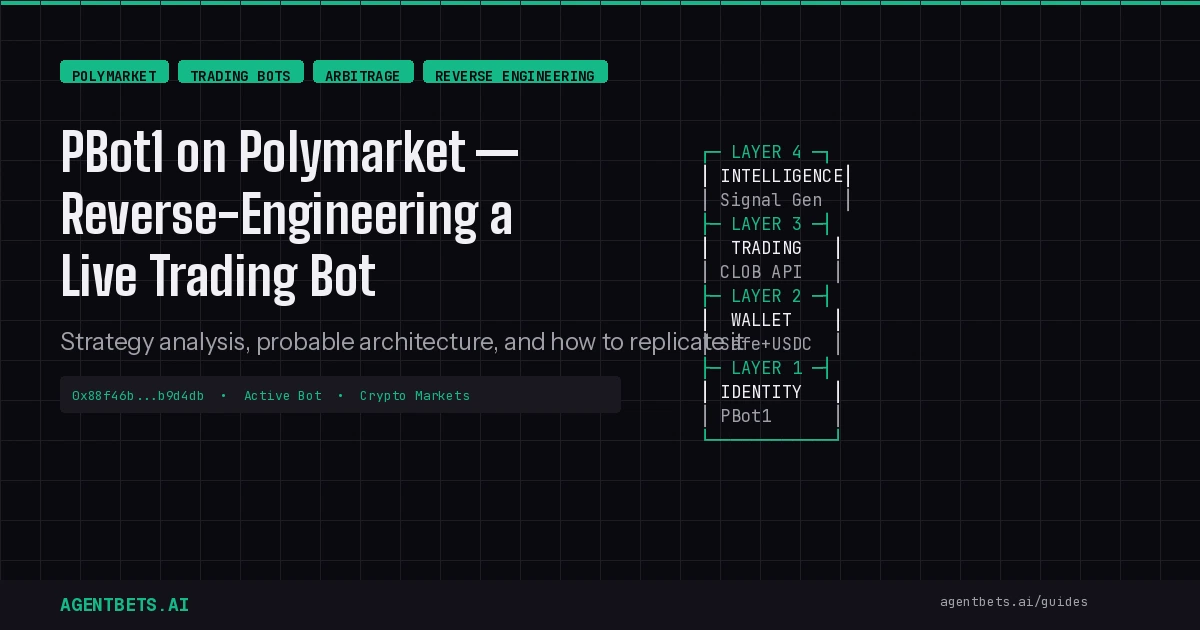
Mapping PBot1 to the agent betting stack, the architecture likely looks like this:
┌─────────────────────────────────────────────────┐
│                 LAYER 4: INTELLIGENCE            │
│  Signal generation (exchange feed → strategy)    │
│  - Binance/Coinbase WebSocket for spot prices    │
│  - Polymarket WebSocket for contract prices      │
│  - Strategy logic (arb detection / momentum)     │
└──────────────────────┬──────────────────────────┘
                       │
┌──────────────────────▼──────────────────────────┐
│                 LAYER 3: TRADING                 │
│  Order execution via Polymarket CLOB API         │
│  - py-clob-client or @polymarket/clob-client     │
│  - EIP-712 order signing                         │
│  - Fill-or-kill (FOK) order management           │
└──────────────────────┬──────────────────────────┘
                       │
┌──────────────────────▼──────────────────────────┐
│                 LAYER 2: WALLET                  │
│  Polygon Safe wallet with USDC                   │
│  - Gasless transactions via Builder Program      │
│  - L1 private key + L2 API credentials           │
└──────────────────────┬──────────────────────────┘
                       │
┌──────────────────────▼──────────────────────────┐
│                 LAYER 1: IDENTITY                │
│  Polymarket proxy wallet (standard onboarding)   │
│  - Username: PBot1                               │
│  - No additional reputation/attestation layer    │
└─────────────────────────────────────────────────┘
The tech stack is almost certainly Python-based, using py-clob-client for Polymarket API access. The alternative is TypeScript with @polymarket/clob-client, but Python dominates the Polymarket bot ecosystem due to its data science libraries and the availability of open-source reference implementations.
Key Infrastructure Components
Data ingestion: Real-time price feeds via WebSocket connections to both exchange APIs (Binance, Coinbase) and Polymarket’s CLOB WebSocket at wss://ws-subscriptions-clob.polymarket.com/ws/. REST polling is too slow — even 1-second polling intervals miss opportunities in the 15-minute crypto markets.
Order execution: Polymarket’s CLOB API supports limit orders, market orders, and fill-or-kill (FOK) orders. FOK is critical for arbitrage — you need the entire order to fill at your target price, or not at all. Partial fills on one leg of a two-sided arb trade create unhedged directional exposure.
Rate limits: Approximately 60 orders per minute on authenticated endpoints, 100 requests per minute on public endpoints. The bot needs exponential backoff for HTTP 429 responses and should batch operations where possible.
Hosting: Almost certainly running on a VPS (DigitalOcean, AWS, or similar) rather than locally. Low-latency connectivity to Polymarket’s infrastructure matters — every millisecond of delay is a disadvantage against competing bots.
How to Replicate PBot1
If you wanted to build a PBot1-equivalent, here’s the minimum viable stack. For a deeper walkthrough on the trading layer, see our Polymarket API guide and the agent wallet comparison for wallet setup.
Step 1: Wallet Setup (Layer 2)
Create a Polymarket account, which generates a proxy wallet on Polygon. Fund it with USDC via bridge from Ethereum or direct transfer from an exchange that supports Polygon. For gasless trading, apply for Polymarket’s Builder Program — this eliminates gas fees on order placement.
Step 2: API Access (Layer 3)
Generate L2 API credentials (key, secret, passphrase) through the Polymarket settings or programmatically via py-clob-client. Your bot authenticates with HMAC-SHA256 signed requests.
from py_clob_client.client import ClobClient

client = ClobClient(
    host="https://clob.polymarket.com",
    chain_id=137,
    key=PRIVATE_KEY,
    creds=ApiCreds(
        api_key=API_KEY,
        api_secret=API_SECRET,
        api_passphrase=API_PASSPHRASE
    ),
    signature_type=2  # Safe/proxy wallet
)
Alternatively, the new Polymarket CLI (Rust-based) provides a terminal interface for browsing markets, placing orders, and managing positions — useful for testing before going fully programmatic.
Step 3: Data Pipeline (Layer 3 + 4)
Subscribe to Polymarket’s WebSocket for live orderbook data. Simultaneously connect to Binance or Coinbase WebSocket for spot price feeds. Your strategy logic sits between these two streams, watching for divergence.
# Pseudocode for temporal arbitrage signal
if binance_btc_change > 0.25% and polymarket_up_price < 0.60:
    signal = BUY_UP
    confidence = calculate_confidence(time_remaining, magnitude)
    if confidence > threshold:
        execute_order(market_id, side="YES", price=polymarket_up_price)
Step 4: Risk Management
This is where most replicas fail. Critical guardrails:
- Position sizing: Never risk more than 2-5% of capital per trade. Use fractional Kelly criterion for optimal sizing.
- Daily loss cap: Auto-halt trading if daily losses exceed a threshold (5-10% of bankroll).
- Kill switch: Ability to cancel all open orders and halt the bot immediately.
- Fill monitoring: Track partial fills aggressively — a half-filled arb trade is a naked directional bet.
Is PBot1’s Strategy Actually Working?
Without access to PBot1’s rendered P&L data, we can make inferences from the broader Polymarket bot landscape:
The bull case: Bots running temporal arbitrage on crypto markets have produced documented returns of 100x+ over months. The strategy is mathematically sound when execution is fast enough. PBot1’s continued activity suggests it hasn’t blown up — inactive bots stop trading.
The bear case: Competition has intensified dramatically. Average arbitrage opportunity windows have compressed from 12+ seconds in 2024 to under 3 seconds in 2026. Sub-100ms institutional bots now capture 73% of arbitrage profits. A bot named “PBot1” with standard infrastructure (no custom co-located servers) is likely operating at a speed disadvantage.
The realistic case: PBot1 is probably marginally profitable on a combination of arbitrage and momentum, generating small but consistent returns that compound over time. The “1” suffix suggests the operator tested this configuration and may have deployed improved versions under different names.
For tools to track PBot1’s performance yourself, check Polymarket Analytics — you can paste the wallet address and see full P&L breakdowns, market category distribution, and win rates.
What This Means for Builders
PBot1 represents the current floor for Polymarket bot sophistication. It’s a functional, active bot with standard infrastructure — no fancy name, no disguised identity, no exotic strategy. It exists because the Polymarket ecosystem makes it straightforward to deploy automated traders.
The barriers to entry are low: an open API, gasless transactions, public orderbook data, and multiple open-source reference implementations. The barriers to profitability are high: sub-second execution, sophisticated risk management, and strategies that account for the 2% fee structure and competition from faster operators.
If you’re building in this space, start with our agent betting stack overview for the full architecture, the Polymarket API reference for trading layer details, and the marketplace for tools that can accelerate development. The intelligence layer — whether that’s a custom ML model, Polyseer for multi-agent analysis, or an LLM-powered pipeline using Claude — is where differentiation happens in 2026.
The trading infrastructure is commoditized. The alpha is in signal generation.