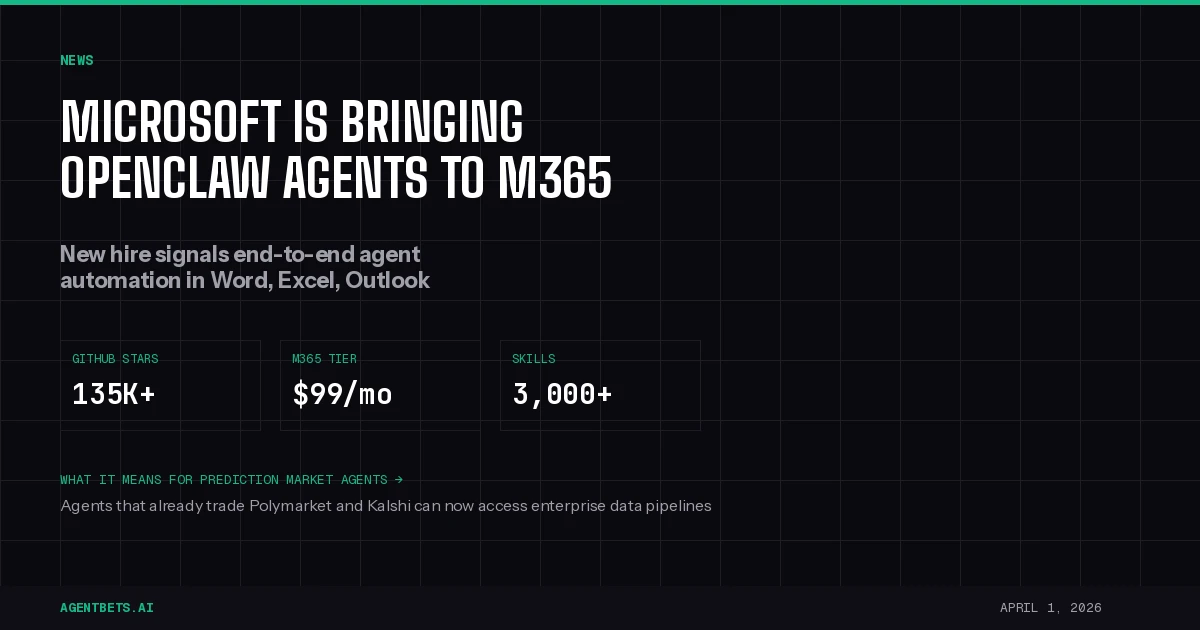
Microsoft is bringing OpenClaw agents to Microsoft 365. On March 31, 2026, the company announced it hired Omar Shahine to lead the effort, with a stated goal of building proactive workplace assistants that handle tasks end-to-end across Word, Excel, Outlook, and Teams. For anyone building autonomous betting or prediction market agents on OpenClaw, this is a structural shift worth tracking.
What Microsoft Actually Announced
Shahine’s announcement on X was direct: he plans to partner with the OpenClaw and M365 community to bring personal agent capabilities to Microsoft’s productivity suite. He described a vision of agents that lighten workloads by taking on tasks end-to-end and stepping in proactively when they can.
This is not a standalone initiative. It sits within Microsoft’s broader agentic AI push that includes Copilot Cowork (now available via the Frontier program), the new M365 E7 AI subscription tier at $99/user/month, and the Agent 365 identity framework that gives agents their own user accounts in a tenant — separate from traditional OAuth “on behalf of” flows.
The infrastructure groundwork is already laid. Microsoft published an Azure VM deployment guide for running OpenClaw on enterprise infrastructure, and a community-built openclaw-a365 project provides native M365 Agents channel integration with Graph API tools for calendar, email, and user operations.
From Hacker Tool to Enterprise Runtime
OpenClaw has moved fast. The framework — created by Peter Steinberger and originally known as Clawdbot — hit 135,000+ GitHub stars within weeks of launch. Its skill ecosystem now exceeds 3,000 plugins spanning everything from email management to financial analysis.
The M365 integration changes OpenClaw’s surface area dramatically. Previously, an agent running locally could manage your inbox and calendar through Graph API skills. Now Microsoft is positioning OpenClaw as a first-class citizen inside the suite used by over 400 million people — with agentic identity, explicit consent models, and enterprise governance controls.
This also follows a March 17 leadership restructuring where Microsoft AI CEO Mustafa Suleyman shifted focus to model science and the superintelligence mission, while Ryan Roslansky, Perry Clarke, and Charles Lamanna took over M365 apps and the Copilot platform. The OpenClaw hire sits at the intersection of these two tracks: frontier agent capabilities meeting enterprise distribution.
Why This Matters for Prediction Market Agents
Here is where it gets interesting for the agent betting stack. OpenClaw already has a deep skill ecosystem for prediction markets and sports betting — and AgentBets has documented most of it:
| Skill | Function | Guide |
|---|---|---|
| Polymarket Monitor | Track price movements, volume spikes, new listings | Build guide |
| Kalshi Tracker | Monitor contract prices, order book depth, trades | Build guide |
| Odds Scanner | Fetch live odds from 20+ sportsbooks via The Odds API | Build guide |
| EV Calculator | Calculate expected value for any bet | Build guide |
| Kelly Sizer | Optimal bet sizing with fractional Kelly variants | Build guide |
| Arb Finder | Detect arbitrage across sportsbooks and prediction markets | Build guide |
| Sharp Line Detector | Monitor steam moves and reverse line movement at Pinnacle | Build guide |
| Cross-Market Pricer | Normalize odds across Polymarket, Kalshi, and sportsbooks | Build guide |
| CLV Tracker | Track Closing Line Value — the gold standard edge metric | Build guide |
| Bankroll Manager | Track bankroll across sportsbooks, Polymarket, and Kalshi | Build guide |
| News Sentiment Scanner | Scan news feeds for market-moving events and score urgency | Build guide |
With M365 integration, the data pipeline gets substantially wider. Consider a concrete workflow:
Outlook integration — An agent monitors your email for earnings reports, regulatory filings, or injury reports that affect prediction market positions. The News Sentiment Scanner already scores urgency; Outlook adds a proprietary information stream.
Excel integration — The EV Calculator and Kelly Sizer can read from and write to Excel models. A portfolio manager could maintain a master spreadsheet of positions, and the agent updates implied probabilities and sizing recommendations in real time.
Teams integration — Push trade alerts, edge notifications, and CLV reports to a Teams channel. A team of analysts sharing a betting operation gets structured alerts instead of scattered Telegram messages.
OneDrive integration — Store historical odds snapshots, backtest results, and performance logs in a structured file system accessible to the agent across sessions.
This is the Layer 4 Intelligence vision made concrete. Agents that already compose modular skills for market monitoring, pricing, and execution now gain access to the data layer where most professional research actually lives — email, spreadsheets, and shared documents.
The Security Problem Has Not Gone Away
The opportunity comes with serious caveats. Microsoft’s own security blog published in February 2026 stated bluntly that OpenClaw should be treated as untrusted code execution with persistent credentials and is not appropriate for standard enterprise workstations.
The track record backs up the concern. CVE-2026-25253 was a one-click remote code execution vulnerability with a CVSS score of 8.8. Censys identified over 21,000 exposed OpenClaw instances publicly accessible on the internet. And 335 malicious skills were distributed through ClawHub — OpenClaw’s public marketplace — disguised with professional documentation and innocuous names.
For agent builders working with financial data and betting accounts, the attack surface is real. A compromised OpenClaw instance connected to sportsbook APIs and wallet credentials is a direct path to fund exfiltration. The agent betting stack framework addresses this at Layer 1 (Identity) and Layer 2 (Wallet), but the M365 integration adds a new dimension: an agent with enterprise email access could be manipulated through prompt injection embedded in incoming messages.
Microsoft’s proposed mitigation — deploying OpenClaw in fully isolated VMs with dedicated credentials and continuous monitoring — is sound but adds operational complexity that most individual agent builders will not implement.
What to Watch Next
Three developments will determine whether this integration meaningfully changes the agent betting landscape:
Copilot Cowork and agent permissions. The Frontier program rollout will reveal how much autonomy Microsoft actually grants to third-party agent runtimes like OpenClaw inside M365. Enterprise governance controls could either enable or throttle betting-relevant workflows.
Skill marketplace curation. The ClawHub malicious skill problem needs a solution before enterprise adoption scales. For prediction market skills specifically, the OpenClaw framework already has a solid base, but quality control at 3,000+ skills is a different challenge than at 18.
MCP convergence. OpenClaw’s skill system and the Model Context Protocol are converging. As M365 exposes more Graph API capabilities through MCP-compatible interfaces, betting agents could access enterprise data through standardized tool protocols rather than custom Graph API plumbing.
The bigger picture is structural. When Microsoft positions an open-source agent runtime inside its productivity suite, it validates the thesis that autonomous agents are moving from developer experiments to production infrastructure. For prediction market agents, the question shifts from “can agents trade markets?” to “what data and decision pipelines can agents access?” — and M365 just made that answer a lot broader.
Further Reading
- OpenClaw for Prediction Markets: Agent Builder’s Guide — comprehensive guide to using OpenClaw for prediction market and sports betting automation
- The Agent Betting Stack — the four-layer architecture for autonomous betting agents
- OpenClaw vs Olas Polystrat — comparison of the two leading agent frameworks for prediction market trading
- Composable Agent Tools for Prediction Markets — how modular skills and MCP servers enable autonomous trading