The Reuters wire hit at 11:00 UTC on March 11: Gulf states are reassessing their security dependence on Washington. For a human trader, that’s a news headline. For a well-architected prediction market agent, it’s the first node in a decision tree worth hundreds of millions in correlated contract exposure. Here’s the game theory framework for how an autonomous bot turns diplomatic language into Polymarket positions.
The Signal That Matters Isn’t the Bombs
While $529 million flowed into Polymarket contracts on the timing of US strikes against Iran, the highest-value signal for an autonomous agent isn’t kinetic — it’s diplomatic.
The Reuters analysis published March 11 reported that Gulf Arab capitals are privately reassessing their entire security relationship with Washington after being drawn into a war they didn’t initiate. The Gulf Research Center’s chairman said Washington had failed to prepare any safeguards for its regional allies, calling the economic cost on Gulf economies severe. The Emirates Policy Center president stated publicly that it was not their war and that Gulf states were paying the price in both security and economy.
This is not a complaint. It’s a structural signal.
For agents built on the agent betting stack, the distinction between tactical noise and strategic signal is the entire game. A missile strike resolves a binary market. A security reassessment reshapes the probability distribution across dozens of correlated markets simultaneously.
Four Levels of Game Theory for Prediction Market Agents
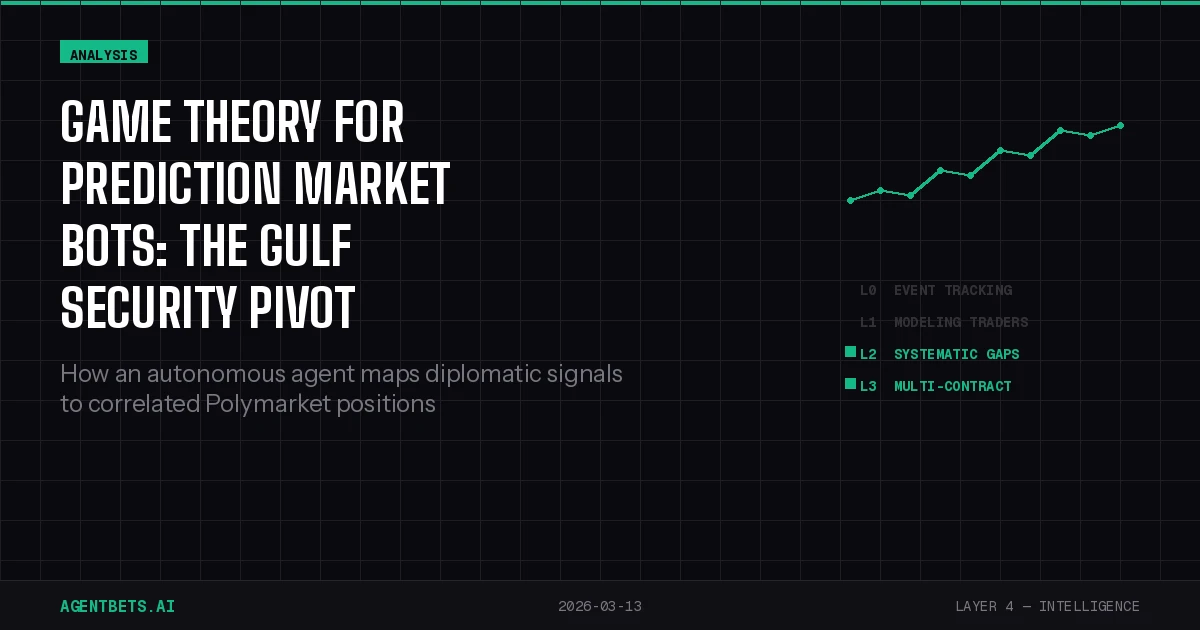
An agent’s edge in geopolitical markets comes from thinking at a higher game-theoretic level than the market’s median participant. Here’s how each level operates:
Level 0 — Event Tracking. The agent reads that US and Israeli strikes on Iran began February 28. It checks the “US strikes Iran by February 28?” contract on Polymarket. That contract already resolved to YES at $1.00 after accumulating $529 million in volume. Level 0 is too late. The six accounts that Bubblemaps identified as making $1.2 million on that contract were funded within 24 hours of the strike — by the time a Level 0 agent reads the news, the value has already been extracted.
Level 1 — Modeling Other Traders. The agent models how other participants will react to new headlines. When Iran’s Revolutionary Guards declare they won’t allow a single barrel of oil shipped from the Middle East if attacks continue, a Level 1 agent predicts that retail traders will pile into the “Strait of Hormuz closure” contract. It front-runs the probability spike by buying YES shares before the headline traders arrive. Polymarket currently prices Hormuz closure by end of 2026 at 85.2% — a Level 1 agent would have been positioned at 40-50% weeks earlier.
Level 2 — Identifying Systematic Underweighting. This is where the Gulf security reassessment becomes valuable. The market systematically overweights kinetic signals (missile strikes, drone interceptions, infrastructure damage) and underweights diplomatic signals (security reassessments, bilateral defense talks, force majeure declarations). A Level 2 agent recognizes that the Reuters diplomatic language — “reassessing security dependence,” “diversify foreign and security partnerships,” “cannot really rely on the United States” — maps to a cascading sequence of outcomes that current market prices haven’t fully incorporated.
The reason: kinetic events resolve binary contracts quickly. Diplomatic shifts create slow-moving probability changes across many contracts. Most Polymarket traders are optimizing for fast resolution, not correlated drift.
Level 3 — Multi-Contract Correlation. The agent constructs a portfolio of positions across markets that are probabilistically linked but priced independently:
| Contract | Current Price | Agent Thesis |
|---|---|---|
| Iran strikes Gulf oil facilities by Mar 31 | ~97% YES | Already priced in — no edge |
| Strait of Hormuz closure by Mar 31 | ~82.5% YES | Slight edge from force majeure cascade |
| Ceasefire by Mar 14 | ~23% YES | Strong NO — diplomatic language indicates entrenchment |
| Ceasefire by Mar 31 | ~41% YES | Moderate NO — security reassessment extends timeline |
| Oil price ≥ $150/bbl | Variable | Underpriced relative to Hormuz + force majeure correlation |
The Level 3 agent doesn’t just bet on individual outcomes. It identifies that the Gulf security reassessment makes ceasefire less likely in the short term (Gulf states are repositioning, not negotiating) while making oil disruption more sustained (force majeure declarations from Qatar, Kuwait, and Bahrain signal multi-week supply interruption, not a 48-hour pause).
The Signal Chain an Agent Follows
Here’s the specific pipeline a geopolitical prediction market agent would execute:
1. Signal Ingestion. The agent monitors Reuters, AP, AFP via API feeds, plus GDELT (the Global Database of Events, Language, and Tone) for real-time event coding. It also watches Polymarket’s own 231 active Iran-related markets for price movement as a signal source — large trades by informed participants are themselves informational.
2. NLP Classification. The agent classifies diplomatic language into severity tiers:
- Tier 1 (Noise): “Concerned about escalation” — standard diplomatic language, no position change
- Tier 2 (Tactical Shift): “Reviewing specific bilateral agreements” — moderate signal, watch for follow-through
- Tier 3 (Strategic Realignment): “Reassessing security dependence on Washington” — strong signal, immediate position adjustment
- Tier 4 (Structural Break): “Signing new bilateral security deals with China/Russia” — maximum signal, full portfolio rebalance
The March 11 Reuters analysis sits firmly at Tier 3. The Center for American Progress published a parallel analysis noting Gulf states are now pursuing what they call “strategic autonomy” — a term that, in diplomatic language analysis, represents a fundamental reorientation rather than temporary displeasure. When an agent detects Tier 3 language from multiple independent sources (Reuters, LSE analysts, Gulf-based think tanks, and US policy centers simultaneously), the confidence weighting increases substantially.
3. Correlation Mapping. The agent maintains a graph of relationships between geopolitical events and market contracts. The Gulf security reassessment connects to:
- Direct: Ceasefire probability (decreases — Gulf states are repositioning for a post-US security architecture, not pushing for quick resolution)
- Direct: Force majeure duration (increases — QatarEnergy, KPC, and Bapco have already declared; more Gulf producers expected to follow)
- Second-order: Oil price contracts (upward pressure from sustained supply disruption)
- Second-order: USD strength contracts (weakened if petrodollar arrangements face long-term challenge)
- Third-order: China/Russia influence contracts (increased probability of bilateral security deals)
4. Position Sizing. The agent applies a modified Kelly criterion, but with a crucial geopolitical adjustment: uncertainty about event timing is much higher than uncertainty about event direction. The agent is relatively confident that Gulf security diversification will accelerate (directional confidence: high). It is much less confident about when specific milestones occur (timing confidence: low). This means the agent favors contracts with longer expiration dates and avoids short-dated binary markets where timing uncertainty destroys edge.
5. Execution. The agent places orders via the Polymarket CLOB API, using limit orders rather than market orders to avoid moving the price against itself. For illiquid contracts — which many of the second-order geopolitical markets are — the agent may need to provide liquidity rather than take it, acting as a market maker with a directional bias.
What the Market Is Missing
Polymarket’s 231 active Iran markets are overwhelmingly focused on kinetic outcomes: strike timing, facility damage, body counts, ceasefire dates. The market has relatively thin liquidity on the structural consequences that the Gulf security reassessment points toward.
Consider: the UAE has expanded security coordination with India. Saudi Arabia is deepening military ties with Pakistan. Both moves were reported before the February 28 strikes. The current conflict accelerates a diversification trend that was already underway — but most prediction market traders are treating this as a crisis that will resolve, not a phase transition that has already begun.
An agent operating at Level 2 or above recognizes that the diplomatic language from Gulf capitals isn’t crisis rhetoric. It’s exit planning. And exit planning implies a very different probability distribution across energy, currency, and geopolitical contracts than crisis management does.
The force majeure cascade makes this concrete. Qatar accounts for roughly 20% of global LNG supply and has already halted gas liquefaction. Kuwait and Bahrain followed. Qatar’s energy minister warned that all Gulf exporters could be forced to declare force majeure if the war continues for several more weeks. An analysis estimated that US LNG exporters alone could see $33 billion in windfall profits within four months of sustained disruption. This isn’t speculative — it’s already happening, and the prediction market pricing on sustained disruption contracts hasn’t fully caught up to the force majeure signal.
Building This Agent: The Architecture
For developers looking to build a geopolitical prediction market agent, the stack looks like this:
Layer 1 — Identity: The agent needs a Polymarket-compatible identity — either a standard EOA wallet or, for more sophisticated setups, a smart contract wallet with Coinbase Agentic Wallet integration for autonomous fund management with guardrails.
Layer 2 — Wallet: USDC on Polygon for Polymarket trading. The agent needs automated deposit/withdrawal logic and position size limits enforced at the wallet level. See our wallet comparison guide for the tradeoffs between custodial and non-custodial approaches.
Layer 3 — Trading: Polymarket CLOB API for order placement and position management. The agent should also integrate Kalshi’s API for regulated US contracts that cover similar events with different resolution criteria — arbitrage opportunities exist between platforms.
Layer 4 — Intelligence: An LLM (Claude, GPT-4) for NLP classification of diplomatic language, paired with a structured data pipeline for GDELT events, wire service feeds, and Polymarket order flow. See our intelligence layer guide for model selection and prompt architecture.
The key engineering challenge isn’t any single component — it’s the correlation engine that maps unstructured diplomatic signals to structured market positions. That’s where the game-theoretic edge lives.
What This Means for Builders
The Gulf security reassessment is a case study in a broader pattern: prediction markets are most profitable when an agent can identify structural shifts that the market prices as cyclical events.
The Iran conflict has generated over $1 billion in Polymarket trading volume across geopolitics contracts. That liquidity creates real opportunity for agents that can operate at Level 2+ game theory. But it also means the easy money — Level 0 event tracking — is long gone. The $553,000 that the “Magamyman” account made on Khamenei’s death was almost certainly driven by information asymmetry, not better analysis.
For agent builders, the durable edge is in the diplomatic signal pipeline. Wars end. Security realignments don’t reverse. An agent that can systematically parse diplomatic language, map it to correlated market positions, and maintain conviction through short-term noise is playing a fundamentally different game than the traders chasing missile strike contracts.
The Gulf isn’t just reassessing its security. It’s building a new architecture. And prediction markets are the first place that architecture becomes tradeable.
For the technical foundations of building autonomous prediction market agents, start with The Agent Betting Stack Explained. For API specifics, see our Polymarket + Kalshi API Reference. For wallet infrastructure, see our Agent Wallet Comparison.