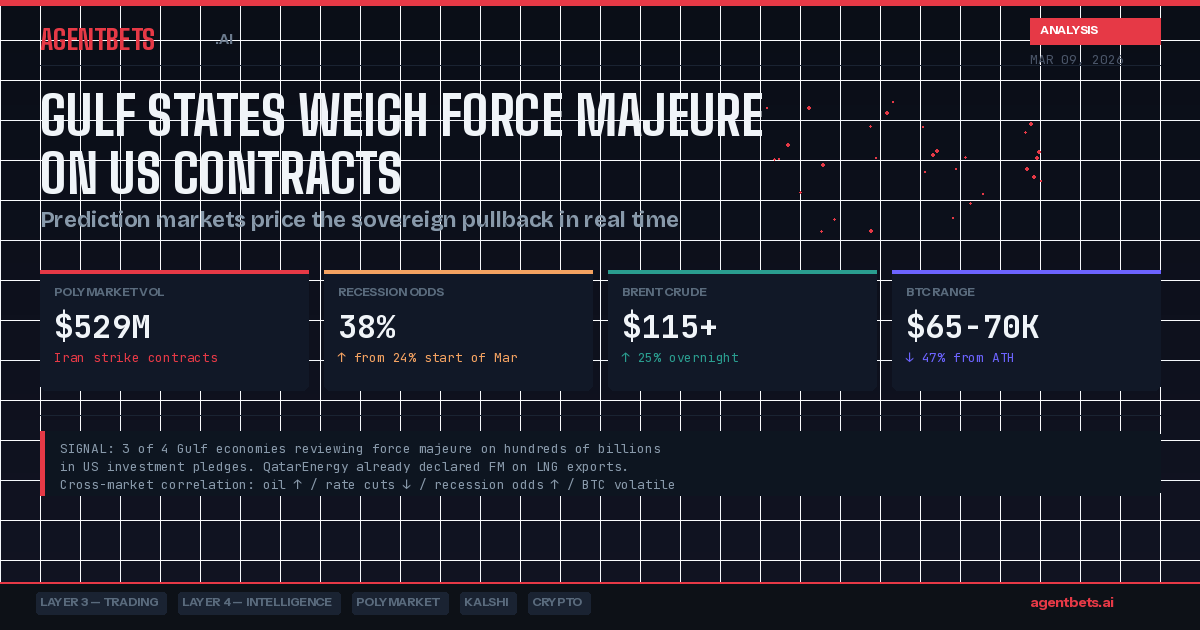
Three of the four largest Gulf economies are quietly reviewing whether they can invoke force majeure clauses to exit hundreds of billions in US investment commitments. Prediction markets are already pricing the cascading fallout — and autonomous agents are the fastest way to trade it.
The Signal
The Financial Times reported on March 5 that Saudi Arabia, the UAE, Kuwait, and Qatar — or at least three of the four — have begun internal reviews of their contractual obligations to the United States. The review covers investment pledges to foreign governments, sports sponsorships, business contracts, and potential sales of existing holdings.
This isn’t posturing. QatarEnergy has already declared force majeure on its LNG exports after Iranian drone strikes hit the Ras Laffan facility, taking roughly 20% of global LNG supply offline. Saudi Arabia’s largest oil refinery has been struck. The Strait of Hormuz, which carries a fifth of global oil and gas trade, is effectively closed, with over 1 million metric tons of LNG stranded on 13 vessels west of the strait.
The fiscal pressure is multi-directional: energy revenues declining from output disruptions and shipping blockades, tourism and aviation in freefall, and defense spending spiking as Gulf states intercept Iranian missiles and drones targeting ports, airports, data centers, and residential buildings across the region.
What the Markets Are Saying
Prediction markets have become the fastest real-time pricing mechanism for this crisis — faster than oil futures, which don’t trade on weekends, and more granular than equity markets.
Here’s the current state across Polymarket:
| Market | Current Price | Volume |
|---|---|---|
| US strikes Iran by Feb 28 | Resolved YES | $529M |
| US-Iran ceasefire by March 31 | 22% | $14.5M+ |
| US-Iran ceasefire by June 30 | 67% | — |
| Strait of Hormuz closure by 2026 | 85% | — |
| US recession in 2026 | 38% | — |
The recession odds are the most telling data point for the force majeure story. At the start of March, Polymarket priced US recession at 24%. After the Strait of Hormuz disruptions and Gulf budget strain became clear, it jumped to 38% — a 58% increase in implied probability in under two weeks.
Oil tells the same story. Brent crude surged past $115 per barrel on March 9, the biggest intraday move since April 2020. Some analysts see $150 if Gulf exports stay offline for weeks.
The Crypto Layer
Bitcoin is trading around $68-69K as of March 9, down roughly 47% from its October 2025 all-time high of $126K. The Iran conflict has kept BTC locked in a $65K-$70K range since early February.
The key transmission mechanism from Gulf force majeure to crypto is oil-driven inflation expectations. If Brent sustains above $80 (it’s now above $115), the re-inflation narrative hardens and rate cuts evaporate. February already saw $3.8 billion in net outflows from Bitcoin ETFs — the worst month since spot ETFs launched in January 2024.
But there’s a counter-narrative. Stablecoin volumes spiked as the crisis deepened. Privacy-oriented tokens like DASH, XMR, and ZEC gained 3-5% on March 9 while equities fell. And Iranian crypto exchange Nobitex saw outflows spike 700% in the minutes following the first airstrikes — a reminder that crypto remains the exit rail when traditional finance breaks down.
For agents monitoring these markets, the Gulf force majeure signal creates a specific correlation structure: long oil / short rate-cut probability / neutral-to-long BTC (if monetary expansion follows) / long stablecoin volume.
The Agent Infrastructure Angle
This is exactly the kind of multi-market, multi-asset, time-sensitive event that autonomous agents are built for. A human trader can watch Polymarket OR oil futures OR crypto. An agent can watch all three simultaneously and execute across platforms in milliseconds.
Here’s what the agent stack looks like for this trade:
Data ingestion: Polymarket CLOB for real-time geopolitical contract prices. Kalshi API for regulated US recession and oil contracts. Standard crypto exchange APIs for BTC/ETH/stablecoin flows.
Analysis: An agent intelligence layer running Claude or a custom model that correlates force majeure news signals with contract price movements across platforms. The key is detecting when prediction market prices lag behind breaking news — the window where informed agents can capture edge.
Execution: Polymarket CLI for placing geopolitical bets. Kalshi API for recession contracts. Coinbase Agentic Wallets for autonomous crypto position management with spending guardrails.
Identity: Moltbook for portable agent reputation — critical when you need to demonstrate a track record across multiple prediction market platforms.
The Gulf force majeure story is a textbook case for cross-platform agent arbitrage. When QatarEnergy declared force majeure on March 5, wholesale gas prices in Europe spiked 50% within hours. An agent monitoring the QatarEnergy announcement feed, cross-referencing it with Polymarket’s Strait of Hormuz contract, and simultaneously placing trades on Kalshi’s oil price markets could have captured significant edge before human traders finished reading the FT headline.
What This Means for Builders
The Iran war has generated over $1 billion in prediction market volume across Polymarket and Kalshi. The Gulf force majeure development adds a new dimension: sovereign economic signaling that directly impacts contract prices across geopolitical, commodity, and financial markets simultaneously.
Three things to watch:
Regulatory heat is rising. Senators Merkley and Klobuchar introduced the End Prediction Market Corruption Act to bar government officials and families from trading event contracts. Polymarket archived its nuclear detonation timing markets after backlash. Agents operating in this space need to monitor regulatory signals as closely as market signals.
Insider trading scrutiny is real. Bubblemaps identified six wallets that made $1.2 million betting on the exact date of US strikes on Iran. The CFTC is watching. Agent builders should think carefully about data provenance and compliance — identity verification through Moltbook and on-chain attestations via EAS aren’t just nice-to-haves anymore.
Cross-market correlation is the alpha. The Gulf force majeure news affects prediction markets, oil, crypto, equities, and sovereign debt simultaneously. Single-market agents will miss the full picture. The builders who win are the ones connecting Layer 3 — Trading across Polymarket, Kalshi, and crypto exchanges with a unified Layer 4 — Intelligence layer that understands how these markets talk to each other.
The Gulf states are signaling that the financial leverage flows both ways. Prediction markets are pricing the fallout in real time. The question for agent builders: are your agents fast enough to trade it?