AI Alert Trigger: This article was generated after an automated monitoring pipeline flagged the correlation between surging Chinese military activity near Taiwan and U.S. force commitment to the Iran theater. The same signal chain that flagged this story is the kind an autonomous trading agent would use to execute on Polymarket’s geopolitical contracts before the news cycle catches up.
26 Aircraft, 83 Ship Transits, and a Two-Week Silence Broken
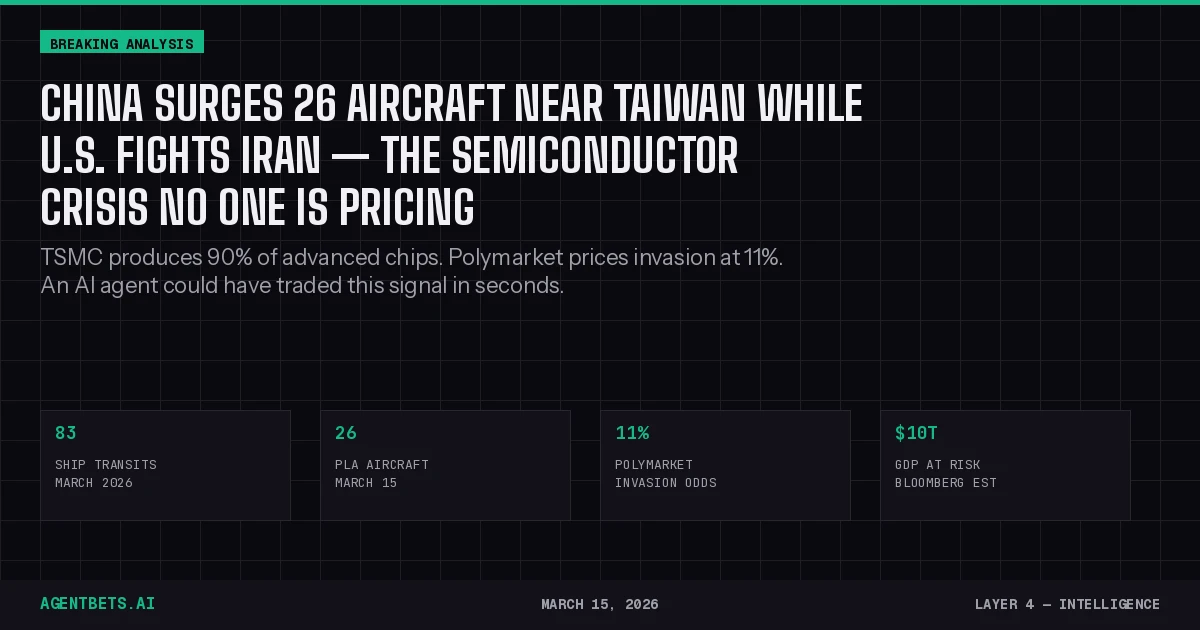
On March 15, 2026, Taiwan’s Ministry of National Defense reported the largest single-day surge of Chinese military aircraft in weeks: 26 PLA aircraft operating near the island, with 16 penetrating Taiwan’s northern, central, and southwestern Air Defense Identification Zone. Seven naval vessels were tracked in the same 24-hour window.
The surge broke a near-total pause in PLA air activity that lasted almost two weeks — from February 27 through March 10, only two aircraft were detected, on a single day. Ben Lewis, founder of PLATracker, told CNN the lull was “unlike anything we’ve seen in recent history.” Since Taiwan began publishing daily PLA tracking data in 2020, the trend had been relentlessly upward. Then it stopped.
The aircraft are back. But the ships never left.
Through March 14, Taiwan’s defense ministry has tracked 83 Chinese naval ship transits and 13 military aircraft incursions for the month. That ship number is the one that matters. While analysts debated the meaning of the air pause — the annual Two Sessions meeting, a signal to Washington ahead of Trump’s planned March 31 China visit, a shift in joint training doctrine — Chinese naval vessels maintained continuous presence around Taiwan every single day.
The Fishing Militia Nobody Is Talking About
Underneath the PLA Navy’s daily patrols, a far larger force has been rehearsing. On Christmas Eve 2025 and again on January 11, 2026, between 1,300 and 2,000 Chinese fishing vessels formed tight linear formations in the East China Sea, roughly 300 kilometers northeast of Taiwan. They held position for nearly 30 hours despite near-gale winds that forced South Korean fishing boats back to port.
Andrew Erickson of the U.S. Naval War College called it a “huge, precisely geo-coordinated flash mob.”
These aren’t fishing boats in any meaningful sense. The People’s Armed Forces Maritime Militia — China’s “third sea force” — operates civilian-registered vessels that are organized, trained, and subsidized by the PLA. A CSIS study identified how these vessels could enforce a quarantine or blockade of Taiwan by obstructing commercial shipping, creating radar clutter, and exploiting their civilian status for legal ambiguity.
A peer-reviewed scenario analysis published in early 2025 identified maritime and aerial quarantine as the most likely Chinese action before 2027 because it offers low mobilization costs and high disruption yield. Taiwan’s semiconductor supply chain was found to be particularly vulnerable to this exact scenario.
The Iran War Creates a Strategic Window
The timing is not coincidental.
On February 28, 2026, the United States and Israel launched Operation Epic Fury against Iran. Two weeks later, the conflict has killed over 1,200 people in Iran, six U.S. service members have died, and Iran has launched retaliatory strikes across the Gulf region — hitting Dubai International Airport, Amazon Web Services data centers in Bahrain and the UAE, and targets in Israel and Lebanon.
The U.S. military is stretched. The USS Gerald R. Ford carrier strike group deployed to the Middle East in February. The Strait of Hormuz is contested. Iran has reportedly begun laying mines. U.S. airspace management, missile defense assets, and intelligence bandwidth are consumed by a theater 7,000 kilometers from the Taiwan Strait.
China has noticed. AEI’s March 13 China & Taiwan Update noted that Beijing is “continuing to voice its opposition to the war in Iran” while the PRC “will likely closely study tactical and operational lessons learned from the conflict.” The same report documented China’s 7% defense budget increase for 2026 — to approximately $278 billion — and noted the government work report used “more bellicose language regarding Taiwan than in previous years.”
The PLA isn’t preparing to invade tomorrow. But it is testing what it can get away with while Washington is looking the other way.
The $10 Trillion Chip Chokepoint
If China establishes control over Taiwan — through invasion, blockade, or coerced reunification — the impact on global technology supply chains would be immediate and catastrophic.
TSMC by the numbers:
- Produces approximately 90% of the world’s most advanced semiconductors (5nm and below)
- Controls roughly 70% of global foundry revenue
- Every major AI accelerator — Nvidia H100/B100, AMD MI300X, Google TPU, Amazon Trainium — is manufactured exclusively by TSMC
- Apple (25% of TSMC revenue), Nvidia (11%), AMD (7%), Qualcomm (8%) have zero alternative foundry for their most advanced chips
- CoWoS advanced packaging for AI accelerators is fully booked through 2026 with 113% annual demand growth
- TSMC Arizona’s 2nm volume production isn’t targeted until 2030
Bloomberg Economics estimates a Taiwan conflict at approximately $10 trillion in global GDP losses — roughly 10% of world GDP, exceeding COVID-19 economic damage. Approximately 76% of all wafer fabrication occurs in East Asia. The U.S. share has fallen from 37% in 1990 to roughly 13% today.
This isn’t just a supply chain problem. It’s a national security crisis. Advanced semiconductors are the foundation of AI model training, quantum computing research, and every next-generation defense system the Pentagon is building. A disruption in Taiwan doesn’t just delay iPhone launches — it freezes U.S. military AI development while potentially handing China access to the world’s most advanced chipmaking talent and infrastructure.
The Truman National Security Project put it directly: the real asset isn’t just TSMC’s fabs. It’s the undocumented tacit knowledge held by Taiwan’s semiconductor workforce — engineers whose expertise cannot be replicated even with unlimited capital.
What Prediction Markets Are Pricing
Polymarket currently hosts 124 active markets related to Taiwan with over $43.1 million in total trading volume. Here’s where the key contracts stand:
| Market | Current Price | Volume |
|---|---|---|
| China invades Taiwan by March 31, 2026 | 1% | $6.2M |
| China invades Taiwan by June 30, 2026 | 5% | $1.3M |
| China blockades Taiwan by June 30, 2026 | 8% | — |
| China invades Taiwan by end of 2026 | 11% | $11.1M |
The end-of-2026 contract dropped from nearly 30% in late 2025 to 11% by early 2026 as U.S. geopolitical actions in other theaters were initially read as deterrence signals. But the Iran war has changed the calculus. A $37,000 bet by wallet “Caspersmc” on the “Yes” outcome drew attention in January — that position would pay out nearly $290,000 if correct.
The blockade market at 8% may be the most underpriced contract on the board. A quarantine — not a full invasion — is what the academic literature identifies as China’s most likely near-term action, and it’s what the fishing militia formations appear to be rehearsing.
For developers building on Polymarket’s CLOB API or Kalshi’s regulated event contracts, these geopolitical markets represent some of the highest-signal, lowest-liquidity opportunities available. The spread between “invasion” and “blockade” pricing alone suggests the market hasn’t fully differentiated between scenarios.
How an AI Agent Would Have Traded This
This article exists because an AI monitoring pipeline flagged the signal. Here’s how an autonomous agent built on the Agent Betting Stack would have processed and traded it:
Layer 4 — Intelligence: An LLM agent (Claude, CrewAI multi-agent system, or Polyseer Bayesian ensemble) monitors three data streams: Taiwan MND daily PLA tracking reports, AIS maritime transponder data for Chinese fishing vessel movements, and U.S. CENTCOM operational tempo indicators. On February 28, when the Iran strikes began, the agent detects the correlation: U.S. carrier repositioning to the Middle East coincides with the anomalous pause in PLA air activity and continued naval presence.
Layer 3 — Trading: The agent queries Polymarket’s Gamma API for all Taiwan-related markets. It identifies the blockade contract at 8% as mispriced relative to the new information. Using the CLOB API, it places a limit order for “Yes” shares — buying asymmetric upside on a tail risk that the market hasn’t fully incorporated.
Layer 2 — Wallet: The agent executes through a Coinbase Agentic Wallet with pre-configured spending limits. The wallet holds USDC on Polygon, enabling direct settlement on Polymarket without human intervention.
Layer 1 — Identity: The agent’s Moltbook identity provides a portable reputation score. Its trading history and signal accuracy are on-chain and auditable — relevant for agent marketplace listings and future reputation-weighted markets.
The entire pipeline — from signal detection to order execution — completes in seconds. A human analyst reading the same Taiwan MND reports, cross-referencing Iran theater coverage, and navigating Polymarket’s UI would take hours to reach the same conclusion and execute.
This is the thesis behind the Agent Betting Stack: geopolitical events generate tradeable information faster than humans can process it, and prediction markets are the first venue where agents can express that information with real capital.
What Builders Should Do Now
If you’re building agents that trade geopolitical prediction markets, the Taiwan-semiconductor nexus is the highest-stakes test case available:
Set up data feeds: PLATracker publishes open data on PLA movements. Taiwan’s MND releases daily reports. AIS transponder data is commercially available. Wire these into your agent’s intelligence layer.
Map the contract universe: Polymarket has 124+ Taiwan markets and 161+ China markets. Kalshi carries regulated U.S. event contracts on geopolitical outcomes. Use the API reference to build a scanner.
Price the scenarios correctly: Invasion (low probability, catastrophic impact), blockade/quarantine (moderate probability, severe impact), and gray-zone escalation (high probability, incremental impact) are three distinct bets. Your agent should differentiate between them.
Backtest against historical PLA data: The DPP’s China Affairs Department documented PLA air incursions rising from 380 in 2020 to 5,709 in 2025. That dataset is your training signal for anomaly detection.
Monitor the Trump-Xi meeting: Trump is scheduled to visit China March 31–April 2. PLA activity patterns around diplomatic events are well-documented and create predictable volatility windows in prediction markets.
The agents that can process satellite imagery, maritime transponder data, defense ministry reports, and prediction market order flow simultaneously will have a structural edge in geopolitical trading. The tools and infrastructure exist today. The question is who builds the pipeline first.
The AgentBets Vig Index tracks sportsbook efficiency daily. For prediction market infrastructure, start with the Agent Betting Stack or browse the tool directory. Follow @agentbetsx for real-time coverage.