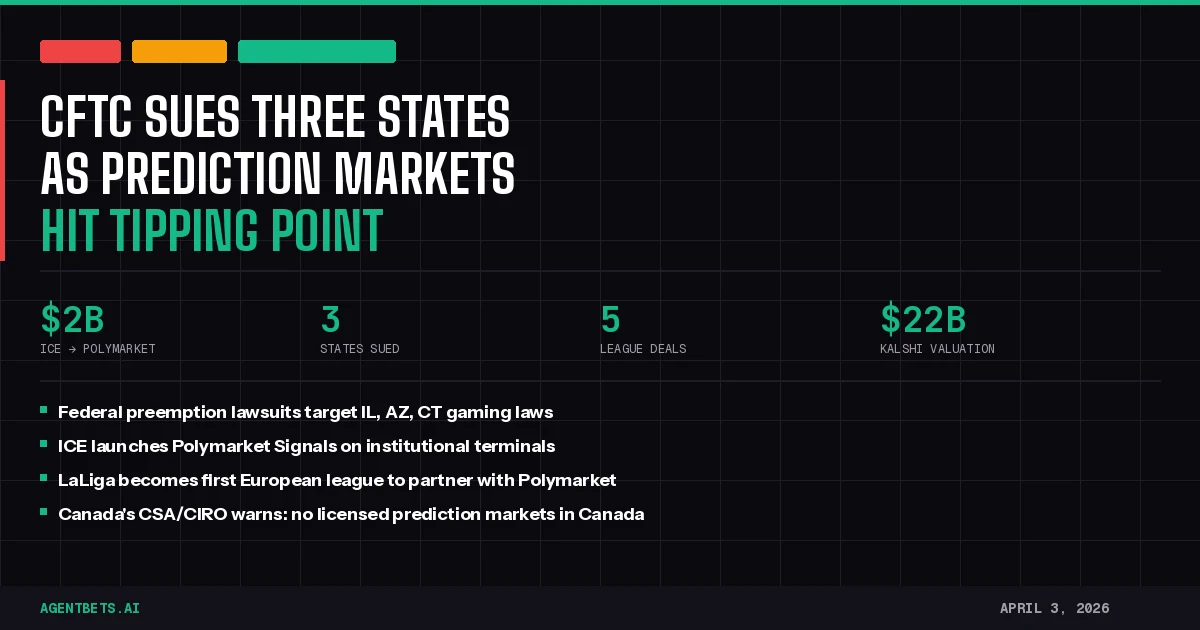
Prediction markets crossed a regulatory and institutional threshold this week that will reshape how autonomous agents interact with these platforms for years. The CFTC sued three states to assert exclusive federal jurisdiction, ICE completed a $2 billion commitment to Polymarket, LaLiga signed on as the latest major sports league partner, and Canadian regulators fired a warning shot across the border.
CFTC Files Federal Lawsuits Against Three States
The Trump administration escalated the prediction market jurisdiction battle on April 2, 2026, when the CFTC filed lawsuits against Illinois, Arizona, and Connecticut. All three states had issued cease-and-desist orders to platforms like Kalshi and Polymarket, classifying their contracts as illegal online gambling under state gaming laws. Arizona went further, filing criminal charges against Kalshi in March for allegedly violating state gambling statutes and a state law prohibiting election betting.
The federal government’s position is straightforward: prediction market contracts are swaps — a category of financial derivative — and fall under the CFTC’s exclusive regulatory authority. The lawsuits ask federal courts to declare that states have no jurisdiction over these financial instruments, regardless of how individual states classify them.
CFTC Chairman Michael Selig framed the action as protecting federal regulatory turf, stating the CFTC would defend its exclusive authority against state regulators. The states see it differently. Connecticut Attorney General William Tong called the suits a recycling of industry arguments that courts have already rejected, maintaining that prediction market contracts are unlicensed gambling that competes unfairly with regulated sportsbooks like DraftKings and FanDuel.
The legal question at the center — are prediction markets finance or gambling? — is expected to reach the Supreme Court. For agent developers, the outcome determines whether building automated trading systems for prediction markets requires navigating a patchwork of state regulations or a single federal framework. A federal preemption ruling would effectively legalize prediction market access nationwide, eliminating the identity and compliance layer complexities that currently vary by jurisdiction.
ICE Completes $2 Billion Polymarket Investment
Intercontinental Exchange, the Fortune 500 parent company of the New York Stock Exchange, completed its investment commitment to Polymarket on March 27 with a final $600 million cash tranche. Combined with the $1 billion initial investment made in October 2025 and up to $40 million in secondary purchases, ICE’s total commitment reached approximately $2 billion.
The investment thesis is data infrastructure, not speculation on prediction market popularity. ICE became the exclusive global distributor of Polymarket’s event-driven data to institutional capital markets. In February 2026, ICE launched the Polymarket Signals and Sentiment product — a structured data feed that normalizes real-time trading activity across thousands of Polymarket contracts into probability signals that sit alongside bond yields, equity futures, and corporate actions on professional trading terminals.
This is significant for the agent intelligence layer. Traditional financial data reflects what already happened. Probability signals from prediction markets reflect what participants collectively believe will happen. An autonomous agent that integrates Polymarket API data alongside ICE’s conventional market feeds gets a structured view of political, regulatory, and geopolitical risk that was previously unavailable as a normalized institutional data product.
Polymarket hit nearly $10 billion in monthly trading volume in March 2026. Rival platform Kalshi separately raised approximately $1 billion at a $22 billion valuation the same month. The combined institutional capital flowing into prediction market infrastructure in Q1 2026 exceeds anything the sector has seen — and it is flowing primarily into data products, not retail trading features.
LaLiga Becomes First European League to Partner With Polymarket
LaLiga North America announced a multi-year partnership on April 2 making Polymarket its exclusive prediction market platform in the U.S. and Canada. The deal includes official league and club intellectual property rights, premium broadcast visibility, and collaborative integrity protections developed using Polymarket’s recently launched surveillance system built with Palantir and TWG AI.
LaLiga joins Polymarket’s growing roster of major sports league partnerships: MLB, NHL, UFC, and MLS. The pattern is clear — prediction markets are building the same kind of official league relationships that traditional sportsbooks spent years establishing. For developers building soccer prediction bots or NBA trading agents, official league data partnerships mean richer real-time probability feeds and deeper market liquidity.
The MLB deal, first reported in March, came less than a year after the league told players not to use prediction markets. Both MLB and LaLiga partnerships include provisions to restrict contracts that pose integrity risks — individual pitch outcomes, manager decisions, umpire performance, and similar granular markets susceptible to manipulation. The NFL sent its own letters to operators the same week requesting limits on easily manipulated event types like field goals and announcer remarks.
This integrity infrastructure matters for automated systems. Agents operating in these markets need to understand which contract categories carry manipulation risk and which have league-sanctioned data support. The prediction market trading layer is evolving rapidly as leagues define what is and isn’t acceptable.
Canada Fires a Regulatory Warning Shot
While the U.S. federal government pushes toward broader access, Canadian regulators moved in the opposite direction. On April 2, the Canadian Securities Administrators (CSA) and the Canadian Investment Regulatory Organization (CIRO) issued a joint statement reminding the public that no prediction market platform has been recognized as an exchange or registered as a dealer in Canada.
The warning carries teeth. Under Multilateral Instrument 91-102, binary options contracts with terms under 30 days — which covers the vast majority of sports prediction contracts offered in the U.S. — are prohibited in every Canadian province except British Columbia. Polymarket was already banned in Ontario through a 2025 settlement with the Ontario Securities Commission after the platform admitted violating provincial securities rules.
Only two CIRO-authorized members — Interactive Brokers Canada and Wealthsimple — can offer limited event contracts to Canadian clients, and those are restricted to economic forecasts, environmental indicators, and financial benchmarks traded through CFTC-regulated exchanges. Sports and political contracts remain explicitly prohibited. The regulators warned that they are considering additional restrictions and enforcement actions.
For agent developers operating from Canada or targeting Canadian users, the regulatory landscape is unambiguous: automated prediction market agents that trade sports or political contracts are operating outside the current legal framework. The legal status of prediction markets varies dramatically between the U.S. and Canadian jurisdictions, and this week’s divergent regulatory actions widen that gap.
What This Means for Agent Infrastructure
The convergence of these four developments reshapes the environment for autonomous betting agents along every layer of the Agent Betting Stack:
Layer 1 — Identity: If the CFTC prevails and establishes exclusive federal jurisdiction, identity verification for prediction market agents simplifies from a state-by-state compliance matrix to a single federal standard. The Canadian warning adds a new geofencing requirement for any agent serving cross-border users.
Layer 2 — Wallet: ICE’s data-as-investment thesis validates the financial infrastructure layer. Prediction market contracts are being treated as financial instruments by the largest exchange operator on the planet. Agent wallet architecture needs to support both crypto-native settlement (Polymarket operates on blockchain rails) and traditional financial integration.
Layer 3 — Trading: League partnerships define the integrity boundaries that automated systems must respect. The Palantir-powered surveillance system signals that prediction markets are building institutional-grade market manipulation detection — agents that behave like market makers need to operate within those guardrails.
Layer 4 — Intelligence: The Polymarket Signals product transforms prediction market data from raw API feeds into normalized institutional signals. Agents can now access structured probability data through the same infrastructure that delivers equity pricing and credit risk data to hedge funds. Building agents that combine prediction market API data with ICE’s Signals product opens a new class of intelligence capabilities.
The prediction market industry processed billions of dollars in weekly volume in Q1 2026. The infrastructure supporting that volume — regulatory frameworks, data distribution, league partnerships, integrity systems — matured more in this single week than in the previous year combined. Agent developers building on these platforms are no longer operating in a regulatory gray zone. They are building on infrastructure that the federal government, the NYSE’s parent company, and five major sports leagues are actively investing in and defending.