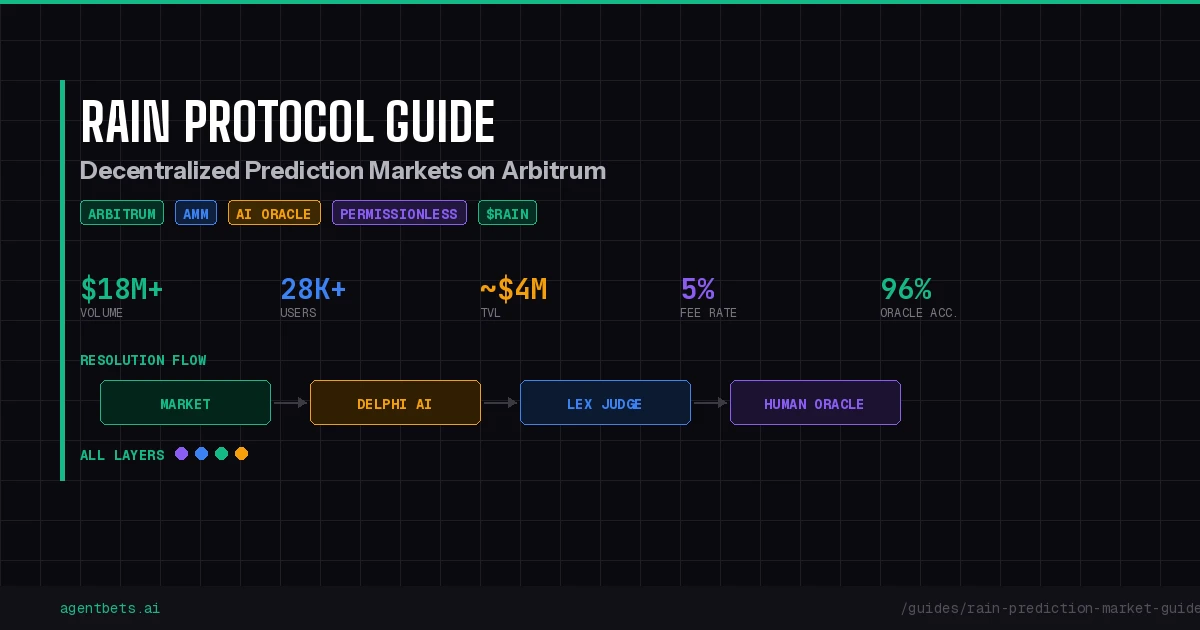
Rain is a decentralized prediction market protocol on Arbitrum that lets anyone create, trade, and resolve markets on any topic — from global events to niche community predictions. This guide covers Rain’s AMM architecture, the Delphi AI oracle system, $RAIN tokenomics, the developer SDK, agent integration via OpenClaw, and how Rain compares to Polymarket and Kalshi across every dimension that matters to builders and traders.
What Rain Is
Rain is permissionless prediction market infrastructure. Where Polymarket operates a centralized order book on Polygon and Kalshi runs a CFTC-regulated exchange with curated contracts, Rain takes a fundamentally different approach: it provides the protocol layer for anyone to build their own prediction market platform or application on top of.
The project describes itself as the “Uniswap of prediction markets” — an apt comparison. Just as Uniswap provided permissionless token-trading infrastructure that replaced centralized exchange gatekeepers, Rain provides permissionless market-creation infrastructure that replaces centralized prediction market operators.
Core architecture:
| Component | Implementation |
|---|---|
| Blockchain | Arbitrum (Ethereum L2) |
| Market model | Automated Market Maker (AMM) |
| Settlement currency | USDT, USDC, ETH, BNB |
| Deposit chains | Arbitrum, Ethereum, Base, BNB Chain |
| Oracle system | Delphi (multi-agent AI) + human escalation |
| Governance | $RAIN token DAO |
| Market types | Public (open) and Private (invite-only) |
| Minimum liquidity | $10 to create a market |
Rain launched its alpha in September 2025, followed by a public beta on November 6, 2025. As of early 2026, the protocol reports approximately $18 million in cumulative trading volume, over 28,000 active users, and roughly $4 million in total value locked.
How Rain Markets Work
Market Creation
Any user can create a market on Rain by defining an outcome with multiple possible options. The minimum liquidity requirement is $10 — dramatically lower than what Polymarket or Kalshi require for meaningful market depth. Creators choose between two market types:
Public markets are visible to all users. The creator selects either Delphi (the AI oracle) or themselves as the resolver. Public markets are subject to the full dispute process and pay standard fees plus a $1 oracle fee if Delphi is selected.
Private markets require an invite code to enter. Only the market creator can resolve these markets. Private markets still support the dispute escalation process but are designed for DAOs, communities, and organizations running internal forecasting.
This public/private distinction is unique to Rain. Neither Polymarket nor Kalshi offers gated, invite-only markets — making Rain the first prediction market protocol that supports both open and closed forecasting environments.
AMM Pricing Model
Rain uses an Automated Market Maker rather than a Central Limit Order Book (CLOB). The pricing is proportional: if 50% of total funds in a market are placed on Option A, its share price is $0.50. As funds flow into different options, prices adjust proportionally and automatically.
The payout multiplier (called the “Line”) is the inverse of share price:
Line = 1 / Share Price
If the Line is 4.2, each $1 placed on that option yields a $4.20 payout if the outcome is correct.
This model has tradeoffs compared to CLOB-based platforms:
| Feature | Rain (AMM) | Polymarket (CLOB) | Kalshi (Order Book) |
|---|---|---|---|
| Liquidity bootstrapping | Automatic | Requires market makers | Requires market makers |
| Price discovery | Proportional | Bid/ask spread | Bid/ask spread |
| Slippage on large orders | Higher | Lower (depth-dependent) | Lower (depth-dependent) |
| Minimum to start trading | $10 | Variable | Variable |
| Limit orders | No (AMM-driven) | Yes | Yes |
| Market making bots needed | No | Yes (for deep liquidity) | Yes (for deep liquidity) |
The AMM model means Rain markets can function with very low liquidity — useful for niche or private markets. But it also means that professional traders accustomed to placing limit orders on Polymarket’s CLOB will find a fundamentally different execution model.
Liquidity-Preserving Exit
Rain’s exit mechanism uses account abstraction to let participants sell positions without withdrawing liquidity from the pool. When a user places a sell order, the protocol matches it internally with incoming buyers. This preserves market depth while allowing position transfers — a meaningful improvement over naive AMM designs where exits drain the pool.
No Refund Policy
Once funds are committed to a Rain market, there is no refund mechanism. All wagers are final regardless of outcome or subsequent disputes. This is consistent with how Polymarket and Kalshi handle settled positions, but worth noting explicitly since Rain’s permissionless market creation means users may encounter markets with less rigorous resolution criteria.
Delphi: The AI Oracle System
Rain’s resolution mechanism is its most technically interesting component — and the strongest reason this protocol matters in the agent betting stack.
Multi-Agent Architecture
Delphi is a consensus-driven AI oracle built by Olympus AI. It uses a multi-agent architecture with six specialized agents:
Five Explorer Agents — each powered by a different LLM — independently gather information from the internet about the market question. Using different models reduces the risk of systematic bias from any single LLM.
One Extractor Agent analyzes the findings from all five Explorers. An answer is confirmed only when at least three of five Explorer Agents agree. This consensus threshold filters out hallucinations and inaccuracies.
Delphi is designed to always select one of the listed options, even if the question is ambiguous — ensuring markets never remain unresolved. The system reports 96% accuracy in its current development stage.
Dispute Resolution: Three-Tier Escalation
If a participant believes the resolution is incorrect, they can dispute it by posting collateral of 0.1% of market volume or $1,000, whichever is less.
Dispute Escalation Path:

1. Initial Resolution
   └─ Delphi (AI oracle) or Market Creator

2. Dispute Filed (requires collateral)
   └─ Lex (AI Judge) reviews claims and evidence
      └─ Ruling issued within minutes

3. Appeal (if losing party disagrees)
   └─ Decentralized Human Oracles
      └─ Final, binding decision
Lex is an autonomous AI judge that uses multiple reasoning models to evaluate dispute claims. It reviews evidence from both parties and delivers rulings within minutes — far faster than human-only dispute resolution.
If the party that Lex ruled against appeals, the dispute escalates to decentralized human oracles for a final binding decision. The resolver reward (0.1% of market volume) goes to the human oracles for their service, regardless of which side wins.
This three-tier system — AI oracle → AI judge → human oracles — is architecturally significant. It maps directly to Layer 4 (Intelligence) of the agent betting stack, demonstrating how AI agents can handle resolution at scale while maintaining a human backstop for edge cases.
The $RAIN Token
$RAIN is the native utility and governance token on Arbitrum. It serves two primary functions: Trading Power and DAO governance.
Trading Power
Users must hold $RAIN to participate in markets. The ratio is 1:100 — holding $1 worth of $RAIN enables trading up to $100 of deposited balance. This is not leverage or credit; it simply gates access to trading based on protocol commitment.
This mechanism creates direct demand correlation between protocol usage and token demand. More active traders need more $RAIN, creating organic buy pressure tied to actual protocol activity rather than speculation.
Governance
$RAIN holders govern the protocol through the Rain DAO. Any holder with 10,000+ $RAIN can propose changes. The DAO votes on market structure and fee logic, oracle and dispute resolution frameworks, development fund allocation, and protocol upgrades and partnerships.
Deflationary Mechanism
2.5% of the trading volume in every prediction market is used to buy back and permanently burn $RAIN tokens. This creates continuous deflationary pressure that scales with protocol usage. An offsetting inflationary mechanism mints 10% of burned tokens back to the foundation for team rewards, ecosystem development, and marketing — resulting in a net-deflationary model as long as the protocol maintains activity.
Token Distribution
The initial total supply is 1.15 trillion tokens. Key allocations include 20% to marketing and development fund, 20% to reserve and treasury (18-month cliff), 15% to ecosystem growth and staking (12-month vesting), 15% to launchpad and exchange liquidity, 10% to team (24-month vesting with 1-month cliff), 10% to contributors and advisors (18-month vesting), 9% to strategic sale, and 1% to presale.
$RAIN is listed on MEXC, BingX, and Gems Trade. Institutional backing includes Nasdaq-listed Enlivex Therapeutics (ENLV), which holds $RAIN as part of a prediction markets treasury strategy — a $212 million private placement in late 2025 was specifically targeted at accumulating $RAIN.
Fee Structure
Rain applies a 5% fee on total market volume, split evenly:
| Fee Component | Rate | Recipient |
|---|---|---|
| Market creator reward | 1.2% | Creator |
| Liquidity provider reward | 1.2% | LP(s) |
| Resolver reward | 0.1% | Delphi or creator |
| Buyback and burn | 2.5% | Burned permanently |
| Oracle fee (optional) | $1 flat | Delphi (if selected) |
The 5% total fee is substantially higher than Polymarket (approximately 0% trading fees for most users) and Kalshi (exchange fees vary by contract). However, Rain’s fee includes built-in creator and LP compensation — effectively paying builders to operate markets on the protocol.
Rain vs Polymarket vs Kalshi
This is the comparison that matters for developers deciding where to build.
| Dimension | Rain | Polymarket | Kalshi |
|---|---|---|---|
| Chain | Arbitrum | Polygon | Centralized (off-chain) |
| Market model | AMM | CLOB | Order book |
| Settlement | USDT/USDC/ETH/BNB | USDC | USD (fiat) |
| Regulation | Unregulated (decentralized) | Unregulated (offshore) | CFTC-regulated |
| US access | No restrictions (permissionless) | Global only (US via separate entity) | Full US access |
| Market creation | Permissionless ($10 min) | Platform-curated | Platform-curated |
| Private markets | Yes (invite-only) | No | No |
| Oracle / resolution | AI multi-agent + human escalation | UMA Optimistic Oracle | Platform-operated |
| Fees | 5% of volume | ~0% trading | Exchange fees |
| Token requirement | Yes ($RAIN for Trading Power) | No | No |
| API/SDK | SDK (agent-ready, March 2026) | CLOB API + CLI + SDKs | REST v2 + WebSocket + FIX |
| Agent support | OpenClaw native | py-clob-client, community tools | kalshi_python_sync SDK |
| Volume (cumulative) | ~$18M | Billions+ | Growing |
When to Use Rain
Rain makes sense when you want to create your own markets without platform approval, you need private/gated markets for a DAO or community, you want to build an independent prediction market frontend on shared infrastructure, you’re building AI agents that create and resolve markets autonomously, or your use case involves niche topics that Polymarket and Kalshi won’t list.
When Rain Is Not the Right Choice
If you need deep liquidity for large position sizes, Polymarket’s CLOB provides tighter spreads. If you need regulatory clarity for US operations, Kalshi is the only CFTC-regulated option. If you need limit orders and precise execution control, AMM-based pricing won’t satisfy that requirement. For a detailed breakdown of how these platforms compare on agent-specific dimensions, see the Polymarket vs Kalshi vs DraftKings comparison.
Agent Integration and the SDK
Rain’s strongest position in the agent betting stack is at the infrastructure layer. While Polymarket and Kalshi are platforms where agents trade, Rain is a protocol where agents can create, operate, and monetize entire prediction market applications.
OpenClaw Integration
In March 2026, the Rain Foundation launched an AI agent-ready SDK alongside a $5 million grant program. The SDK enables agents — specifically OpenClaw agents — to create live prediction markets via single text prompts without manual coding.
The integration means an OpenClaw agent can take a prompt like “Create a prediction market on whether SpaceX launches Starship by June 2026” and execute the full market creation flow: defining outcomes, setting initial liquidity, selecting the resolver, and publishing the market — all autonomously.
Builder Economics
Rain offers a direct monetization path for agent builders:
- 0.5% volume commission — Every builder earns a flat 0.5% of the trading volume they generate, paid from Rain’s token allocation
- 1.2% creator reward — Market creators receive 1.2% of total market volume from fees
- 1.2% LP reward — Liquidity providers earn 1.2% of volume
For an agent that creates and provides liquidity for its own markets, the combined take is 2.9% of generated volume — a meaningful revenue stream for autonomous agents. This is structurally different from Polymarket (where agents earn through trading edge) and Kalshi (where there is no creator incentive).
Where Rain Fits in the Stack
Rain touches all four layers of the agent betting stack:
- Layer 1 — Identity: Wallet-based authentication, no KYC requirement for the permissionless protocol
- Layer 2 — Wallet: Cross-chain deposits (Arbitrum, Ethereum, Base, BNB Chain), $RAIN token management
- Layer 3 — Trading: AMM-based execution, position entry/exit, liquidity provision
- Layer 4 — Intelligence: Delphi AI oracle for resolution, agent-driven market creation via SDK
Getting Started with Rain
Setting Up an Account
Rain uses wallet-based authentication. Connect a wallet that supports Arbitrum, deposit funds (USDT, USDC, ETH, or BNB), and acquire $RAIN tokens for Trading Power. Cross-chain deposits from Ethereum, Base, and BNB Chain are handled automatically by the protocol.
Creating a Market
- Define the outcome question with multiple possible options
- Set minimum $10 initial liquidity
- Choose market type: public or private
- Select resolver: Delphi (AI oracle) or self-resolution
- Submit — the market is live immediately
Trading
With $RAIN in your wallet (for Trading Power) and deposited funds, you can trade on any active market. Share prices reflect implied probability: a $0.60 share implies 60% probability. Payouts are determined by the Line (1 / share price).
For Developers
The Rain SDK provides programmatic access to market creation, trading, and resolution. The agent-ready interface launched in March 2026 exposes market creation, pricing, trading, liquidity provision, and resolution as composable primitives that AI agents can invoke.
For developers building autonomous agents, the recommended path is integrating via OpenClaw — Rain’s SDK is designed to work as an OpenClaw skill, meaning agents can add Rain market creation to their existing capability stack without rebuilding from scratch.
Risk Factors and Considerations
Rain is early-stage infrastructure operating in an unregulated environment. Several factors warrant attention:
Liquidity depth — With ~$4 million TVL and ~$18 million cumulative volume as of early 2026, Rain’s liquidity is orders of magnitude smaller than Polymarket’s. Large positions will experience significant slippage on the AMM.
Oracle accuracy — Delphi reports 96% accuracy, which means roughly 1 in 25 markets could see incorrect initial resolution. The dispute mechanism exists for this reason, but disputing requires collateral and relies on escalation to human oracles whose decentralization and reliability are still being proven.
Token requirement — The Trading Power mechanism (hold $RAIN to trade) adds friction and introduces token-price exposure for traders. If $RAIN’s value drops, the cost of accessing Trading Power decreases — but so does the value of earned rewards.
No refund policy — All positions are final. Combined with permissionless market creation, users may encounter markets with poorly defined resolution criteria or ambiguous outcomes.
Smart contract risk — Rain’s smart contracts have been audited by Hacken, but no audit eliminates all risk. The protocol is under active development, and its features, tokenomics, and governance mechanisms are subject to change.
Regulatory uncertainty — Prediction markets face varying legal treatment across jurisdictions. Rain’s fully decentralized, permissionless design provides no regulatory cover for users. For an overview of the legal landscape, see Are Prediction Markets Legal?
Further Reading
- The Agent Betting Stack — How Rain maps to the four-layer architecture
- Polymarket API Guide — The CLOB-based alternative
- Kalshi API Guide — The CFTC-regulated alternative
- Polymarket vs Kalshi vs DraftKings — Platform comparison
- Cross-Market Arbitrage — Arb strategies across platforms
- Prediction Market API Reference — Side-by-side endpoint docs
- Best Prediction Market Bots — Agent rankings and reviews
- Rain Protocol Review — Our marketplace listing
- OpenClaw Guide — Agent framework integration
- How to Automate Prediction Market Trading — Automation strategies