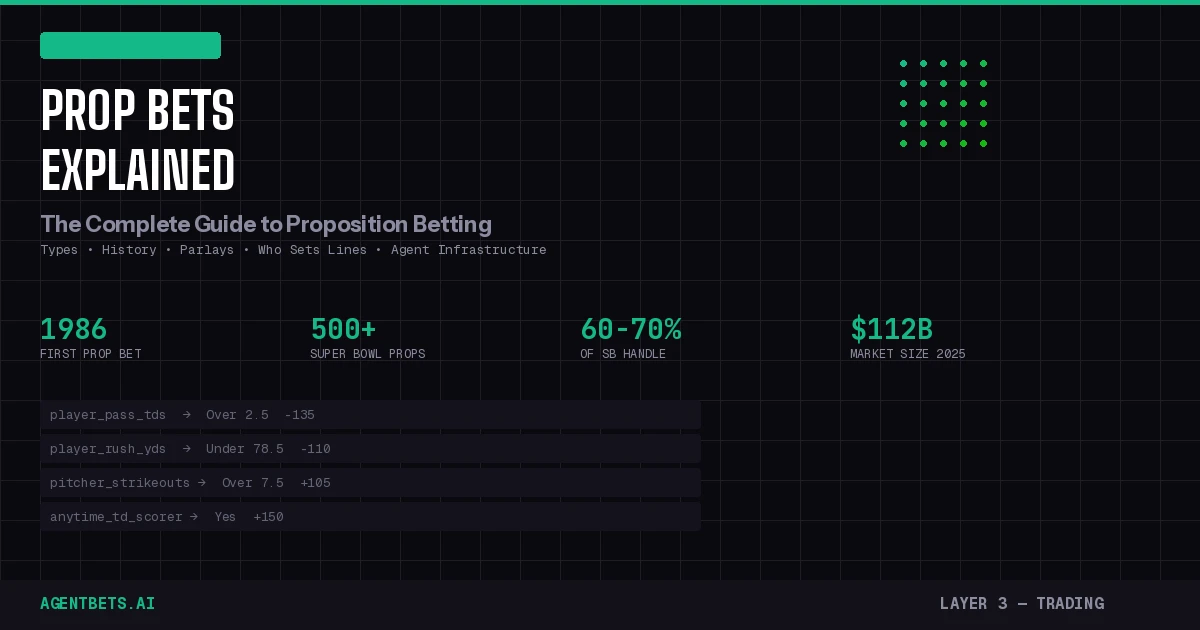
Prop bets are wagers on specific in-game outcomes beyond the final score. They originated with a single William Perry touchdown bet in 1986, now account for 60–70% of Super Bowl handle, and represent the single largest surface area of pricing inefficiency in sports betting. For agents, that means opportunity.
What Is a Prop Bet
A prop bet — short for proposition bet — is a wager on whether a specific event occurs during a sporting contest. Unlike a moneyline, spread, or total, a prop bet isn’t about who wins or the final score. It’s about individual performances, team milestones, and game events.
Examples of prop bets:
- Player prop: Patrick Mahomes over/under 275.5 passing yards
- Team prop: Will the Chiefs score the first touchdown?
- Game prop: Will the game go to overtime?
- Novelty prop: What color Gatorade gets dumped on the winning coach?
A quarterback throws for over 275.5 yards. The first team to score is the underdog. The game goes to overtime. A pitcher records 8+ strikeouts. Those are all props.
The formal definition: any bet on an outcome that doesn’t directly determine the final score. If you strip away spread, moneyline, and total — everything else is a prop.
Prop bets have grown from a Super Bowl novelty into the dominant betting format in US sports. Player props and same-game parlays now account for the majority of handle at major sportsbooks, and the 2026 FIFA World Cup is expected to push soccer prop volume to record levels across both traditional sportsbooks and prediction market platforms.
A Brief History of Prop Betting
1986: The Fridge Bet That Started It All
Prop betting began at Super Bowl XX. Art Manteris, then the sportsbook director at Caesars Palace in Las Vegas, posted 20-1 odds on Chicago Bears defensive tackle William “Refrigerator” Perry scoring a touchdown against the New England Patriots.
The logic was sound — Bears coach Mike Ditka had publicly stated Perry wouldn’t carry the ball again, and Perry hadn’t been used as a goal-line fullback since late November. Manteris and ticket writer Chuck Esposito figured it was safe.
It wasn’t. The AP picked up the story. Bettors flooded in. The odds compressed from 20-1 down to 2-1 by kickoff. With the Bears ahead 37-3 in the third quarter, Ditka sent Perry rumbling in from the sideline for an easy touchdown. Caesars lost big, but the prop betting industry was born.
1990s: The Imperial Palace Revolution
Jay Kornegay, Kirk Brooks, Vic Correll, Ed Salmons, and Jeff Sherman at the Imperial Palace took the prop concept and blew it open. Their reasoning was practical — Super Bowls in the late ’80s and early ’90s were blowouts, and bettors needed something to keep them engaged into the second half.
They started with about 50 props and it was a massive hit. By Super Bowl XXIX in 1995 (San Francisco vs. San Diego, a 19.5-point spread), the menu had tripled to 180 props. The rationale: if everyone knows who’s going to win, give them hundreds of other things to bet on.
They also invented the crossover prop. For Super Bowl XXIV in 1990, Brooks put up a proposition on whether Michael Jordan (playing a Saturday Bulls game) would outscore the San Francisco 49ers. Jordan dropped 39, but the Niners hung 55 on Denver.
2000s–2010s: Digital Explosion
Online sportsbooks expanded prop menus from dozens to hundreds, then thousands. The Super Bowl became the prop betting holiday — Westgate SuperBook now routinely posts 500+ props with over 1,000 ways to bet on a single game.
The critical shift: props went from a novelty sideshow to the main event. Kornegay has stated that props now account for roughly 70% of their Super Bowl handle. In raw numbers, Nevada sportsbooks reported over $158 million wagered on the Super Bowl, with an estimated $90+ million of that on props alone.
2019–Present: The Same Game Parlay Era
FanDuel launched the Same Game Parlay, letting bettors combine multiple props from a single contest into one ticket. DraftKings followed. Every major book now offers SGPs. This format turbocharged prop betting volume because it turned a set of individual prop picks into a single high-payout lottery ticket.
Then came SGP+ (DraftKings) and SGPx — formats that chain same-game parlays from multiple contests together. The prop market went from a footnote to the dominant betting format in US sports.
Types of Prop Bets
Props break down into four categories. Here’s the taxonomy:
Player Props
Wagers on individual player performance. The most popular category and the one with the deepest markets.
| Sport | Common Player Props |
|---|---|
| NFL | Passing yards, rushing yards, receiving yards, passing TDs, anytime TD scorer, receptions, interceptions, longest completion |
| NBA | Points, rebounds, assists, 3-pointers made, steals, blocks, points+rebounds+assists (PRA) combos, first basket scorer |
| MLB | Pitcher strikeouts, hits allowed, innings pitched, batter home runs, batter hits, batter RBIs, batter total bases |
| NHL | Goals, assists, shots on goal, saves (goalies) |
| Soccer | Goals, assists, shots on target, cards received |
| Golf | Top 5/10/20 finish, head-to-head matchups, total strokes for winner, hole-in-one in tournament |
| Tennis | Total sets, total games, aces |
Player props can be structured as:
- Over/Under — Will Patrick Mahomes throw over or under 2.5 touchdowns?
- Yes/No — Will Saquon Barkley score a touchdown? (Anytime TD scorer)
- Head-to-Head — Who gets more receiving yards: CeeDee Lamb or A.J. Brown?
Team Props
Focused on a single team’s performance within the game.
Examples: total team points, total team touchdowns, first team to score, team to score last, team to reach 20 points first, team total sacks, team total turnovers.
Team props differ from game totals because they isolate one side. Instead of the combined over/under of 47.5, you’re betting on whether the Chiefs specifically score over 24.5.
Game Props
Wagers on events within the game that involve both teams or the game itself.
Examples: will the game go to overtime, total number of field goals, will both teams score 20+, will there be a safety, will the first score be a touchdown, total penalty yards, highest-scoring quarter.
Game props can be broken into derivatives — first half, second half, quarters, innings. A first-half spread or first-quarter total is technically a game prop derivative.
Novelty Props
Non-athletic outcomes tied to the event. Almost exclusively a Super Bowl phenomenon at regulated books, though offshore sportsbooks offer them more broadly.
Classic examples: color of the Gatorade dumped on the winning coach, length of the national anthem (over/under), coin toss result (heads/tails), first commercial advertiser shown, halftime show song count.
The Octopus is a newer novelty prop — will a player score a touchdown AND the subsequent two-point conversion (eight points on one drive). The term was coined by journalist Mitch Goldich in 2018. It’s hit once in Super Bowl history (Super Bowl LVII, Chiefs vs. Eagles). Typical odds: Yes +1600 / No -6000.
Regulated US sportsbooks tend to be conservative with novelty props. Offshore books go deeper, offering markets on celebrity appearances in commercials, specific brand ads, and cultural moments during the broadcast.
Who Sets Prop Lines
The Old Way
Before online sportsbooks, a small group of Las Vegas oddsmakers set opening lines based on personal power ratings — proprietary blends of player performance, schedule strength, and intuition. Bob Martin’s “Las Vegas Line” at the Plaza, followed by Roxy Roxborough’s LVSC at the Stardust, were the numbers everyone followed.
For props specifically, the process was even more insular. A small team at a single book would brainstorm interesting propositions, set rough odds based on gut feel and basic stats, then adjust as money came in.
The Modern Process
Today, prop lines are generated through a four-step pipeline:
Step 1: Model Output. Teams of mathematicians and data analysts run statistical models incorporating historical performance, matchup data, injury reports, weather, and pace-of-play factors. For a player rushing yards prop, the model considers the running back’s per-game average, the opposing defense’s rushing yards allowed, game script probability (likely game flow), and snap count projections.
Step 2: Market-Making Book Opens. A market-making sportsbook — historically offshore, now increasingly Circa Sports, DraftKings, or FanDuel — posts the first line with low limits (often a few hundred dollars for props). This is the “opening line.”
Step 3: Sharp Money Shapes the Line. Professional bettors who specialize in specific prop markets identify mispriced lines and bet into them. Oddsmakers react by moving the number. As one Circa Sports oddsmaker described it: the most respected professional bettors ultimately dictate what the line is, not the bookmaker.
Step 4: Consensus Forms. Other sportsbooks see the adjusted line, copy it (with slight tweaks for their customer base), and open their own markets. This is called “moving on air” — books moving lines not because of action they received, but because other books moved.
Why Prop Lines Are Less Efficient
Sportsbooks post hundreds of prop lines per event. For a single NFL Sunday, that’s thousands of individual markets across all games. No oddsmaking team can model every one perfectly.
This is why props carry wider margins. While a standard spread might be offered at -110/-110 (a 20-cent line), props commonly sit at -115/-115 (30-cent) or -120/-120 (40-cent). The book knows sharp bettors will find soft spots, so they build in extra cushion across the entire prop menu.
The implication for agents: more markets + wider margins + thinner modeling = more pricing inefficiencies to exploit programmatically.
Can You Parlay Prop Bets?
Yes, with caveats. The rules depend on the sportsbook and the type of parlay.
Standard Parlays
You can combine props from different games into a traditional parlay at virtually every sportsbook. Take LeBron James over 28.5 points in one game and Nikola Jokic over 11.5 rebounds in another — those legs combine into a standard multi-game parlay with multiplied odds.
Same Game Parlays (SGPs)
The innovation that changed everything. SGPs let you combine multiple outcomes from a single contest on one ticket:
- Chiefs to win
- Patrick Mahomes over 275.5 passing yards
- Travis Kelce over 5.5 receptions
- Game total over 48.5
All four legs must hit for the SGP to pay. The critical difference from standard parlays: the sportsbook adjusts odds to account for correlation. If you bet the Chiefs to win AND Mahomes to throw 3+ touchdowns, those outcomes are positively correlated — a Mahomes explosion makes a Chiefs win more likely. The book’s model prices that relationship into your payout, reducing it compared to what you’d get if the legs were independent.
FanDuel pioneered SGPs and maintains the best combination of available markets, user experience, and pricing transparency. DraftKings offers the deepest prop menus. BetMGM runs frequent prop boosts. Caesars posts competitive odds across both player and team props.
SGP+ / SGPx
These formats chain SGPs from multiple games together. Pick three player props from the Monday Night Football game as one SGP, combine with two props from the Thursday night game as a second SGP — the whole thing becomes a single bet.
Correlation and the House Edge
Sportsbooks hold significantly more on parlays than straight bets. New Jersey data shows books kept roughly 16% of all parlay wagers versus about 4.5% on straight bets. SGP hold is likely even higher. Some books shave the odds even on uncorrelated legs within the same game, simply because they can.
The math: if the book can’t be beaten on correlation pricing (they have better models), the bettor’s edge on SGPs is negative by design. SGPs are entertainment products for recreational bettors and revenue drivers for sportsbooks.
Parlay Restrictions by Book
| Sportsbook | Prop Parlay Rules |
|---|---|
| DraftKings | Deepest SGP menu, SGP+ across games, can’t edit SGP after adding to slip |
| FanDuel | Originated SGPs, transparent individual leg pricing, strong UX |
| BetMGM | Cross-sport prop parlays supported, frequent boosts |
| Bovada | Cannot include same-game props in standard parlays; SGP available separately |
| BetOnline | Pre-game props are straight bets only (no parlays); SGP and Props Builder are separate pools |
| bet365 | Strong live prop betting, supports chaining SGPs from multiple games |
Props by Sport: What’s Available
NFL
The deepest prop market in sports. A single NFL game can generate 200+ individual prop lines across both teams. Super Bowl props exceed 500 at major books.
Key markets: passing/rushing/receiving yards, anytime TD scorer, first TD scorer, passing TDs, interceptions thrown, longest reception, completions, sacks, kicking props (longest field goal, total PATs).
NFL player prop unders have historically been profitable, cashing at nearly 60% across multiple full seasons — driven by recreational bettors’ tendency to bet overs.
NBA
Second-deepest prop market. Star-driven league means heavy action on marquee players. Points/rebounds/assists combos (PRA) are uniquely popular in basketball.
Key markets: player points, rebounds, assists, 3-pointers made, steals, blocks, double-double (Yes/No), first basket scorer, PRA combos.
NBA props are the most popular format for same-game parlays, particularly on nationally televised games.
MLB
Props are split across pitchers and hitters. Pitcher props (strikeouts, innings, earned runs) are generally more modelable than hitter props because pitchers control a larger sample of plate appearances.
Key markets: pitcher strikeouts, hits allowed, innings pitched, batter home runs, batter hits, batter RBIs, batter total bases, first team to score (first inning run line).
Hitter props carry elevated variance — a batter gets 3-4 plate appearances per game, making individual game outcomes highly volatile.
NHL
Smaller prop menu than the Big Three but growing. Goal scorer props are the centerpiece.
Key markets: player goals (anytime goal scorer, first goal scorer), player assists, player shots on goal, goalie saves.
Soccer
Prop markets for major leagues (EPL, Champions League, La Liga, World Cup) are expanding rapidly. Goal scorer, cards, and shots props are most common.
With the 2026 FIFA World Cup approaching (June 11 kickoff, hosted in US/Canada/Mexico), expect a massive expansion of soccer prop markets — both at regulated books and on prediction market platforms.
College Sports: The Regulatory Minefield
College player props face escalating restrictions. The NCAA has aggressively lobbied state regulators to ban player-specific props on student-athletes, arguing they create harassment risks and integrity vulnerabilities (spot-fixing on a single play is easier than fixing an entire game).
States that have banned college player props (as of March 2026): Connecticut, Illinois (in-state teams), Iowa, Kansas, Louisiana, Maryland, Massachusetts, Montana (online only), New Jersey, New York, Ohio, Oregon, Pennsylvania, Vermont, Virginia, and others with partial restrictions.
States that still allow them: Arizona, Colorado, Indiana (pre-game only), Michigan, Nevada, Tennessee, Wyoming, and others.
The landscape is shifting rapidly. In January 2026, the NCAA renewed its formal request to all state gaming commissions to eliminate college player props entirely. Washington state passed SB 6137 expanding college betting access while banning individual player props — though the state then separately expanded out-of-state college player props for tribal sportsbooks in March 2026.
Two additional state legislatures were actively considering codifying college prop bans in early 2026, with more expected through the year.
The Sharp Bettor’s View on Props
Professional bettors treat props differently than recreational bettors. Here’s the framework:
Volume creates opportunity. When a sportsbook posts 300 props for an NFL Sunday, they cannot model all 300 with the same precision they apply to the main spread. Some will be soft. The sharp bettor’s job is to find those soft spots.
Specialize. The best prop bettors focus on specific sports, specific stat categories, or specific situations. A bettor who knows NFL rushing matchups cold can identify when a book has posted a running back’s rushing yards 3-5 yards too high or too low.
Shop multiple books. Prop odds vary more across sportsbooks than primary lines. A player’s strikeouts over/under might be 6.5 at one book and 7.5 at another. That gap is the edge.
Bet unders. The public overwhelmingly bets overs on player props — they want to root for big performances. This creates structural value on unders, which is why NFL player prop unders have shown profitable win rates across multiple seasons.
Beware correlation in SGPs. Same Game Parlays are designed as entertainment products with high house edges. The sportsbook’s correlation model is better than yours. If you’re building SGPs, know that you’re paying a premium for the convenience of combining legs, and that premium comes directly out of your expected value.
For deeper strategy on finding edge in betting markets, see our sharp betting guides.
The Agent Infrastructure Angle
Props are the most agent-friendly betting market in existence. Here’s why:
Scale Problem, Scale Solution
A human bettor can realistically compare 10-20 prop lines across 3-4 sportsbooks before a game starts. An autonomous agent connected to odds APIs can scan every prop across every book in seconds.
The Odds API exposes player props via the /events/{eventId}/odds endpoint. Market keys include player_pass_tds, player_rush_yds, player_points, pitcher_strikeouts, player_rebounds, and dozens more. Props are accessed one event at a time — the API returns structured JSON with per-bookmaker odds for each market.
GET /v4/sports/americanfootball_nfl/events/{eventId}/odds
  ?regions=us
  &markets=player_pass_tds,player_rush_yds
  &oddsFormat=american
  &apiKey={apiKey}
The response includes every bookmaker’s line for each player, each market — exactly the data an agent needs for cross-book comparison.
Agent Architecture for Props
An autonomous prop betting agent operates across the Agent Betting Stack:
- Layer 2 — Wallet: Coinbase Agentic Wallets hold USDC for placing bets autonomously without human confirmation
- Layer 3 — Trading: API connections to sportsbooks and odds aggregators for line ingestion and order execution
- Layer 4 — Intelligence: Player performance models, injury feed integration, historical prop outcome analysis, and line movement detection
The agent’s core loop: ingest all available prop lines → compare to internal fair-value model → identify mispriced markets → execute trades at books offering the best price → monitor for line movement that invalidates the position.
Props on Prediction Markets
Prediction markets like Polymarket and Kalshi offer event contract equivalents of traditional props. “Will Player X score 30+ points?” is structurally identical to a player prop — but traded on an order book instead of against a sportsbook.
The advantage for agents: prediction market order books are fully programmable via API, with no risk of account limitation for winning. An agent can both provide liquidity (market-make) and take directional positions on player performance contracts.
For agent tooling, see the AgentBets marketplace and tool directory.
Market Size and Where Props Are Headed
The global sports betting market was valued at roughly $112 billion in 2025, with projections ranging from $226 billion to $326 billion by the mid-2030s depending on the research firm. US legal handle alone exceeded $165 billion in 2025 across 38 states and DC.
Props and same-game parlays are the fastest-growing segments of that market. Player props and SGPs are gaining revenue share every month, while in-play betting (which includes live props that update play-by-play) represented over 62% of online betting market share in 2025.
The 2026 FIFA World Cup (June–July, hosted across North America) will be the next major catalyst. Expect an explosion in soccer prop markets — goal scorers, cards, shots, assists — across both traditional sportsbooks and prediction market platforms.
Micro-betting — wagering on the outcome of individual plays (next pitch result, next possession outcome) — is the frontier. These are essentially real-time props that resolve in seconds. For agents with low-latency API connections, micro-betting markets represent the ultimate automation opportunity.
What’s Next
- Agent Betting Stack — The four-layer framework for building autonomous betting agents
- Prediction Market API Reference — API documentation for Polymarket, Kalshi, and odds data providers
- Agent Wallet Comparison — How agents hold and deploy funds autonomously
- Sharp Betting Guides — Advanced strategies for finding edge in betting markets
- AgentBets Vig Index — Daily-updated sportsbook efficiency rankings to identify which books offer the tightest lines on props