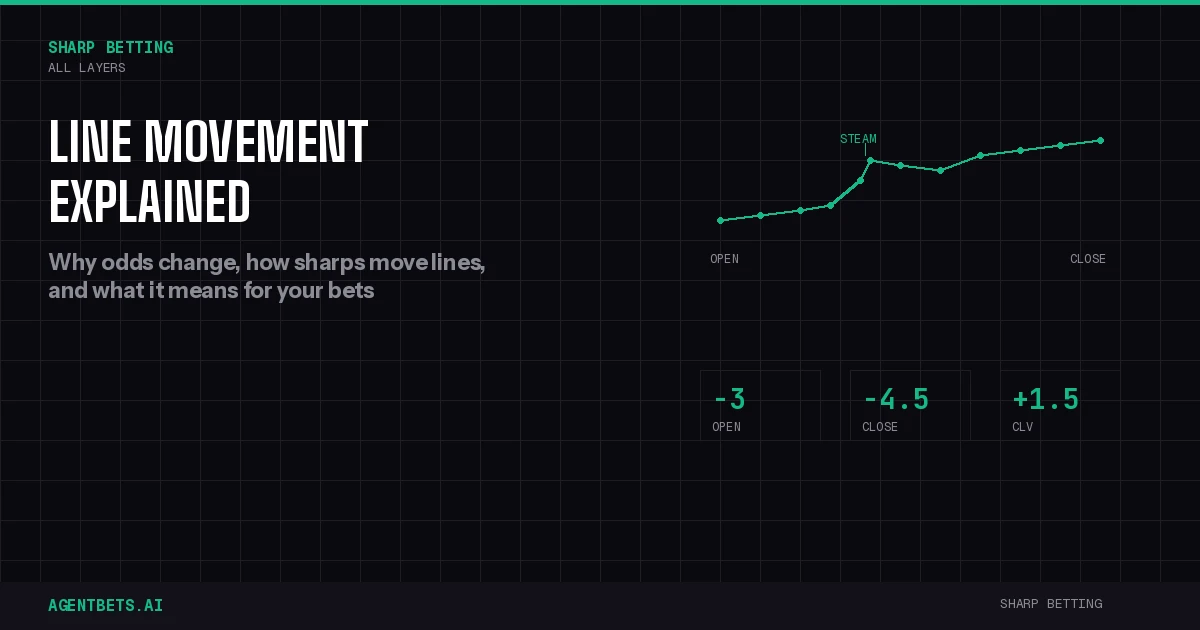
Lines move because money talks. Sportsbooks set an opening number, then adjust it based on who bets what and how much. Sharp bettors move lines disproportionately because books respect their track record. In prediction markets, prices move through open order books where anyone can be the market maker. Understanding why a line moved matters more than knowing that it moved.
What Is a “Line” and What Does “Movement” Mean?
A line is the number a sportsbook or market sets for a betting opportunity. In sports betting, it’s the point spread (-3.5), the total (over/under 217.5), or the moneyline (-150/+130). In prediction markets, it’s the price of a contract — $0.62 means the market thinks there’s a 62% chance of that outcome.
Line movement is any change to that number between the time it opens and the time the event starts (or the market resolves). When you see “the line moved from -3 to -3.5,” that’s movement. When a Polymarket contract goes from $0.55 to $0.62, that’s movement.
The question everyone asks first: does the line move because of the event or because of the bets?
Both. But mostly bets.
How Sportsbooks Set the Opening Line
Before a single dollar is wagered, someone has to post the first number. Here’s how that works.
Market-maker books go first. A small group of sportsbooks — Pinnacle, Circa, and a handful of sharp offshore books — post opening lines before anyone else. These books employ teams of traders and quantitative models that combine power ratings, historical data, situational factors (rest days, travel, altitude, weather), and early sharp opinions into an opening number.
The opening line is not the book’s prediction of the final score. It’s the number they think will attract roughly balanced action from their sharpest customers. Think of it as a hypothesis: “We think this number will survive scrutiny from the best bettors in the world.”
Everyone else copies. The majority of sportsbooks — DraftKings, FanDuel, BetMGM, most offshore books — do not set their own opening lines. They wait for the market-makers to post, then adopt similar numbers with slight adjustments based on their own customer base. If Pinnacle opens Chiefs -3, DraftKings might open Chiefs -3 with different juice, or maybe -2.5 if they expect their recreational customers to pound the Chiefs.
This is why line movement at Pinnacle matters more than line movement at any retail book. Pinnacle’s line is the closest thing to a “true” market price.
Why Lines Move: The Three Forces
Once the line is live, three things push it around.
1. Betting Action (The Big One)
When money comes in on one side, the book faces potential liability. If $500,000 comes in on the Chiefs -3 and only $50,000 on the Bills +3, the book has massive exposure to the Chiefs covering. They move the line to Chiefs -3.5 to make the Bills side more attractive and slow down the Chiefs action.
But — and this is the critical part — not all money is equal. A $10,000 bet from a known sharp bettor will move a line faster and further than $100,000 in $50 recreational bets. Books know which accounts have a history of beating the closing line, and they react to those accounts differently.
2. New Information
Injury reports, lineup changes, weather shifts, coaching decisions. When Patrick Mahomes is listed as questionable and then ruled out, the line doesn’t move because of bets. It moves because the fundamental probability of the outcome changed. Every book adjusts simultaneously, usually within minutes.
In prediction markets, information-driven moves look like sudden, high-volume price spikes. When a political figure makes an unexpected announcement, the corresponding Polymarket contract can swing 10–20 cents in seconds as traders race to reprice.
3. Copycat Movement
When Pinnacle moves a line, other books follow. This isn’t because they received the same bet — it’s because they trust Pinnacle’s price discovery. If Pinnacle moves from -3 to -3.5, a book still sitting at -3 knows they’re about to get hammered by sharp money arbitraging the discrepancy. So they move proactively.
For agent builders, this creates a window. The lag between a market-maker moving and a retail book catching up is where arbitrage and closing-line-value opportunities live. Track this programmatically with The Odds API and you can quantify the delay per book.
Sharps vs. Recs: Why It Matters Who’s Betting
The terms “sharp” and “rec” (recreational) describe bettors by their historical accuracy, not their bet size.
Sharp bettors are professionals or semi-professionals who consistently beat the closing line. They have tracked records, use quantitative models, and bet with the intent to make long-term profit. Sportsbooks know who they are because they track every account’s CLV (more on that below).
Sharp characteristics:
- Bet early, often at the opening line when there’s the most value
- Stake significant amounts (though not always — some sharps are limited to small bets)
- Focus on specific sports or markets where they have an edge
- Often part of syndicates that coordinate bets across multiple books
- Will bet either side — they have no emotional attachment to teams
Recreational bettors are everyone else. They bet for entertainment, bet on their favorite teams, bet based on narratives and TV coverage, and tend to bet favorites, overs, and big names. The industry calls their money “square money” or “public money.”
Rec characteristics:
- Bet closer to game time (after hearing TV analysts, seeing social media hype)
- Stake smaller individual amounts but represent the majority of total handle
- Bias toward favorites and overs (people like rooting for scoring and winners)
- Influenced by recency bias and narrative (“They just won 5 in a row, they’re hot”)
How this affects lines: When a book sees $200,000 come in from 10,000 rec accounts on the Chiefs, they adjust the line modestly — that money is “expected” and already somewhat priced in. When a book sees $50,000 come in from 3 sharp accounts on the Bills, they move the line significantly — that money signals informed opinion.
This is why you can have 80% of bets on one side and the line still moves the other way. That’s called reverse line movement, and it’s one of the most valuable signals in sports betting.
The Key Line Movement Patterns
Opening Line to Closing Line
The single most important trajectory is where the line opened versus where it closed (the final number at game time). If the line opened Chiefs -3 and closed Chiefs -4.5, the market decided that the opening price undervalued the Chiefs by 1.5 points. That movement is the collective wisdom of every dollar wagered.
Why this matters: The closing line at a sharp book like Pinnacle is the most efficient price available in sports betting. Studies consistently show that closing lines are better predictors of outcomes than any individual model. If you can consistently bet at prices that beat the closing line, you’ll be profitable long-term — even if individual bets lose.
Steam Moves
A steam move is a rapid, simultaneous line movement across multiple sportsbooks. Here’s the sequence:
- A sharp bettor or syndicate identifies value on a number
- They hit the same side at 5–10 books within a 60-second window
- Books that got hit move their lines immediately
- Books that didn’t get hit (but see the market shifting) move preemptively
- Within 2–5 minutes, every major book has adjusted
Steam moves are the loudest signal the market generates. When you see a line jump from -3 to -4 across the board in under five minutes with no injury or weather news, that’s steam. It means serious money has decided the current number is wrong.
How to spot steam programmatically: Pull odds from The Odds API every 60 seconds across all tracked books. Flag any game where 3+ books move in the same direction within a 5-minute window. That’s your steam detection algorithm.
Reverse Line Movement
Reverse line movement (RLM) is when the line moves opposite to where the public betting percentages suggest it should.
Example:
- 78% of bets on Team A -3
- Line moves to Team A -2.5

The public is pounding Team A, but the line moved in Team B's
direction. The book is essentially saying: "We'd rather have
more Team A exposure than move the line with the public."
RLM signals sharp money. The 22% of bets on Team B represent a smaller number of wagers but from accounts the book respects. The book is responding to the quality of the money, not the quantity.
RLM is a real signal, but it’s not magic. Important caveats:
- Betting percentage data from public sites is estimated, not exact. No one outside the book knows the true split
- Some RLM is information-driven (the book got a credible injury tip before it’s public)
- RLM works best as a confirming signal alongside other factors, not a standalone system
Line Freezes
Sometimes a line just stops moving — the book takes it off the board entirely or keeps it posted but won’t accept action above a very small limit. This is a line freeze or a “hold.”
Line freezes happen when the book knows something is off but doesn’t know what. Common triggers: unconfirmed injury rumors, lineup uncertainty, weather reports that conflict. The book would rather refuse action temporarily than post a number they know is wrong.
If you see a line frozen at multiple books simultaneously, pay attention. The information that caused the freeze is about to become public.
How Prediction Markets Move Differently
Everything above describes how sportsbooks manage lines. Prediction markets work differently because there’s no bookmaker.
On Polymarket, Kalshi, and other prediction markets, prices are set by a continuous double-auction order book (CLOB). Anyone can post a limit order to buy or sell shares at any price. The current price is simply where the last trade happened, or the midpoint between the best bid and best ask.
Polymarket order book example:
┌─────────┬──────────────────────────────┐
│  Bids   │           Asks               │
├─────────┼──────────────────────────────┤
│ $0.60   │  ██████████  500 shares      │
│ $0.59   │  ████████████████  800       │
│ $0.58   │  ██████████████████████ 1200 │
├─────────┼──────────────────────────────┤
│ Asks    │                              │
│ $0.61   │  ████████  400 shares        │
│ $0.62   │  ██████████████  700         │
│ $0.63   │  ████████████████████ 1100   │
└─────────┴──────────────────────────────┘
Current price: ~$0.605 (midpoint)
Key differences from sportsbooks:
| Factor | Sportsbook | Prediction Market |
|---|---|---|
| Who sets the price | The bookmaker (centralized) | The order book (decentralized) |
| What moves the price | Bets force the book to adjust | Buy/sell orders shift the order book |
| Vig/fee structure | Built into the odds (typically 4–10%) | Trading fees (1–2%) plus spread |
| Sharp identification | Account-level CLV tracking | Wallet analysis (on-chain for Polymarket) |
| Manipulation risk | Low (book controls the line) | Higher (whales can move thin books) |
| Speed of reaction | Minutes to hours | Seconds (if liquidity exists) |
| Information edge window | Opening line → steam move (hours) | Near-instant on deep markets |
In prediction markets, there’s no “sharp vs. rec” distinction in how the platform treats you — your order has the same priority whether you’re a first-time trader or a whale. But the effect is similar: large, informed orders move the price just like sharp bets move sportsbook lines.
The whale problem in prediction markets: Because prediction markets are order-book-based, a single large buyer can temporarily push prices far from “true” value on illiquid markets. This is what happened during the 2024 US presidential election when a small number of Polymarket accounts placed massive Trump bets that moved odds significantly. On-chain transparency means these moves are visible — you can see exactly which wallets drove the price — but they can still mislead casual observers who interpret the price as “what the market really thinks.”
For agent builders tracking prediction market price movement, the Polymarket CLOB API provides real-time order book data. Monitor the depth at each price level, not just the last trade price. A 2-cent move on an order book with $500K of depth means something very different from a 2-cent move on a $5K book.
Closing Line Value: The Metric That Matters Most
Closing Line Value (CLV) is the single most important concept in sharp sports betting. It measures whether you consistently get better prices than the market’s final consensus.
You bet:      Team A +3 at -110
Line closes:  Team A +2.5 at -110

You got half a point of positive CLV. Over time,
getting +3 instead of +2.5 is worth real money.
Why CLV matters more than win rate: A bettor can win 55% of their bets against the spread and still lose money if they consistently bet at prices that are worse than the closing line. Conversely, a bettor who wins only 49% but consistently beats the closing line will be profitable long-term because they’re getting mathematical value on every wager.
Research from Pinnacle’s own published data has shown that CLV is the strongest predictor of long-term profitability across all bet types and sports.
How books use CLV against you: Every major sportsbook tracks CLV per account. If your CLV is consistently positive — meaning you’re betting at prices the market later confirms were too generous — the book will limit you. On regulated US books (DraftKings, FanDuel, BetMGM), this can happen after as few as 50–100 winning bets at good prices. Offshore books like BookMaker and BetOnline generally tolerate sharps longer, which is part of why serious bettors use them.
For a data-driven look at which books offer the tightest lines (and therefore the hardest closing lines to beat), check the AgentBets Vig Index.
How to Read Betting Line Movement
Here’s a practical framework for interpreting line moves.
Track the direction from open to current. If a line opened at -3 and is now -4, the market is saying the opening price undervalued that side. If it opened -3 and is now -2.5, the market found the opening price was too high.
Compare across books. If Pinnacle is at -3.5 but DraftKings is still at -3, one of two things is true: DraftKings is slow to update (opportunity), or DraftKings’ customer base is tilted enough that -3 is the right number for their book. Check whether the Pinnacle number is moving — if it’s stable at -3.5, DraftKings is just slow.
Look for information vs. money. Did the line move because of a news event (injury, weather, lineup) or because of betting action? Information-driven moves happen suddenly and uniformly across all books. Money-driven moves start at sharp books and cascade outward.
Check the timing. Moves in the first few hours after opening are usually sharp-driven. Moves in the final hour before game time are often recreational-driven (weekend bettors piling on favorites after watching pregame shows). Early moves are generally more meaningful.
Respect the close. The closing line at a sharp book is the market’s final answer. If you’re tracking your own bets, compare your entry price to Pinnacle’s closing line. Do this for 200+ bets and you’ll know whether you have an edge.
Why This Matters for Agent Builders
Autonomous betting agents need to understand line movement at a programmatic level. Here’s how this guide translates to code:
Data pipeline. Pull odds snapshots from The Odds API at regular intervals (every 1–5 minutes depending on your use case). Store every snapshot with a timestamp. This gives you the raw material for detecting steam moves, measuring CLV, and identifying stale lines.
Steam detection. Compare each snapshot to the previous. If 3+ books move the same side by 0.5+ points within a 5-minute window, flag it as steam. Your agent can then decide whether to follow the steam or fade it based on its model.
CLV tracking. For every bet your agent places, record the price and the closing price at Pinnacle. After 500+ bets, calculate the average CLV. Positive CLV = your agent is finding real value. Negative CLV = your agent is consistently late or wrong, and you need to fix the model before you lose more money.
Prediction market depth monitoring. For Polymarket trades, don’t just track the midpoint price. Use the CLOB API to monitor order book depth at each price level. Your agent should size positions based on available liquidity, not just the posted price.
Cross-market signals. Some events are priced on both sportsbooks and prediction markets (e.g., World Cup outcomes, Super Bowl props). When the sportsbook line and the prediction market price diverge, one of them is wrong. An agent monitoring both via The Odds API and the Polymarket API can exploit these gaps before they close.
For more on the full infrastructure stack for building agents that trade on these signals, start with The Agent Betting Stack Explained.
What Does Line Movement Mean in Betting?
Line movement means the odds or point spread for a game changed between the time they were first posted and the current moment. When you see a spread go from -3 to -4.5, the market is telling you that money — particularly sharp money — has pushed the number in one direction. Line movement is not random. It is the direct result of wagers placed, information revealed, or other sportsbooks adjusting in response to market leaders like Pinnacle.
For bettors, line movement is a signal, not a guarantee. A line moving from -3 to -4.5 means the market thinks the favorite is stronger than the opening number suggested. But the reason for the move matters: sharp action, injury news, or copycat movement from retail books all produce the same visual result (a line shift) but carry different predictive weight.
The practical takeaway: always compare the current line to the opening line. If you are getting a number that is better than where the market has moved, you may have found value. If you are betting a number that has already moved past you, the market is ahead of you.
Quick Reference: Line Movement Cheat Sheet
| Signal | What It Means | Strength |
|---|---|---|
| Line moves with heavy public action | Normal — book adjusting to balance exposure | Weak signal |
| Line moves against heavy public action (RLM) | Sharp money on the other side | Moderate-to-strong |
| Steam move (rapid multi-book shift, no news) | Coordinated sharp action | Strong |
| Line frozen / off the board | Book suspects unreleased information | Caution signal |
| Opening line → close moves 1+ points one direction | Market found the opener significantly wrong | Strong directional |
| Line moves on confirmed news (injury ruled out) | Information-driven repricing | Not actionable (already priced in) |
| Prediction market price swings on thin book | Possible whale manipulation | Weak — check order book depth |
| Your bet price beats the close (positive CLV) | You found real value | The gold standard |
Line Movement Example: NFL Sunday Walkthrough
To tie all of these concepts together, here is how line movement plays out for a real-world NFL game from open to close.
Thursday 8 PM ET — Pinnacle posts the opener. Chiefs -3 (-110/-110). This is Pinnacle’s best estimate of the number that will attract balanced sharp action. Within 30 minutes, Circa posts -3 as well. The market-maker consensus is Chiefs -3.
Friday morning — Retail books open. DraftKings opens Chiefs -3 (-110), FanDuel opens Chiefs -2.5 (-115/+100). FanDuel expects their recreational customer base to lean Chiefs, so they shade the number half a point and adjust the juice.
Friday afternoon — First sharp action. Pinnacle moves from -3 to -3.5. No injury news, no weather change. This is money: a sharp bettor or syndicate hit Bills +3 at Pinnacle hard enough to push the line. Within 45 minutes, DraftKings follows to -3.5. FanDuel stays at -2.5 — their customer base is still pounding Chiefs, so the rec money is absorbing the sharp signal on their book.
Saturday noon — Steam move. Three sharp books move from -3.5 to -4 within a 5-minute window. No news event. This is coordinated sharp action: a syndicate hit multiple books simultaneously. Within 20 minutes, every tracked sportsbook has moved to at least -3.5, and most are at -4. FanDuel finally moves to -3 (-110/-110).
Sunday 11 AM — Injury news. The Chiefs starting left tackle is ruled out. Pinnacle moves from -4 to -3.5. This is information-driven — the fundamental probability shifted. Every book adjusts within minutes. The direction is the same across all books (toward the Bills), which is the hallmark of information-driven movement versus money-driven movement.
Sunday 1 PM — Closing line. Pinnacle closes at Chiefs -3.5 (-108/-112). This is the market’s final answer. Every bet placed at any point during the week should be measured against this number. A bettor who took Bills +4 on Friday afternoon got half a point of positive CLV. A bettor who took Chiefs -2.5 at FanDuel on Friday morning got 1 point of positive CLV — the best value available at any point in the cycle.
This sequence — open at market-makers, sharp action pushes the number, retail books lag, steam moves cause rapid multi-book shifts, information events trigger uniform repricing, and the close represents the most efficient price — plays out every week across every sport.
Tools for Tracking Line Movement
Manually comparing odds across books is impractical for systematic line movement analysis. These tools automate the process:
| Tool | What it does | Best for |
|---|---|---|
| The Odds API | Real-time odds from 15+ sportsbooks via REST API | Building custom steam detection and CLV tracking pipelines |
| AgentBets Vig Index | Sportsbook-level vig rankings updated daily | Identifying which books consistently offer the sharpest lines |
| Polymarket CLOB API | Order book depth, trades, and price history | Monitoring prediction market price movement at the order level |
| Cross-Market Arb Finder | Live comparison of sportsbook and prediction market prices | Spotting line movement divergences between traditional and prediction market pricing |
For agent builders, the pattern is: poll odds from The Odds API every 1–5 minutes, store timestamped snapshots, compute opening-to-current movement per game, flag steam moves (3+ books moving the same direction within 5 minutes), and track CLV for every bet your agent places. After 500+ bets, your CLV data tells you whether your model is finding real value or consistently arriving too late.
What’s Next
This guide gives you the conceptual foundation. To go deeper into the mechanics:
- Understand the cost of betting: How to Calculate Vig explains the math behind the bookmaker’s edge on every line
- Find efficient books: The AgentBets Vig Index ranks sportsbooks by pricing efficiency across sports and markets
- Know which books tolerate sharps: Sharp vs. Soft Sportsbooks breaks down where your action is welcome and where you’ll get limited
- Get the data programmatically: The Prediction Market API Reference covers every endpoint for tracking odds across platforms
- Build your first trading agent: The Agent Betting Stack walks through the four-layer architecture from identity to intelligence