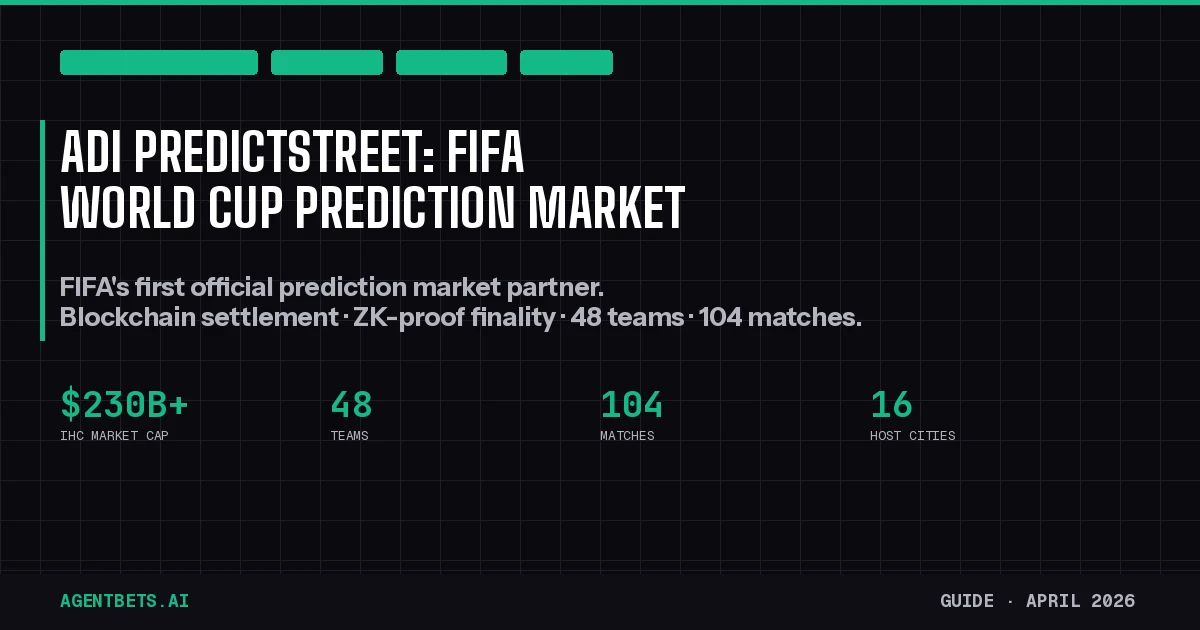
ADI Predictstreet is FIFA’s first Official Prediction Market Partner, announced April 2, 2026, for the FIFA World Cup 2026. Built on ADI Chain — an Ethereum Layer 2 using ZKsync’s zero-knowledge proof technology — the platform introduces blockchain-based sports forecasting to the largest tournament in football history: 48 teams, 104 matches, 16 host cities across Canada, Mexico, and the United States.
What ADI Predictstreet Is
ADI Predictstreet is a prediction market platform that lets users forecast real-world event outcomes by trading contracts whose prices reflect collective probability estimates. The platform aggregates participant sentiment into measurable probabilities, functioning as what the team describes as a real-time sentiment engine.
The FIFA partnership makes Predictstreet the presenting partner for FIFA’s global free-to-play bracket challenge and gives it access to FIFA’s official historical data for market resolution. Users can trade on match outcomes, tournament statistics, standout player performances, and key moments throughout the World Cup.
Football is the launch vertical, but ADI Predictstreet has announced plans to expand into prediction markets covering politics, economics, technology, and popular culture — positioning itself as a general-purpose forecasting platform with sports as its entry point.
Corporate Structure and Backing
ADI Predictstreet sits within a deep corporate hierarchy rooted in Abu Dhabi’s sovereign-adjacent capital ecosystem.
The ownership chain works like this: International Holding Company (IHC), listed on the Abu Dhabi Securities Exchange with a market capitalization above $230 billion, sits at the top. IHC is one of the most valuable companies in the Gulf states and operates over 400 subsidiaries across real estate, healthcare, food, energy, technology, and financial services. Sirius International Holding, an IHC subsidiary, founded the ADI Foundation — the Abu Dhabi-based non-profit entity (registered with ADGM under commercial license number 20599) that developed ADI Chain. ADI Predictstreet itself is a subsidiary of Finstreet Limited, another IHC subsidiary.
This matters for prediction market builders and agents because it signals a level of institutional capitalization that few prediction market platforms can match. Polymarket’s largest investor is Intercontinental Exchange (operator of the NYSE), which agreed to invest up to $2 billion. Kalshi has raised over $1 billion from venture firms including Paradigm. ADI Predictstreet’s parent ecosystem manages hundreds of billions in assets — a different order of magnitude entirely.
Key personnel include Andrey Lazorenko as CEO of the ADI Foundation and Ajay Hans Raj Bhatia as Principal Council Member of ADI Predictstreet.
ADI Chain: Technical Architecture
ADI Chain is an Ethereum Layer 2 blockchain built on ZKsync’s zkStack framework and powered by the Airbender prover. Understanding the infrastructure matters because it dictates what agents can and cannot do on the platform.
Zero-Knowledge Rollup Design
ADI Chain executes transactions off-chain, generates zero-knowledge validity proofs that batches were processed correctly, and posts proof data to Ethereum for final settlement. This gives the chain Ethereum’s security guarantees while operating at much higher throughput and lower cost than mainnet.
The Airbender prover is the differentiating component. Traditional ZK provers are CPU-bound and slow; Airbender uses GPU acceleration to parallelize proof generation, reducing proof times from minutes to seconds. ADI Chain was the first blockchain built with this technology, delivering Ethereum block proofs in approximately 35 seconds according to ZKsync’s documentation.
Custom Gas Token
Unlike most L2s that require ETH for gas fees, ADI Chain runs natively on the $ADI token. Every on-chain transaction — including Predictstreet market trades — consumes $ADI as gas. This design simplifies the user experience for institutional and retail users who don’t need to hold ETH separately.
As of early April 2026, the $ADI token trades around $4.05, with a circulating supply of 80 million tokens (out of a maximum supply of 1 billion), giving it a market capitalization of approximately $324 million. The token hit an all-time high of $4.54 immediately following the FIFA partnership announcement.
EVM Compatibility
ADI Chain is EVM-compatible, meaning Ethereum smart contracts and tooling work with minimal modification. For agent builders, this means existing Ethereum development frameworks (ethers.js, web3.py, Hardhat, Foundry) should integrate without custom adapters.
Modular Layer 3 Support
ADI Chain supports modular Layer 3 chains on top of its L2 infrastructure. Entities — governments, enterprises, regulated platforms — can deploy their own compliance-optimized L3 domains, segmented by jurisdiction or policy, while remaining connected to ADI Chain’s L2. This is relevant for Predictstreet’s phased global rollout, where different jurisdictions may require different compliance configurations.
Security Audits
ADI Chain’s smart contracts have been audited by two firms: OpenZeppelin and Hacken. Both are established blockchain security auditors. The audit reports provide baseline assurance for the settlement layer that Predictstreet trades will resolve on.
Licensing and Regulation
ADI Predictstreet is licensed from Gibraltar, which granted its first-ever prediction market license on March 26, 2026, under the 2005 Gambling Act. This is a meaningful regulatory milestone — Gibraltar has historically been a progressive jurisdiction for online gaming but had never previously licensed a prediction market operator.
The Gibraltar license means Predictstreet operates under gambling regulation rather than financial derivatives regulation (the framework used by U.S. platforms like Kalshi, which is regulated by the CFTC). This distinction has practical implications: the platform is classified as a forecasting/gaming product, not a financial instrument, which affects which jurisdictions it can legally operate in and how user funds are protected.
ADI Predictstreet’s FIFA activities specifically operate under FIFA’s own integrity monitoring framework, which includes real-time monitoring of suspicious trading activity, structured information-sharing protocols, and reporting systems. The platform implements geographic and age restrictions on a per-jurisdiction basis as part of its phased rollout.
FIFA World Cup 2026: Market Scope
The 2026 World Cup is the largest FIFA tournament ever staged: 48 teams (up from 32), 104 matches (up from 64), and 16 host cities spanning three countries. FIFA estimates a global audience of over 5 billion viewers. This scale creates an enormous surface area for prediction markets.
Based on the partnership announcement and FIFA’s press release, Predictstreet will offer markets across several categories:
Match outcomes — win/draw/loss contracts for individual group stage and knockout matches, resolved using FIFA’s official data.
Tournament statistics — aggregate market contracts on goals scored, cards issued, penalty shootouts, and other tournament-level metrics.
Standout players — individual player performance markets (Golden Boot, Golden Ball, specific stat lines) resolved against official FIFA records.
Key moments — event-level markets on specific in-match occurrences (first goal timing, red cards, extra time).
Bracket challenge — Predictstreet serves as the presenting partner for FIFA’s free-to-play bracket prediction game, which has historically drawn tens of millions of participants.
For agent builders working with World Cup prediction models and Poisson-based soccer forecasting, the FIFA data access is significant. Official historical data for market resolution eliminates one of the biggest reliability concerns with sports prediction markets: data source disputes.
Competitive Landscape
ADI Predictstreet enters a prediction market space that has consolidated rapidly around league partnerships. Here is where the major platforms stand as of April 2026:
| Platform | League Partnerships | Regulator | Infrastructure | Token |
|---|---|---|---|---|
| ADI Predictstreet | FIFA (World Cup 2026) | Gibraltar Gambling Act | ADI Chain (Ethereum L2, ZKsync) | $ADI |
| Polymarket | NHL, MLB, MLS, UFC | U.S. CFTC (via brokers) | Polygon PoS | USDC settlement |
| Kalshi | NHL | U.S. CFTC | Centralized exchange | USD |
What Predictstreet Does Differently
The FIFA deal gives Predictstreet three structural advantages that Polymarket and Kalshi lack in the soccer/football vertical.
First, exclusive official data access. Polymarket and Kalshi resolve markets using third-party data providers. Predictstreet resolves using FIFA’s own data, which is the canonical source for the tournament. This eliminates resolution disputes, a persistent pain point for prediction market traders.
Second, institutional-grade blockchain settlement. Polymarket runs on Polygon PoS, a general-purpose sidechain. Predictstreet runs on ADI Chain, a purpose-built institutional L2 with ZK-proof finality on Ethereum. For agents managing significant capital, the settlement security model matters.
Third, global-first licensing. Polymarket and Kalshi operate primarily under U.S. federal derivatives regulation (CFTC), which creates jurisdictional friction outside the U.S. and ongoing state-level legal challenges. Predictstreet’s Gibraltar license gives it a cleaner regulatory path for global deployment, though it faces its own set of per-country compliance hurdles as it rolls out.
What Predictstreet Lacks
Polymarket and Kalshi have years of operational history, deep liquidity, established APIs, and proven track records. Polymarket alone processes billions in monthly trading volume across thousands of markets. Kalshi operates a fully regulated order book exchange with direct CFTC oversight.
ADI Predictstreet has not yet launched publicly (scheduled for April 9, 2026). It has no public API documentation, no published order book data, no historical trading volume, and no track record of market resolution. For agent builders, this means there is currently no way to backtest strategies, evaluate liquidity depth, or build integrations against a live system.
The platform’s decision to launch with a FIFA mega-event as its first product is high-risk, high-reward: massive audience exposure, but zero margin for error on the technical and operational side.
Agent Integration Potential
From the perspective of the Agent Betting Stack, ADI Predictstreet introduces a new Layer 3 (Trading) surface that agents will need to evaluate.
Layer 1 — Identity
ADI Chain’s institutional design suggests KYC/AML requirements will be baked into the onboarding process, particularly given FIFA’s integrity framework. Agent builders should expect identity verification requirements that may be more restrictive than Polymarket’s pseudonymous trading model. The modular L3 architecture could mean different identity requirements per jurisdiction.
Layer 2 — Wallet
The $ADI gas token requirement means agents need to hold ADI tokens for transaction fees, separate from whatever settlement currency is used for market positions. For a comparison of how different wallet architectures handle multi-token gas requirements, the wallet security post-mortem analysis provides relevant patterns.
EVM compatibility is the saving grace: existing Ethereum wallet infrastructure (Coinbase AgentKit, Safe multisig, standard EOAs) should work with ADI Chain after pointing at the correct RPC endpoint.
Layer 3 — Trading
No public API documentation exists yet. The platform has announced mobile and desktop applications, which suggests the initial focus is on retail consumer trading rather than programmatic access. Agent builders should monitor for REST API or WebSocket endpoints post-launch.
The Prediction Market API Reference will be updated with ADI Predictstreet endpoints once public API documentation becomes available. For comparison with existing trading interfaces, the Polymarket API guide and Kalshi API guide provide reference implementations.
Layer 4 — Intelligence
The most compelling agent opportunity may be cross-platform arbitrage between ADI Predictstreet’s World Cup markets and equivalent markets on Polymarket, Kalshi, and traditional sportsbooks. If Predictstreet offers the same match outcome contracts as sportsbooks, agents running expected goals models or World Cup bracket simulations can compare prices across venues and route execution to the best available line.
The OpenClaw World Cup odds skill provides a framework for aggregating odds across multiple sources — adding Predictstreet as a data source would extend its coverage once an API is available.
The Prediction Market–Sports League Convergence
The ADI Predictstreet–FIFA deal is part of a clear pattern. In chronological order:
- October 2025: The NHL became the first major U.S. sports league to partner with prediction markets, signing multiyear deals with both Kalshi and Polymarket.
- January 2026: MLS signed an exclusive multiyear deal with Polymarket covering the All-Star Game and MLS Cup.
- March 2026: MLB named Polymarket its official prediction market partner and signed a memorandum of understanding with the CFTC — the first such agreement between a sports league and a federal regulator.
- April 2026: FIFA named ADI Predictstreet as its first-ever prediction market category partner for the 2026 World Cup.
The NFL, NBA, PGA Tour, and NCAA have not yet entered prediction market partnerships, though individual athletes (Giannis Antetokounmpo, Kyle Kuzma, Saquon Barkley) have made personal investments in Polymarket and Kalshi.
This convergence matters for anyone building in the agent betting space. Every league partnership creates a new set of officially sanctioned markets with league data feeds, integrity frameworks, and branded trading products. The marketplace tracks which agent tools and frameworks integrate with each platform as these partnerships expand.
Risks and Open Questions
Several important unknowns remain for anyone evaluating ADI Predictstreet as a trading venue or integration target.
No live product. The platform has not launched publicly. Everything described in this guide is based on the partnership announcement, press releases, corporate disclosures, and inference from ADI Chain’s documented architecture. Actual platform mechanics, fee structures, market types, liquidity provisioning, and API access may differ materially from what’s been announced.
Liquidity depth. New prediction market platforms typically struggle with liquidity in early operation. Even with FIFA’s global audience, converting passive viewers into active market participants is a nontrivial challenge. Thin order books mean wider spreads and higher execution costs for agents.
Token economics. With only 80 million of 1 billion $ADI tokens in circulation (8% of max supply), significant token unlocks lie ahead. Dilution risk and gas cost volatility are real concerns for agents that need to hold $ADI for transaction fees.
Regulatory fragmentation. A phased global rollout means the platform’s availability, market types, and user protections may vary significantly by jurisdiction. Agent builders targeting global arbitrage strategies need to track which markets are available in which geographies.
Integrity scrutiny. Prediction markets on sports events have repeatedly drawn regulatory challenges. The CFTC’s existing oversight of Polymarket and Kalshi in the U.S. is still being litigated in multiple states. Predictstreet’s Gibraltar license insulates it from U.S. state challenges but exposes it to other jurisdictions’ gambling regulators.
API access timeline. No public API has been announced. Without programmatic access, agent integration is impossible. This is the single most important item to watch for builders evaluating the platform.
Key Dates
| Date | Event |
|---|---|
| March 26, 2026 | Gibraltar grants first-ever prediction market license to ADI Predictstreet |
| April 2, 2026 | FIFA announces ADI Predictstreet as Official Prediction Market Partner |
| April 9, 2026 | ADI Predictstreet public launch (announced) |
| June 11, 2026 | FIFA World Cup 2026 kicks off |
| July 19, 2026 | FIFA World Cup 2026 final |
Bottom Line
ADI Predictstreet has the most consequential sports partnership in prediction market history. FIFA’s 5-billion-viewer audience dwarfs the reach of any existing league deal with Polymarket or Kalshi. The IHC-backed capital structure, ADI Chain’s ZK-proof settlement architecture, and Gibraltar licensing give the platform institutional credibility that most crypto-native prediction markets lack.
But credibility is not liquidity, and announcements are not products. The platform launches April 9 with zero operational track record. Agent builders should watch for three things: a public API, published order book data, and evidence of meaningful trading volume in the first week. Until those exist, Predictstreet is a high-potential venue that cannot yet be integrated into production trading systems.
For World Cup 2026 forecasting, the most practical approach right now is building models with the World Cup betting math framework and the OpenClaw World Cup odds skill, routing execution through existing platforms like Polymarket and sportsbooks, and adding Predictstreet as a venue once its API becomes available.