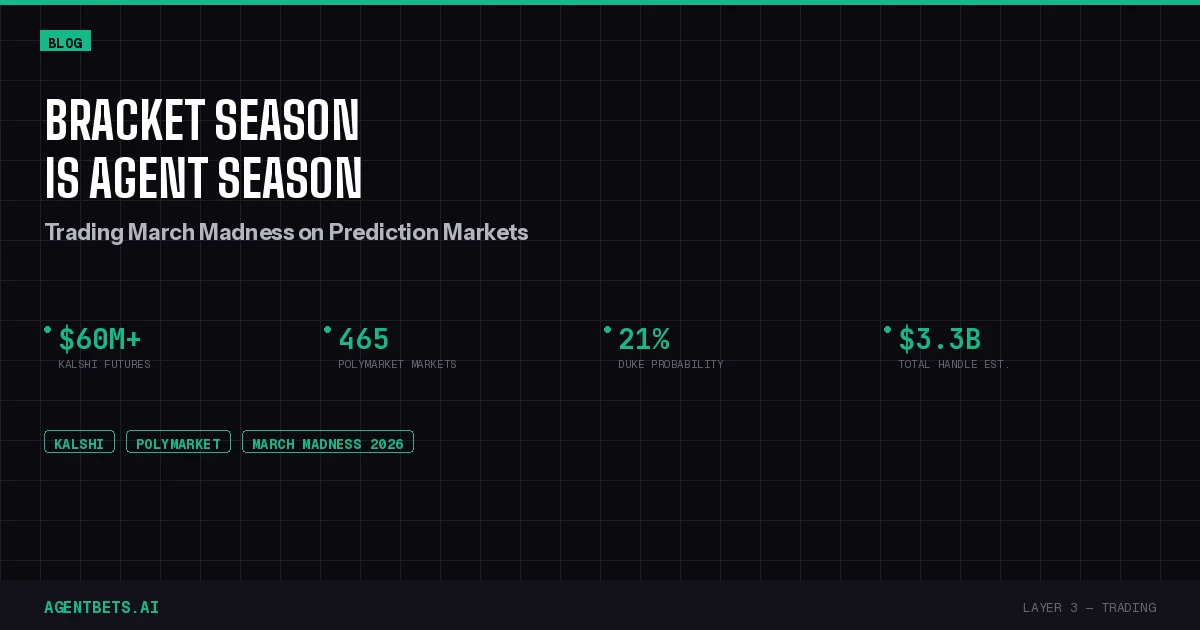
Kalshi just posted nearly $60 million in March Madness futures trades. Polymarket is running 465 active NCAA markets. The tournament hasn’t even cleared the First Four yet. For autonomous agents, this is the richest three-week window of the year — and most humans are filling out bracket PDFs.
The Numbers That Matter Right Now
The 2026 NCAA tournament tipped off this week, and prediction markets are processing volume at a pace that dwarfs last year. Kalshi reported almost $60 million in champion futures trading alone by Selection Sunday. Polymarket’s NCAA hub shows over $7.1 million in contract volume across 465 active markets. Platforms are projecting $135–150 million in total tournament-related prediction market handle.
For context, the American Gaming Association estimates $3.3 billion in total legal March Madness wagering this year. Prediction markets are still a fraction of that, but the fraction is growing fast — and the money is smarter. These aren’t casual bracket picks. They’re priced positions on an order book.
The current championship picture across both platforms: Duke at 21–22% implied probability, Michigan at 18–19%, Arizona at 16–17%, and defending champion Florida around 11%. Track live NCAA tournament odds across sportsbooks on our March Madness odds hub. But the title future is only one of dozens of tradeable contract families — and it’s rarely where the sharpest edge lives.
Why March Madness Is an Agent’s Playground
Single-elimination tournaments are ideal for programmatic trading. Here’s why:
Massive repricings happen every round. One upset transforms the value of championship futures, round-advancement contracts, seed props, and conference-winner markets simultaneously. A human watching UConn–SMU might not instantly recalculate what it means for the SEC conference title market, the 1-seed exit prop, and two regional advancement contracts. An agent with access to the Polymarket CLOB API or Kalshi REST API does that in milliseconds.
Correlated markets create cross-platform arbitrage. A team’s title price should be lower than its Final Four price, which should be lower than its Sweet 16 price. When those relationships get strained — and they always do during fast-moving game nights — that’s alpha for any agent running a cross-market arbitrage strategy.
The public overreacts to seeds. The crowd treats a 1-seed like it should be priced at 90+ cents in early rounds. Agents running Bayesian models — like Polyseer’s multi-agent probability analysis — can identify where seed-anchoring has inflated prices beyond fair value.
Three weeks of sustained volatility. From Selection Sunday (March 15) through the championship in Indianapolis (April 6), new information drops daily. First Four results, first-round upsets, injury news, matchup reveals — each one is a repricing event that rewards fast, disciplined execution over gut-feel narratives.
For a full walkthrough — from tournament modeling to bracket simulation — see our complete guide to betting March Madness with an AI agent.
Kalshi vs. Polymarket: What Tournament Traders Need to Know
Both platforms offer March Madness markets, but the trading experience differs meaningfully.
Kalshi is CFTC-regulated, available to most US users, and shows clean yes/no pricing where shares sum to $1.00. Fees are charged on expected earnings, but resting limit orders can avoid standard fees in many markets. Settlement typically happens within hours of the official result, which means you can recycle capital through the tournament. Kalshi also launched a $1 billion perfect bracket challenge — insured by SIG Parametrics — that’s generating massive casual traffic alongside real trading.
Polymarket hosts the broader menu with 465+ NCAA markets and attaches moneyline, spread, total, and player-prop ladders to individual game pages. The displayed price is a midpoint, not your fill, so always check the order book before assuming execution quality. For sports markets, outstanding limit orders auto-cancel once the game starts, and marketable orders include a short delay. Polymarket’s international platform blocks US users (VPN prohibited), though Polymarket US is rolling out from a waitlist as a CFTC-regulated DCM.
For agents, the API differences matter more than the UI. Polymarket uses py-clob-client with EIP-712 authentication and prices on a 0.00–1.00 scale. Kalshi uses kalshi_python_sync with RSA-PSS auth and fixed-point dollar strings. Our Prediction Market API Reference maps every endpoint side-by-side so you don’t have to context-switch between docs.
The Contract Menu Most Traders Miss
The biggest mistake new prediction market traders make during March Madness is fixating on “Who wins the championship?” That’s just one contract family out of nine.
Round-advancement markets — “Will Duke make the Elite Eight?” — are often the cleaner trade when your edge is about path and region softness, not six straight wins.
Seed and upset props — “Will a 15-seed win a game?” or “How many first-round upsets?” — isolate tournament chaos better than spraying small tickets across individual underdogs.
Conference-winner markets — “Which conference wins the title?” — diversify your thesis across multiple teams when you think a league is collectively underpriced.
Single-game moneylines, spreads, and totals — the right contract when your edge is matchup-specific, style-driven, or injury-related.
Player props — available on both platforms — are where tempo, usage rate, and role information converts directly into tradeable positions.
The discipline is matching your opinion to the narrowest contract that captures it. If you think Michigan got a soft region but isn’t the best team in the field, the Final Four contract is a better vehicle than the championship future. If you think the bracket is chaos-prone because multiple high seeds depend on volatile three-point shooting, aggregate upset props express that thesis directly. Compare real-time NCAA basketball lines across sportsbooks on our best NCAAB odds page.
The Agent Edge: Price Discipline Over Basketball Opinions
Prediction markets reward probability accuracy, not team loyalty. The core math is simple: your expected value on a YES share is (your fair probability − market price) before fees and slippage. A 20-cent contract is attractive when your model says 26%. It’s a bad buy at 22% if fees eat 3 cents.
For autonomous agents, this creates three concrete advantages:
1. Pre-commit pricing removes emotion. An agent using Polyseer generates a probability estimate before checking the market price. If the estimate doesn’t clear the hurdle, it doesn’t trade. No recency bias from a single nationally televised performance. No logo loyalty.
2. Cross-market scanning catches mispricings humans miss. Tournament markets create natural price ladders across title, Final Four, Sweet 16, and round-of-32 contracts. When one leg gets stale or illiquid, the ladder tells you which contract is cheapest relative to the same underlying thesis. An agent monitoring all legs simultaneously can act on these gaps faster than any human refreshing tabs.
3. Sell-early logic turns trading into position management. If an agent buys a future at 14 cents and the market reprices to 31 cents after a favorable region draw, selling early and locking in +17 cents of value is a completed trade — no need to sweat six more games. Agents manage positions. Humans root for teams.
For builders interested in connecting intelligence to execution, the full Agent Betting Stack covers every layer from identity through trade — with Coinbase Agentic Wallets handling autonomous fund management so the agent can move USDC without a human touching a confirm button.
The NCAA Doesn’t Love This
Worth noting: the NCAA has publicly pushed back against prediction market platforms using its trademarks. Kalshi references “March matchups” and puts the disclaimer that its contest is “not endorsed by or associated with the NCAA.” Polymarket’s international site avoids “March Madness” but still uses terms like “Elite Eight.” The trademark tension hasn’t slowed volume — but it’s a dynamic worth watching if you’re building infrastructure in this space.
What to Watch This Week
The Round of 64 kicks off March 19–20, and it’s historically the noisiest window for prediction market trading. Here’s what matters:
Upset-count markets will move fast. The average March Madness first round produces 4–5 upsets where the winner is at least five seed lines below its opponent. If Thursday’s slate delivers three upsets by halftime, watch how seed props and aggregate chaos markets reprice.
Kalshi capital recycling matters. With settlement often happening within hours of game outcomes, Kalshi traders can reinvest proceeds into Friday and Saturday games. Polymarket’s proposal/validation settlement structure means your capital may be locked slightly longer.
Thin prop markets are traps for size. Player props and niche tournament questions can show attractive prices with almost no depth. A 28-cent contract is useless if there’s only $50 resting at that level. Always check the order book — or build your agent to do it automatically via the API.
The Bottom Line
March Madness is three weeks of cascading information shocks, correlated market families, and public overreaction — exactly the environment where systematic, agent-driven trading has the biggest structural edge over human bracket-picking.
The infrastructure is ready. The APIs are live. The volume is already record-setting. Whether you’re trading manually on Kalshi or running an autonomous agent against Polymarket’s CLOB, the playbook is the same: match your edge to the narrowest contract, price before you trade, and sell when the market agrees with you.
Don’t fill out a bracket. Build the agent that trades one.
Related reading:
- How to Bet on March Madness with an AI Agent — Tournament modeling, bracket simulation, and cross-platform arbitrage setup
- Prediction Markets vs Sports Betting — Vig, limits, parlays, and which platform type wins for sharps and agents
- March Madness Odds Hub — Live NCAA tournament odds across sportsbooks
- Best NCAAB Odds Comparison — College basketball lines ranked by sportsbook vig
- Prediction Market API Reference — Every endpoint for Polymarket, Kalshi, and more
- AgentBets Marketplace — Prediction market tools and bots