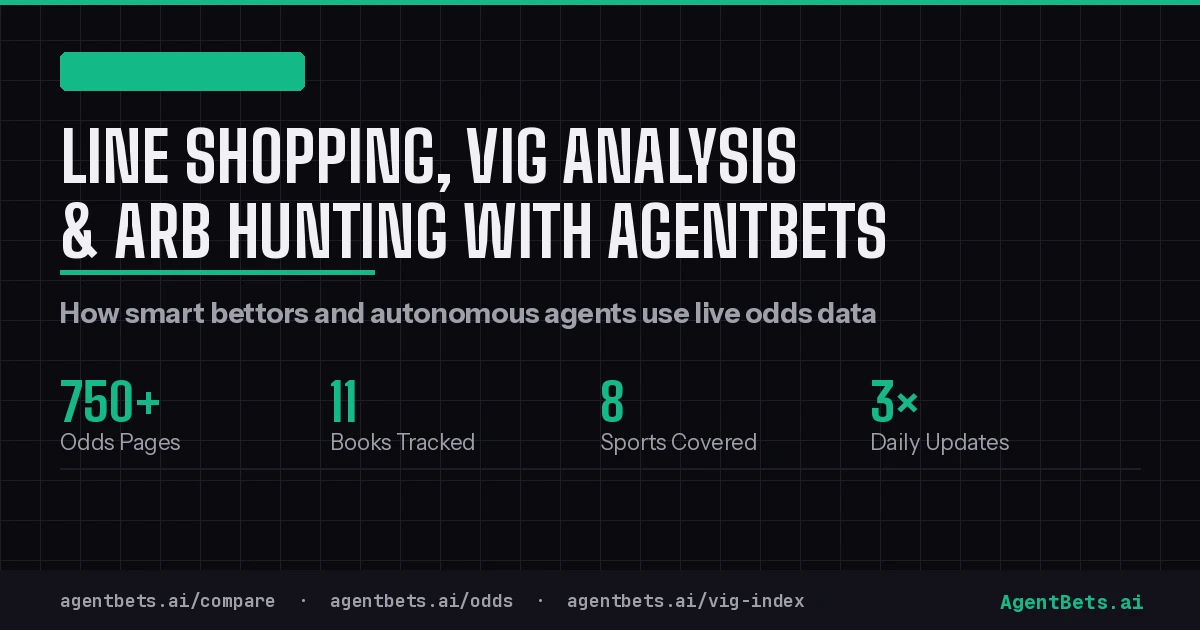
AgentBets tracks live odds across 11 sportsbooks and 8 sports, updated 3x daily. The tools on
/compare/and/odds/exist for one purpose: eliminating the information asymmetry between sharp bettors (and autonomous agents) and the books. This is how to use them.
Every dollar of vig is a dollar of edge the sportsbook keeps. Every half-point of line difference is a material shift in your expected value. The gap between a bettor who shops lines and one who doesn’t is measured in percentage points over a year — and percentage points are the margin between profitable betting and slow-burn loss.
AgentBets runs a live odds infrastructure specifically built to close that gap. This guide covers everything: what each data hub does, how to interpret vig grades, how to use comparisons for line shopping, how to hunt arbitrage, and how autonomous agents consume all of this programmatically.
The Three Data Hubs
The entire AgentBets odds infrastructure flows from three sources. Understand these first and everything else clicks into place.
1. The Vig Index
Start at /vig-index/. This is the strategic layer — aggregate efficiency rankings that tell you which books are worth having accounts at before you look at a single game.
The Vig Index ingests live odds from The Odds API across every in-season sport, calculates the overround on each market, averages across all events, and assigns a letter grade. It runs at 6 AM, 2 PM, and 10 PM UTC — three fresh snapshots per day.
The grading scale is anchored to a real number: a standard -110/-110 two-way line equals 4.76% vig. That’s a B. Everything below 4.76% is above average for US bettors.
| Grade | Avg Overround | What It Means |
|---|---|---|
| A+ | < 2.0% | Exchange-level. Pinnacle territory. |
| A | < 3.5% | Sharp lines. You’re getting close to true probability. |
| B+ | < 4.5% | Above average. Better than most US retail. |
| B | < 6.0% | Standard US range. The -110/-110 baseline. |
| C | < 8.0% | Below average. You’re subsidizing the book. |
| D | < 10.0% | High vig. Use only when you have no alternative. |
| F | ≥ 10.0% | Predatory. Avoid. |
The index covers both regulated US books (DraftKings, FanDuel, BetMGM, Caesars, BetRivers, Fanatics, ESPN BET) and offshore/sharp books (Bovada, BetOnline, MyBookie, BetUS, LowVig.ag, BetAnySports, Pinnacle). Books are discovered dynamically — when a new book appears in The Odds API’s us or us2 regions, it gets picked up automatically.
One thing to check: the Events column on each book’s ranking. A grade based on 50 events is less reliable than one based on 500. A book showing an A with 40 NFL events in the sample might just be cherry-picking a few markets; an A with 400 events is signal.
2. The Live Odds Hub
The /odds/ hub is event-level. Where the Vig Index tells you which book is cheapest in aggregate, the Odds Hub shows you actual lines on actual games.
It runs over 750 dynamically generated pages organized two ways:
By sport — each sport gets its own page showing every active event across all tracked books. When a sport is in season, you’ll see vig rankings, per-market breakdowns (moneyline, spreads, totals), best-line leaders for each event, and book coverage counts. Off-season pages surface which other sports are live so you can navigate to active markets.
By sportsbook — every tracked book has its own odds page. Browse BetMGM odds, BetOnline odds, Bovada odds, and so on. These are useful when you want to check a specific book’s current slate rather than compare across books for a specific sport.
The /odds/vig/ sub-hub goes deeper: per-sport, per-market, per-book vig breakdowns. If you want to know specifically whether DraftKings is sharper on NBA totals than on NBA moneylines, that’s where you find it.
3. The Compare Hub
/compare/ is the decision layer — where you translate vig data and odds data into concrete choices. It organizes into four categories:
Best odds by sport — 8 pages, one per sport, each ranking 11 sportsbooks by vig with live data. If you only ever use one page on this site, use the one matching the sport you bet most.
Head-to-head sportsbook matchups — 54 pairwise comparisons covering regulated vs regulated, offshore vs regulated, and offshore vs offshore. Each page goes deep on vig, coverage, market depth, and best-line win rates by sport.
Prediction market comparisons — head-to-heads across Polymarket, Kalshi, DraftKings Predictions, and the bots that trade them.
Bot infrastructure analysis — which sportsbooks have the most favorable structure for automated and arbitrage betting, including /compare/best-sportsbook-arb-bots/.
How to Shop Lines: The Manual Flow
Line shopping is the simplest edge in sports betting and the most consistently ignored by recreational bettors. The AgentBets tools make it mechanical.
Step 1: Check the Vig Index for your sport. Before the week starts, pull up the per-sport ranking for whatever you’re betting. This tells you the structural pricing leader for that sport. That’s your primary book — the one where, absent a specific line advantage elsewhere, you’re placing the bet.
Step 2: Before any specific bet, check the sport’s best-odds page. Go to /compare/best-nba-odds/ (or NHL, MLB, MMA, etc.) and look at which book is leading on best-line wins for the current slate. The best-line leader isn’t always the lowest-vig book — sometimes a book prices a specific game differently from its general market behavior.
Step 3: Cross-reference with the relevant head-to-head. If you’re deciding between two books you have funded, go straight to that matchup page. DraftKings vs FanDuel is the most-used for regulated US bettors; Bovada vs BetOnline for offshore. These pages show historical best-line win rates by sport — you’ll see that one book might win on spreads while the other wins on totals.
Step 4: Check the Odds Hub for the specific event. Once you know which books to focus on, go to the sport’s page on /odds/ and see which book has the better number on your specific game. Sometimes the structural leader gets outpriced on a specific event by a competitor that’s slow to adjust.
The fully optimized line-shopping stack means having accounts at 3–4 books: your lowest-vig structural leader, the main alternative that wins on totals or specific sports, and one offshore reduced-juice book for any line where you’re getting a full point or more better than the regulated books.
Understanding Vig: The Math That Makes This Matter
The vig grade isn’t abstract. It maps directly to long-run cost.
At -110/-110, the implied probabilities sum to 104.76% — meaning the book’s edge on a fair coin-flip bet is 4.76%. Over a flat $100 wager on 1,000 bets (a reasonable annual volume for an active bettor), the difference between a 4.76% and a 2.5% vig book is over $2,200 per year in pure drag, before any skill or edge.
Expressed differently: moving from a B-grade book to an A-grade book is worth roughly 2+ percentage points of vig reduction. If you’re a break-even bettor at -110, you’re immediately profitable at -105.
This is why the Vig Index uses letter grades rather than just percentage numbers. Bettors don’t need to memorize overround formulas — they need to know whether the book they’re using is in A territory (worth using as a primary), B territory (fine as a secondary), C territory (use only for specific line advantages), or below (never use as a primary account).
The offshore vs regulated comparison quantifies this clearly. Offshore reduced-juice books typically run 2–3% vig vs 4–5% at US regulated books. That gap is structural — regulated US books operate with higher compliance costs and customer acquisition expenses, and they price accordingly. The Vig Index makes this difference visible in real time rather than as a general rule of thumb.
Arbitrage Betting: How to Spot Opportunities with the Compare Tools
Arbitrage (arb) betting means covering every outcome of an event across multiple books such that the combined implied probabilities sum to under 100% — locking in a guaranteed profit regardless of result.
The math: if Book A prices Team 1 at -110 (implied probability 52.38%) and Book B prices Team 2 at -105 (implied probability 51.22%), the sum is 103.6%. That’s a normal vig situation — no arb. But if Book A prices Team 2 at +105 (implied probability 48.78%), then backing Team 1 at -110 on Book A and Team 2 at +105 on Book B gives a combined implied probability of 52.38% + 48.78% = 101.16% — still not an arb. Push Book A’s Team 2 to +115 (implied 46.51%) and you get 52.38% + 46.51% = 98.89%. Now you have a 1.11% arb.
These situations are rare on sharp markets and don’t last long. But the Compare hub surfaces the conditions where they’re most likely to appear:
Look at books that systematically diverge on specific sports. The head-to-head matchup pages show best-line win rates by sport. A book that consistently wins NFL spreads but loses NBA moneylines is pricing those markets from a different model than one with the opposite pattern. Different models mean divergent lines — and divergent lines on the same event is where arb lives.
Compare offshore vs regulated. The offshore vs regulated vig comparison shows that offshore books often move lines faster or shade them differently than regulated US books. An offshore book that moves early on sharp action can create a temporary pricing gap against a regulated book that’s slower to adjust. This is a well-documented structural source of arb windows.
Use the /compare/best-sportsbook-arb-bots/ guide for infrastructure decisions. Not all books are created equal for arb betting operationally. Some limit accounts quickly. Some have slow payout cycles that tie up capital. Some have API access that makes automated scanning possible. That page ranks books specifically on these dimensions.
The honest reality on arb: consistent manual arb requires monitoring multiple books simultaneously at high frequency — it’s a full-time job. Automated arb is much more tractable, which is why the agent-betting angle matters here.
How Autonomous Agents Use This Data
For an autonomous betting agent, vig data isn’t a ranking to look at — it’s a routing parameter to consume.
The AgentBets Vig API exposes per-sport rankings as JSON. An agent running inside the agent betting stack can pull current vig grades on every bet-sizing cycle and make execution decisions without human input:
Order routing by sport. The agent maps each sport to its lowest-vig book from the current Vig Index snapshot. NFL bets go to Book A, NBA bets go to Book B, MMA bets go to Book C. This is trivial to implement with the per-sport rankings — one JSON fetch, one conditional routing rule per sport.
Threshold gating. The agent refuses to execute any bet if the target book’s current vig exceeds a configured ceiling. If your edge model requires a minimum of 3% true edge to justify a position, and the book is running 5% vig, the net EV is already negative before execution. Threshold gating catches this automatically.
EV modeling. Raw edge from an intelligence layer (Layer 4) needs to be adjusted for execution cost. The formula: net_EV = raw_edge - (overround / 2). A book graded B (4.76% vig) costs approximately 2.38% off the top of any edge estimate. A book graded A (3% vig) costs 1.5%. That difference compounds across hundreds of bets.
Arb scanning. An agent connected to real-time odds across multiple books via The Odds API or similar can scan for arb conditions continuously. The AgentBets compare infrastructure gives human-readable visibility into where those conditions concentrate by sport and book pair — and the same underlying logic can be encoded directly into an agent’s scanning loop.
This is where the Compare hub’s prediction market bot comparisons become relevant. OpenClaw vs Olas Polystrat, open-source vs commercial bots, and agent vs copy trading all address the intelligence layer (Layer 4) directly. The odds data from /compare/ and /vig-index/ feeds Layer 3 execution; the bot comparisons cover the Layer 4 decision-making on top.
The Full Workflow: Sport by Sport
The Compare hub’s sport-specific best-odds pages aren’t all equal in utility — different sports have different structural characteristics that change how you should use the data.
NFL — The highest-volume US sport and the most competitive market. Books price NFL tightly because they get hammered by sharp action if they’re off. Line shopping on NFL spreads typically yields fractions of a point, not full points. Focus on the vig grade rather than line-hunting; the structural cheapest book wins over time. Check Best NFL Odds.
NBA — Faster-moving than NFL, with lines shifting more significantly in the 12 hours before tip-off as injury news drops. The best-line leader on NBA often changes by time of day. Shop totals more aggressively than spreads — totals are softer in many books. Check Best NBA Odds.
MLB — A moneyline market primarily. Vig on run lines and totals varies dramatically. Offshore books frequently have better prices on MLB totals than regulated US books because the volume is lower and pricing models differ. The offshore vs regulated comparison is more materially useful here than in NFL. Check Best MLB Odds.
NHL — Similar to MLB in structure. Check Best NHL Odds.
NCAAF and NCAAB — College sports see more volatile vig because books take lower limits and some books are slower to adjust. This is where the biggest discrepancies appear and where arb windows are widest — but also where books are quickest to limit sharp accounts. Check Best NCAAF Odds and Best NCAAB Odds.
Soccer (EPL) — Three-way markets (home/draw/away) mean higher structural overround. The Vig Index notes this explicitly: soccer vig is calculated across all three outcomes, so a C-grade in soccer is more comparable to a B-grade in a two-way market. Use sport-specific grades for sport-specific comparisons. Check Best Soccer Odds.
MMA — Moneyline only, smaller sample sizes, and significantly more pricing variation across books than team sports. Underdog mispricing is common. This is where the compare tools find the most material line differences. Check Best MMA Odds.
Navigating the Head-to-Head Comparisons
The 54 pairwise matchup pages on /compare/ cover every meaningful book pairing in the US market. Here’s how to navigate them by use case:
You’re a regulated US bettor choosing between DraftKings and FanDuel. Start with DraftKings vs FanDuel — the most-covered rivalry in US sports betting. This page breaks down vig by sport, best-line wins, and coverage depth. The practical finding from the data: both books are comparable on NFL and NBA; the real differentiation shows up in secondary sports and alternate markets.
You’re comparing the big three regulated books. Go to DraftKings vs FanDuel vs BetMGM for a three-way view. Note that BetMGM frequently prices alternate lines and props differently from the other two — that’s where the best-line win rate diverges.
You’re deciding between offshore and regulated. The offshore vs regulated vig comparison gives the aggregate picture. For specific pairs: Bovada vs DraftKings, BetOnline vs DraftKings, and BetMGM vs Bovada each show where the offshore line advantage is most pronounced.
You’re an offshore bettor choosing between books. BetOnline vs Bovada, Bovada vs MyBookie, BetOnline vs BetUS, and Bovada vs BetUS cover the main offshore pairings. BookMaker is also tracked and frequently grades better than the high-profile offshore books on sharp markets.
What’s Next
The odds and comparison infrastructure is the foundation. Where you take it from there depends on your setup:
- For sharp betting strategy — /sharp-betting/ covers CLV (closing line value), vig shopping strategy, and execution discipline that turns good odds data into a long-run edge.
- For building a betting agent — /guides/agent-betting-stack/ is the complete architecture guide. Vig data is Layer 3; the full stack covers identity (Layer 1), wallets (Layer 2), and intelligence (Layer 4).
- For sportsbook research — /offshore-sportsbooks/ and /regulated-sportsbooks/ cover the full picture on each book: bonuses, limits, banking, payout speed, and bot tolerance — all the factors that matter beyond the odds.
- For API integration — /offshore-sportsbook-api/ documents how to connect directly to odds feeds, normalize data across books, and build the data layer underneath a betting agent.
- For bot selection — /marketplace/ and /betting-bots/ cover the tools that consume this data in production.
The data updates 3x daily. The pages are live. The gap between bettors who use this and bettors who don’t is real and it compounds.