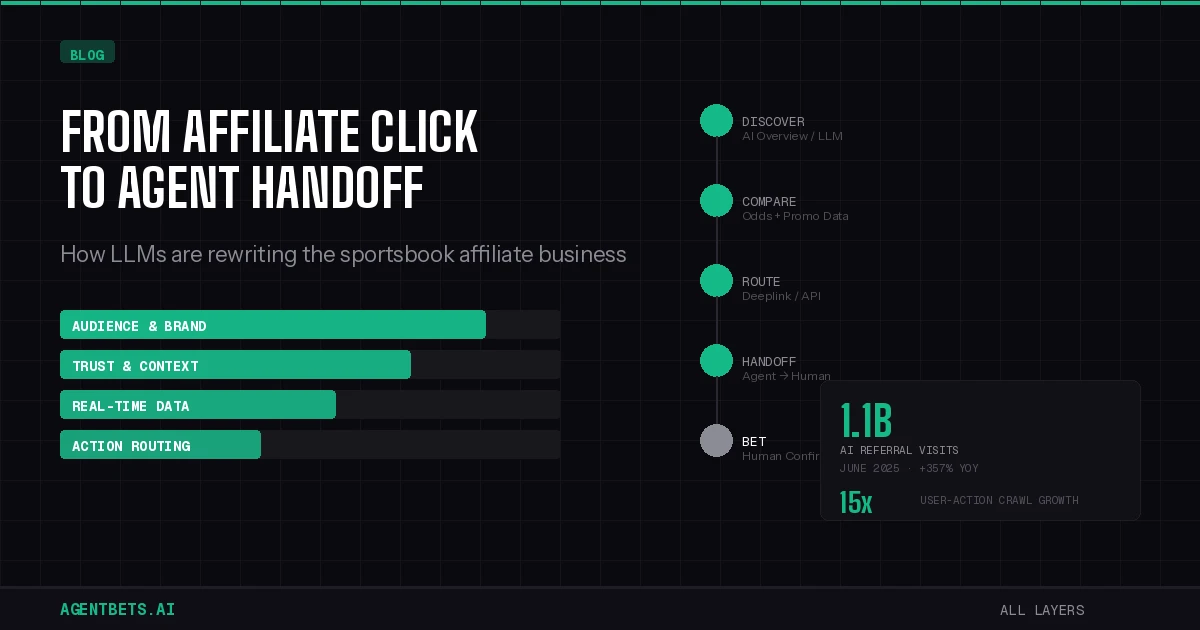
The sportsbook affiliate model was built on a simple loop: rank a bonus page, capture the click, earn a CPA or rev-share payout. That loop is being disaggregated. Discovery is moving from search results to AI-generated answers. Execution is moving from manual comparison to structured data feeds. And the affiliate click is becoming an agent handoff.
The numbers behind the shift
The underlying market is enormous. U.S. commercial sports-betting revenue hit $16.96 billion on $166.94 billion wagered in 2025, per the American Gaming Association. Ontario’s regulated market handled $82.7 billion in wagers and $2.9 billion in gaming revenue in fiscal 2024-25. Traditional affiliates still sit on top of that spend — but the traffic mechanics underneath are changing.
Cloudflare’s 2025 year-in-review data quantifies where AI crawling actually stands. Training accounts for roughly 80% of AI bot activity. Search makes up about 17%. User-triggered actions — the kind where a bot visits a page because a human asked a question in ChatGPT — sit at about 3%. That 3% sounds small until you see the growth rate: user-action crawling volume increased more than 15x from January through early December 2025.
On the referral side, Similarweb reports AI platforms generated over 1.1 billion referral visits in June 2025, up 357% year-over-year. Those referrals to transactional sites are converting at roughly 7% — higher than many traditional search channels. But Google Search still sent 191 billion referrals in the same period. The point isn’t that AI replaces search tomorrow. It’s that a second discovery layer is forming, and affiliates who aren’t visible in it are ceding ground.
Semrush’s 2025 study found AI Overviews appeared for about 16% of queries after peaking near 25% mid-year, and they’re spreading beyond informational searches into commercial and transactional ones. For a sportsbook affiliate whose entire model is “rank for ‘best sportsbook bonus’ and collect the click,” that erosion in organic CTR is structural.
Public affiliates are already rebuilding
The publicly traded affiliate companies aren’t waiting. Their moves tell you what the market thinks is coming.
Better Collective still generates most Publishing traffic from direct or organic search, but its 2024 annual report shows it has been shifting North America from mostly CPA toward recurring revenue share since 2022 — rev-share was 49% of group revenue by 2024. More telling is the product stack. Better Collective’s Playbook uses bet-slip image recognition and smart deeplinks to turn content into one-click bets that open preloaded inside a sportsbook app. That is an agent handoff layer waiting for agent traffic. Its sports-media portfolio — Action Network, VegasInsider, AceOdds, The Nation Network, Yardbarker — reaches over 450 million monthly visits and produces the kind of structured odds and calculator content that AI agents can consume programmatically.
Gambling.com Group acquired OddsJam in 2024, adding a platform that processes over one million odds requests per second across nearly 300 sportsbooks. OddsJam’s tools for arbitrage, positive EV, and promo conversion already route users to the exact wager at the correct sportsbook via API. That’s not an affiliate link — it’s a structured action endpoint. Exactly the surface a betting agent would query.
Catena Media disclosed the pain most directly. Its 2024 annual report said a Google policy update hurt rankings for betting and casino content produced with media partners. The response: diversify beyond SEO into AI, paid media, subaffiliation, and the proprietary MRKTPLAYS platform. Gentoo Media is making a parallel move with 150+ websites and the compliance tool Sitebee. Raketech is leaning into AffiliationCloud and subaffiliation as a platform-first strategy.
The pattern across all of them: move from “pages that rank” to “infrastructure that routes.”
Agents will pick objective functions, not brands
A human bettor picks a sportsbook the way most consumers pick anything: brand familiarity, a headline bonus, maybe a friend’s recommendation. An agentic workflow will optimize differently.
The agent’s selection logic is portfolio-based. For any given bet, it evaluates: Is this book legal in the user’s jurisdiction? What’s the real KYC friction? What’s the actual value of the welcome offer after rollover terms? What price is this specific market at this specific book? Can the bet be placed via structured data or deeplink? What’s the fastest payout path?
That logic already exists in the tools affiliates are building. Oddschecker scans real-time odds. OddsJam routes to exact wagers. Better Collective’s Playbook turns content into preloaded sportsbook actions. The difference is these tools currently serve human users through a GUI. When they serve agent users through an API or structured feed, the economics change — the “click” becomes a programmatic handoff.
The deposit decision also becomes dynamic. Rather than funding one favorite book, an agent keeps several legal accounts available and directs each deposit to whichever operator wins on price, promo conversion, or market availability. This is how the Wallet layer of the agent betting stack connects to the Trading layer — autonomous fund management plus market execution.
Autonomous betting is not imminent
Before anyone extrapolates to fully autonomous betting agents placing wagers at scale: the sportsbooks won’t allow it. DraftKings’ terms explicitly prohibit automated means including bots, scripts, and AI from placing wagers. FanDuel’s terms say the same. Ontario also requires physical location verification and identity consent.
OpenAI’s ChatGPT agent pauses for logins and asks users to take over for sensitive steps. Anthropic’s computer-use tool can control a browser, but it operates with explicit user confirmation for consequential actions.
The realistic near-term agent role in sports betting is: research the market, shortlist legal books, calculate the real promo value after terms, surface the best available line, deeplink the exact market — and then hand login, funding, and bet confirmation to the human. That’s still an enormous amount of value extracted from the traditional affiliate funnel. The comparison page, the bonus calculator, the odds screen — all of that gets collapsed into a single agent query.
Onshore vs offshore in an agent world
Regulated onshore books probably gain relative advantage in an agentic world, at least for mass-market consumer flows. They expose exactly the kind of verifiable, structured signals that consumer agents will prefer: protected deposits, licensed operations, responsible gambling tools, legal entity disclosures, KYC compliance.
The AGA estimates Americans still wager $84 billion annually with illegal bookies and offshore sportsbooks. Offshore operators aren’t uniform — Pinnacle, Bovada, and BetOnline each occupy different niches. But U.S. regulators keep acting: Michigan has moved against Bovada, BetOnline.ag, SportsBetting.ag, and MyBookie.ag, and in 2025 expanded enforcement further.
My expectation: mainstream AI assistants tied to large consumer platforms will default heavily toward regulated books. Offshore discovery stays concentrated in specialist communities, higher-risk workflows, and the kind of sharp betting strategies where reduced juice and higher limits matter more than regulatory comfort.
The disaggregation thesis
The sportsbook affiliate world isn’t heading toward extinction. It’s heading toward disaggregation into distinct layers:
Audience and brand — owned media, newsletters, communities, creators. Action Network, Yardbarker, The Nation Network.
Trust and context — reviews, complaints, regulatory databases, compliance signals. AskGamblers, Casinomeister, Sitebee, LegalSportsReport.
Real-time data — live odds, historical pricing, vig calculations, promo math. OddsJam, AceOdds, Oddschecker, The Odds API.
Action routing — deeplinks, bet-slip generation, preloaded sportsbook actions. Better Collective’s Playbook, sportsbook APIs.
An affiliate that owns only one of these layers is vulnerable. An affiliate that owns the full stack — or at least the data-plus-action layers — is the natural surface for agent traffic.
What this means for builders
If you’re building in the agent betting stack, the affiliate transition is your opportunity:
The Identity layer matters here because agent reputation and verification determine which sportsbooks an agent can interact with on behalf of a user. Portable identity (Moltbook, ENS, EAS attestations) means an agent doesn’t need to re-verify for every book.
The Wallet layer enables the dynamic deposit allocation that makes portfolio-based betting work. Coinbase Agentic Wallets, x402 protocol, and multi-sig smart accounts give agents the ability to manage funds across multiple sportsbooks with guardrails.
The Trading layer is where the handoff happens. Structured odds data, market deeplinks, and execution APIs turn the agent’s research into an actionable surface.
The Intelligence layer — the LLMs, the analysis frameworks, the multi-agent orchestration tools like CrewAI and Polyseer — is what turns raw data into the comparison logic that replaces the traditional affiliate review page.
The affiliate click doesn’t disappear. It becomes an agent handoff. The companies building for that future — machine-readable, trusted, action-ready — are the ones that will own the next generation of sports betting distribution.